Projects, posts and guides about Jev, the System One model from TypeSafe AI. Each entry links to its source and shows the cost and speed its author reported.
After co-inventing ChatGPT, I kept asking myself: why have superhuman chat models not led to AGI?
I’ve spent the last 2 years in stealth building a new way to train models (RLCD), and a new type of frontier AI model that we are releasing today: Jev
• 20-200x faster
• 40-400x cheaper (w/ output tokens free)
• Frontier composable intelligence optimized for decisions
AFAICT the shortest path to AI-based economic revolution
The launch post, 15 Sep 2026
Choroshin Alex
@choroshin
"לקוח יקר, זוהתה פעילות חריגה בחשבון הבנק שלך. החשבון יוקפא תוך 24 שעות. לאימות פרטים לחץ כאן."
רציתי לשחק עם Jev, המודל החדש של TypeSafe, וגם לבנות איתו משהו שיש בו תועלת אמיתית. אז בניתי ב-Skills IL כלי שבודק הודעות כאלה: מדביקים את ההודעה, מ-SMS, מוואטסאפ או ממייל, ומקבלים
And just when I thought I have a crazy idea with JEV that i will open source then this happened.
Please @typesafeai fix it ASAP, the curiosity inside me to build that thing is insanely high
scoreboar v8: 128 MB instead of 597, about 30 ms a post instead of a second. and more accurate.
guessing which of two X posts did better for its account size: 61.4%.
grok 4.7: 55.3%.
jev: 52.5%.
free, in your browser.
github.com/Siim/scoreboar…
Jev Engineers just released Jev, and the architecture is simple: state goes in, auditable decisions come out
I mapped the decision layer into a field blueprint: what Jev reads, what it returns, and how an agent uses those answers in a real loop:
step 1 → give each layer a job. The LLM plans and writes. Jev chooses between bounded options. Code carries out the action.
step 2 → build the state before asking for a decision. Include the goal, evidence, available actions, previous actions, and what the environment looks like now.
step 3 → define the questions in code. Choice selects an option. Score rates it. Noul estimates whether a condition is true. The answers are typed, so the runtime can use them directly.
step 4 → ask independent questions together. One state snapshot can support routing, risk, and relevance decisions in the same pass.
step 5 → use the answers to route work. A lookup, a complex reasoning task, and a tool call don’t need the same model or execution path.
step 6 → add a gate before the tool runs: allow, ask, or deny. A high-confidence answer still has to pass the action policy.
step 7 → execute the selected action and check the outcome. Record what the tool actually did, including failures.
step 8 → update the state with that result. Otherwise, the agent’s next decision is based on a world that no longer exists.
step 9 → apply the pattern where small decisions repeat: model routing, tool guardrails, inbox triage, research classification, browser actions, and context compaction.
step 10 → judge the whole task. Track whether the agent reached its goal alongside cost, latency, approvals, and failed actions.
the result: you can trace an action from the evidence Jev received to the decision it returned and the outcome your tools produced.
Save the Jev Decision Infrastructure blueprint for your next agent build ↓
i created a 404 page that fixes your typos for you, and redirects you to the correct page
built with @typesafeai jev
try it out: kobra.systems/cmr-table
Немного упоролся в Jev, но так у меня всегда бывает, когда на чем-то гиперфиксацию поймаю.
Вот, например, собрал подборщик нейросетей на базе тех, что есть у OpenRouter, под ваши задачи. Просто пишите, что хотите - получаете подборку нейросетей.
Is the Jev hype real,
so I made to test this on my movie recommendation engine, which is getting crazy results on Quen Re ranker , I used an open-source alternative of Jev , Laya.
But unfortunately Quen is way better, dekhlo!
@typesafeai
#jev #Jev
Jev Founder, Diogo Amogo, just released 12-page PDF on building a Jev Harness for coding agents
this is a 10-step blueprint on how to make your coding agents 200× faster and 400× cheaper:
step 1 → meet Jev: the LLM writes, the harness executes, Jev decides what each turn sees, where it routes and whether it runs
step 2 → ask the question that breaks every agent: how would you design one if LLMs had no KV cache?
step 3 → stop routing blind: Opus → Sonnet → Opus costs 6.19 vs 4.15 for pure Opus, because handing back reprocesses the whole context
step 4 → follow the tokens: reading and searching take 56.2% of tool turns and 46.5% of tokens. Writing code is under 10%
step 5 → score every chunk per query: hide, short summary, long summary or full. Compress after the question, not before
step 6 → disclose tools in tiers: one-line snippets for 100s of tools, schema on demand, docs for one-off queries. Batteries stop costing context
step 7 → load instructions by condition: touching *.tsx loads the style guide, billing/ loads its gotchas file, and compaction can't erase either
step 8 → route by trust, not just difficulty: secrets and infra stay on first-party frontier models, public docs go to the cheapest one
step 9 → share one retrieval pass: cross-model review, eval generation, ELI5 explainers and live progress pages all run read-only in the background
step 10 → gate every command: programmable allow / ask / deny policies that read a script before it runs, not just its name
Send this PDF and the article below to your Claude Code or Codex instance and start shipping 200× faster.
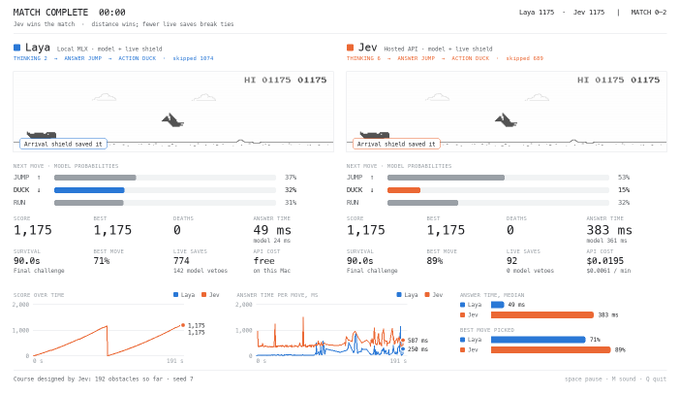
Laya just mogged Jev at Tetris.
The interesting part isn’t just that a local model won.
Laya is an open-weights System One model running locally on a 16GB MacBook Air.
Jev, meanwhile, is cloud-based and built with Grok 4.7.
JEV integration is not another demo.
It feeds live data to one ID with a hard risk cap.
The trace after execution is the moat — not the launch graphic.
Great minds! I've been building a stylized SF with Opus too, just without the pets. My cars follow rules on the real street network, lanes and traffic lights included. Jev driving pedestrians is tempting though. How many agents can it run at once?
you know how x feed is blasting you with promos, politics, rage baits, etc?
so i made a (tamper)monkey script that uses jev to classify and hide types of posts you don't want
I made a tool with Jev that reads my whole codebase to answer one question: what should I be looking at?
Every chunk of code in your project is scored for relevance.
The founder of Jev just dropped a 1-hour masterclass on how Jev actually works
LLMs → Decisions → Verification → Coding Agents
0% → 0:40 - why LLMs alone aren't enough
25% → 20:27 - the 3 primitives behind Jev
50% → 26:15 - turning huge AI tasks into tiny reliable decisions
75% → 45:04 - real systems: data, agents, verification
100% → 56:33 - the future of coding agents, memory and subagents
Most people are still learning prompts.
This explains the layer that decides what the model should do, checks whether it worked, and decides what happens next.
Basically: how you go from “AI chatbot” to software you can actually trust to run itself.
And it's explained by the guy building it.
Bookmark this.
Watch the full hour tonight.
Then read the guide below and steal the architecture for your own agents ↓
Opus 5.5 + Jev = Automatic scoring of 120 competitor ads, shortlisting the 10 worth adapting, and creating versions of each.
Both models came out in the recent days, so I tried them together on a marketing use case, playing to what each one is built for:
→ Claude Opus 5.5 built the pipeline: it found the competitors, ran the http://Pletor.ai workflow "Meta ads spyer", wrote the scoring script and built the interface.
→ Jev made the judgement calls on every ad
The use case: I picked Grüns, the greens gummy brand, as a test case.
I pulled 120 ads from 12 of its competitors on the Meta Ad Library, and had Jev score each one on 7 questions:
hook, clarity, message, concept fit, tone, angle, health claim risk.
Code then combined the scores and picked the 10 worth adapting, and created them, via Pletor MCP.
tool which made me over $2,000 is open now
my Jev + Grok Bot copytrading bot finally has a front door
50k+ lines written. 270+ contributions. four weeks of it.
every buy walks the same floor before it can become yours:
> watch only the wallets you picked
> match the move against the rule you wrote
> check it on two providers first
> hold it to your caps, allowlist, slippage and expiry
the full build is in the article below.
Working on a simple tool that uses JEV to help organise my bookmarks. The UI is awful and it’s nothing crazy, but it’s been nice to learn about JEV and how it works.
Jev but for images? I built a local model to try it out! 63ms for a 512x384 image and fast enough for 15fps video.
Birthday 94%. Golden retriever 78%. Sprinkles 93%. Candles lit 67%. Dog about to eat the cake? 52%.
What stands out to me in the Jev + Grok Bot setup is the division of work:
Jev decides. Grok Bot acts. Human stays in control for anything irreversible.
That’s a much cleaner agent architecture than asking one model to do everything.
Cheaper, faster, and easier to reason about.
@typesafeai @grok
Jev has been blowing up lately.
If you already have API access but don't know where to start, just copy this checklist:
1. jev-browser
Drives a real headless browser through MCP, CLI or a library. Jev picks one action per step from the page's clickable and typeable elements, and scores whether the goal is met or the run is stuck. https://github.com/jkudish/jev-browser
2. jev-browser-agent
Per-step browser decisions at about a second. One request asks "which operation" and "which target" together, and confidence under 0.6 escalates to a bigger model or to you. https://github.com/smartdio/jev-browser-agent
3. typesafe-jev-bridge
Zero-dependency OpenAI-compatible bridge. Use typed yes/no, choice and score judgments from Claude Code, Cursor, Cline or any OpenAI SDK, over CLI or HTTP. https://github.com/RevocGG/typesafe-jev-bridge
4. pilot-typesafeai-jev
Jev inside LangGraph and Deep Agents. One request asks three questions, plain code picks the route, and only the winning route spends chat model tokens. https://github.com/jyje/pilot-typesafeai-jev
5. building-with-jev-skill
An agent skill for writing programs that call Jev: question design, state structure, thresholds, and how to diagnose a question that answers wrong. https://github.com/dbreunig/building-with-jev-skill
6. jev-skill
Guided setup plus evaluation workflows, with a read-only presence check and no silent provider switches or fabricated probabilities. https://github.com/wuyoscar/jev-skill
7. awesome-jev
Source-backed catalogue of what people actually shipped, sorted by category, with limitations noted per entry. https://github.com/yibie/awesome-jev
8. awesome-typesafe-jev
Field guide with SDKs, live demos, agent tools and independent evaluations, including where the vendor numbers came from. https://github.com/AbdelStark/awesome-typesafe-jev
9. awesome-jev-by-typesafe
Evidence-backed use cases, patterns and starter code, with the 70 to 500 ms latency claim marked as vendor-reported. https://github.com/Anil-matcha/awesome-jev-by-typesafe
10. awesome-jev (cobanov)
The widest catalogue right now: SDKs in Go, Java and JS, MCP connectors, guardrail experiments and studies. https://github.com/cobanov/awesome-jev
Copy these complete Jev blueprints - then read the full Jev setup below ↓
Grok Bot does the job, Jev decides where the job goes next
That's the ai company split: a work model and a decision model
In this free 22-min tutorial they walk through jev, typesafe's "system one" model that makes decisions instead of chatting
You ask one question, Jev answers from a fixed menu: noul, choice, score
The demo: customer messages in, frustration score out. usable right in code
Not another chat model, it's the fork in the pipeline
Grok Bot keeps generating
Jev keeps deciding
Humans keep the approvals
The teams wiring in that third layer are quietly becoming one-person companies
Save this before your competitors put a decision layer between their bots
I launched a chatbot yesterday and used JEV as a 17-in-1 router, filter, classifier, intent judge for efficient tool calling.
Then further downstream is a relevance/context loop system.
Worked really well. No more unwanted spams and prompt injections.
اولین تجربهی خودم با JEV 👀
این تجربه برای ۳ روز پیشه؛ وقتی JEV هنوز توی حالت Waiting List بود.
من کلاً هر ابزاری که سختافزارم بتونه بکشه رو تست میکنم 😄
برای همین توکن JEV رو از OpenRouter گرفتم و به Grok Bot دادم.
ماجرا چی بود؟
از GITEX کلی ویدیو گرفته بودم و نمیدونستم کدومها رو اول منتشر کنم. از اون طرف هم برای هرکدوم کلی کاور طراحی کرده بودم و واقعاً حوصله انتخاب و مرتبکردنشون رو نداشتم 😂
به JEV گفتم:
«خودت انتخاب کن، دستهبندی کن و فولدربندیشون کن.»
در کمتر از چند دقیقه همهچیز رو مرتب کرد و حتی پیشنهاد داد کدوم ویدیوها رو اول منتشر کنم.
Grok Bot هم بقیهی توضیحات و تحلیلها رو انجام داد.
برای اولین تجربه، واقعاً از JEV راضی بودم 🔥
هنوز Laya-Max چینی رو هم تست نکردم؛ نصبش هنوز تموم نشده.
اونم که آماده شد، تجربهام رو میگم 👀
was trying to figure out how to make these 2 models fight each other, so I put jev vs laya in chess lol
script picks the 10 best moves, captures, and moves that put pieces under attack. still wip but jev feels way smarter
It has been a really interesting experience to build an eval suite for System One Models like Jev.
My first two attempts didn't work out. But I learned a lot in the process, and since Jev is so fast, and cheap, it's a lot easier to run quick tests than with an LLM.
I'm on attempt number three with this eval suite, and thought I'd share more about it.
The eval suite is called @VulcanBench Verdict, and here's the high-level on how it works:
I vibe coded more fun apps using @typesafeai AI jev on the backend. My fav one is probably JevedIn, which is an extension for linkedin that automatically detects and blocks AI slop (thank me later). But I am lowk afraid of my linkedin feed being empty at this rate lol.
Source code:
JevedIn: https://github.com/akshatnerella/jevedin
JevTube: https://github.com/akshatnerella/jevtube
(currently building jevvit for reddit lol)
comment what you want me to build next!
#TypesafeAI #jev #classificationmodel #extensions #aislop
Enough is enough! Is it that LinkedIn sucks or what?
Let's settle this.
I go viral on LinkedIn for slop (attached)
Then I spend 2 days to build a JEV product to scan Reddit for leads.
And get tumbleweed!?! How??
98% of my feed is junk. Now I don’t even see it
I built a filter that reads my feed for me. It runs on Jev - a model that doesn’t generate text; it just makes binary decisions, in milliseconds and for pennies.
For every post, it evaluates four questions: Is it relevant to my niche? Does it provide real value? What format is it (breakdown, news, ad, meme)? And does it make loud claims with zero proof?
Out of 1,000 posts, only 20 remained.
97 milliseconds per post.
1.2 cents for the entire morning.
The most frustrating takeaway, nearly half of my feed was ads and memes, not the creators I originally followed for substance.
An hour of mindless scrolling turned into five lines over breakfast.
JEV + OPUS 5.5 IS INSANE.
I built an AI system that analyzes an X post before you publish it.
Paste any X link.
Press Start.
Get a virality score in minutes.
The entire production version was built in 9 minutes.
Here’s what happens:
Jev analyzes 800 viral posts as a live baseline
Groups them by hook type: demo, launch, proof, contrarian take
Runs 12 structured checks: hook, numbers, media, CTA and more
Finds the 5 most similar viral posts
Opus 5.5 explains why those posts spread
Then your post receives:
Virality score out of 100
Estimated likes and views
Percentage of the viral baseline it beats
Direct comparison with similar winners
It works on drafts too.
So instead of posting and hoping, you can identify weak hooks, missing proof and unclear CTAs before anyone sees them.
Hover over any result to inspect the original post, its media, every check and the final score.
JEV DECIDES FAST.
OPUS EXPLAINS WHY.
#JEV
Jev + GPT-6 Astra just built the most TERRIFYING AI trading setup on the internet...
[this article covers 90% of what is required to build quant-level systems]
/1 GPT-6 Astra reads the order book, the tape and 3 correlated futures
/2 Jev turns the signal into a trade and checks the risk limit
/3 computer use clicks the order screen, no broker API needed
/4 the full loop runs in 6 ms, signal to fill
steal this setup in the article below👇
Did you know that we have @typesafeai Jev AI giving you the sentiment on the news?
Don't miss the next ethereum:0xfaba6f8e4a5e8ab82f62fe7c39859fa577269be3 like move.
One click long on bullish news only on app.proliquid.xyz/terminal 🦈
First thing I built on Jev: a memory gate for Claude Code.
Every message gets one question: is this worth remembering? 0.3s later it's either skipped or saved as one line in JEVMEM.md in the repo.
Open source, link in my pinned post.
AGREED. team built an internal tool using Jev to qualify candidates, and Jev itself is genuinely impressive at what it’s designed todo. but recruiting is hard. there are too many variables that don’t fit neatly into a rubric: context, trajectory, ownership, quality of work, potential, and the signals you only catch by actually digging into someone’s work tbh
https://x.com/idleshubh/status/2102429846660079971?s=20
TypeSafe founder Diogo Almeida introduced Jev, and the field I would inspect first in any agent built around it is not model. It is state
An agent can have room for a long conversation and still miss the one line that matters.
A refund request needs the current order, the charge record and the policy that applies today. It does not need twelve earlier attempts to sound helpful
Here is the state packet I would put in front of Jev:
step 1 → name the decision the code needs to make now, not the entire job the agent was given
step 2 → pull facts from the system of record: order status, amounts, timestamps and permissions
step 3 → include the customer's actual words as evidence, without asking Jev to reconstruct the whole conversation
step 4 → state the constraints that can change the route, such as a refund window or an account hold
step 5 → build the available actions from live code, so a closed account never appears as a valid destination
step 6 → put the question in the question field. State is evidence, not a second prompt hiding instructions
step 7 → leave the sums and date arithmetic to code, then send Jev the result it needs to judge
step 8 → keep the exact packet with the answer, because you cannot debug a decision from its label alone
The point is not to compress everything until it looks clever. The point is to make it obvious which piece of evidence could change the answer
The document below shows that packet on one page. The article goes further into shaping state without turning it back into a transcript
TanStack AI just shipped subagents.
Jev picks which models / agents should run for the task, in parallel, in sequence, or mixed.
Best Jev use case I've seen so far.
TanStack team cooked. 🔥
built a full production app with opus 5.5 and jev...
fed it a url, it screenshots the site, scores it against a list of known patterns, and ships a shareable report
here's the actual pipeline:
- gemini flash takes the screenshot, that's the only vision step needed
- jev scores it against a fixed list of criteria in a fraction of a second, no text generation, just structured ratings
- opus 5.5 writes the entire app, front to back, off a single planning prompt
- product os turns the plan into a spec, then a roadmap, then working code, task by task
- code review, security audits, and testing happen automatically as it builds, not after
- a deploy checklist gets generated too, walks you through auth setup, hosting, env variables, step by step
- cost to run per scan lands in fractions of a cent, both models chosen specifically because they're cheap at their job
what actually makes this work: opus 5.5 handles everything generative, jev handles every decision that doesn't need generation, and neither model gets used for a job it's not built for
that split is why the whole thing runs on pennies instead of frontier-model pricing
pair that with a structured build system instead of one long freeform prompt, and a non-coder ships a live, secured, production app in an afternoon, not a sprint
التجربة الثانية مع JEV 👇
سويت له Vibe Coder Launch Inspector
تحط رابط مشروعك
يفحصه ويطلع لك هل جاهز للإطلاق ولا يحتاج شغل
يعطيك Score + المشاكل + الأدلة + وش اللي يحتاج تعديل
والأحلى كل مشكلة معها Fix with Codex
يطلع لك برومبت جاهز ترسله لكودكس
#AI #JEV #Codex #VibeCoding
congrats on the release! i've included xor on the Decision Index 0.2 benchmark of jev-like models
we don't have a vision benchmark yet, but the text-only version got 8th place, strong in arts & human taste
x.com/multimodalart/…
congrats on the release, i've added it to the jev decision index 0.2, it's the #2 open weight jev-like model 🥳
and the strongest in chess and for its size
x.com/multimodalart/…
Been building an agent-agnostic permission gate: Jev (TypeSafe) + hooks.
Many harnesses copy Claude Code's hook format. Some barely have hooks at all.
This makes me happy: agy in YOLO mode. chmod -R gets blocked, the agent asks me, I say yes, it runs once. Again? Blocked again.
Built Cortex, a local MCP server: Claude plans, a fast layer does the clicking.
Same Mac-app task: computer use 23 s → Cortex 0.8 s
One action: ~5 s Claude round → 0.25 s, no model
24 tools: browser, Mac apps, GitHub search, safety gate
Measured on my Mac. @typesafeai #JEV
The Jev-powered AutoScalper passed all Tests during the Testnet Live Test with an average win rate of 82% trading on the 1m chart, using a 120 candle lookback window.
So 2h structures get scalped top-to-bottom and bottom-to-top
Now its time to aim for mainnet deployment!
Now that I've collected so much data on System One models on my DGX Spark. Lets see if I can beat Jev on size, speed, and accuracy.
It will be MIT for anybody to build on. Everything I do on here is open source.
another @treg_ai /Jev demo to analyze data SUPER fast
used treg to pull meta ads and then Jev to teardown the landing pages so you can understand where brands are sending traffic to
categorizes the type of page, offers they're using and language used to sell
also shows ad creative launch velocity, creative mix
takes a few seconds to do it all end to end.
Four typed questions across four authored fictional notes, labels written before the calls. Jev 16/16, Laya 13/16. On the medication-conflict question alone: 4/4 vs 2/4. A useful diagnostic, not a clinical accuracy estimate.
Jev Engineering turns a static agent workflow into a graph that can rewrite itself while running.
the video is basically the problem at scale:
hundreds of routes
→ thousands of crossings
→ different agents
→ different tools
→ different confidence levels
Jev Engineering doesn’t control every step.
it controls the crossings.
when two paths compete:
→ score both
→ kill the weak route
→ reroute the task
so instead of one fixed chain, you get a live braid:
state
→ decision → parallel paths → crossings → Jev → next state
that’s the point of Jev Engineering:
more parallel execution without letting the system lose the objective.
the agents create the paths.
Jev decides which paths survive.
full breakdown below ↓
A beautiful pattern can still be noise.
Here’s a JEV × Opus 5.5 workflow I’d test:
→ A data pipeline identifies candidate signals.
→ JEV selects which candidates to investigate using defined criteria.
→ Opus helps explore those candidates and propose explanations.
→ Statistical checks and human review test whether those explanations hold up.
The critical question: what evidence would change our mind?
That question belongs inside the workflow, before a promising pattern becomes a confident conclusion.
This animation illustrates the concept. The particles and activity are simulated.
Jev made competitor ad research 30x faster and ~90% cheaper.
Typed “game” as the category.
20 seconds later: 294 top TikTok ads across 68 brands analyzed.
Jev:
1/ pulled the top ads from the past 180 days
2/ scored every ad on stop-scroll, hook, format + trust
3/ clustered them into creative patterns
4/ classified winners, watches + dogs
5/ built a leaderboard of what’s winning
6/ recommended what to make next
20 sec · ~$0.02
For gaming:
Winning hooks: offer/promo, challenge accepted
Winning format: gameplay + UGC
This is what we’re building at @frevana_ai with Jev:
decode your category’s ads → know what to make next, in seconds.
Try it free. Link in the first comment 👇
Jev is the semantic if in your agent loop.
LLM writes. Jev (TypeSafe System One) answers typed questions on the same state (Noul, Choice, Score) with calibrated probs. Your code branches.
Pull the cheap decisions out of the LLM. Early access: console.typesafe.ai
the lead engineer at a research company used Jev + GPT-6 Astra to build a system that analyzes 12,000,000 source updates every 6 hours
the system processes massive streams of information, a process like this used to cost $1,000,000+, now Jev engineering does it for $200
the first version relied on GPT-6 Astra to interpret every result
it worked, but processing millions of routine decisions through a large model created unnecessary latency and huge inference costs
then the engineer rebuilt the decision layer around Jev
instead of explaining every source, Jev reads the saved task state and decides what should happen next: Research, Write or Review
Astra handles the open-ended work: comparing evidence, resolving contradictions and preparing the client brief
code controls the queue, permissions, budget, retries and files
at the core of this system is the same architecture I break down in the article: Jev routes the work, GPT-6 Astra handles the open-ended tasks, and code keeps the process running continuously
the full step-by-step build of a client research process that runs 24/7 is below ↓
would you let AI decide which findings deserve further research?
Here is another use case for Jev in DeFi.
Vault risk classification.
I pulled the signals that matter for Morpho vault risk (allocations, LLTV, utilization, idle, oracle, curator, APY sanity, liquidity and more) across 50 @Morpho vaults on Base, then asked Jev to score each one LOW / MEDIUM / HIGH / EXTREME.
50 judgments in 22.6s, ~452ms avg, ~60% median confidence, around $0.006 in costs
Result mix: 30 MEDIUM - 12 HIGH - 8 EXTREME - 0 LOW.
Jev also ranked curators and vaults by trust, who looks safest, who looks riskiest.
Claude, Codex and other models can do this as well but it takes much more time and money.
JEV can’t see images. So how do you give it eyes?
What’s possible? What can run locally? How far can you get for free?
The answers (and the catches) are in the full breakdown below:
Just trained Tev1 0.8B, a tiny Jev-like classifier.
Here it is running completely locally on my mac with @ollama & classifying some tasks.
It's extremely fast: only ~50ms E2E latency. Video is not sped up!
Releasing weights & benchmarks very soon so you can try it yourself :)
Jev for RAG
in almost all cases you trust the semantic matching capability of Jev more than dot product similarity
very useful as the direct similarity metric in small data cases
and a great reranker with big data
I rebuilt CAPTCHA with Jev
The browser measures how you fill in the form. Server turns that into a few plain sentences, and Jev decides: person or bot.
Blog post with source code in the comments:
What people posted on X while they built with Jev. Every card plays the original video or shows its images here, so you see the demo before you open the thread.