Jev + on-device models = results in seconds with no LLM in the loop.
Quick demo app to show the possibilities. Drop in an audio file: Ear detects the language, Voz transcribes it and Redact removes PII.
Then @typesafeai's Jev makes about 20 decisions in one call in milliseconds, and picks which of our on-device models to run. Voice memo to to-do list. Meeting to redacted transcript. Podcast to clips.
1/ Introducing CUA-S1: a family of System One Models, small, specialized, and built for computer use.
Today we're open-sourcing CUA-S1-FORMS, the first in the family: github.com/trycua/cua
Inspired by @typesafeai , here is a Jev-compatible public API to play with
It runs a comparable open model (Qwen3.6-35B-A3B), and just uses SGLang radix cache to preserve the prefill reuse / really fast parallel systemone generation - 64 tasks in <1s.
github.com/ekzhang/openje…
A self-hosted skills library, with optional Jev recommendations.
KKitze
226
Eugene Cheah - AI builder @ 🇸🇬|🇺🇸
@picocreator
love jev, but upset it
- isn't open source?
- it lack vision capability?
We fixed all of that, introducing SimpleJev.ai
A fully open source library which takes any HF model and Jev-ify it, with an API endpoint
Now on github, and live in production at @FeatherlessAI
An open 151M decision model on ModernBERT, with a WebGPU playground.
HKHemant Kumar
68
Nick Khami
@skeptrune
you can make any open source model behave like jev with just a bit of inference engineering.
it's shockingly easy. to prove it, we built a new endpoint we're calling deepseek-v4.1-flash-jev. see the demo below. here's how it's done:
sglang (an inference engine) offers a scoring endpoint in addition to the normal generation one. in scoring mode, given an input & set of possible answers, it forces the model to produce probabilities for each one. example:
> input: what is most common letter in abcccde?
> possible answers: a, b, c
> output: (c, 0.9), (b, 0.0.5), (a, 0.05)
getting the above behavior instead of streamed output is as simple as using sglang's /v1/score endpoint instead of /generate. there's just one other trick required.
for deepseek, you have to add a closing think tag before the response. this forces a direct answer instead of a reasoning trace. if you want reasoning, you can do that too, but imo that makes things too slow to be worth it.
dsv4.1 flash is not as good as jev, but if we had enough spare compute to experiment with this same approach for a larger model then i think the decision quality would be at least as good, if not better.
also, somewhat unrelated, i think decision-making models kill all prospecting & sourcing work. i would have absolutely killed to have jev or similar when i was recruiting @mintlify. absolutely incredible.
Local System One models on Qwen3, for an NVIDIA DGX Spark.
ARAbhishek Rai
Anand Prasad
@theanandprasad
you can turn any low-cost open-source LLM into a Jev like fast decision model without training it. Here's how to do it:
An LLM doesn't write text directly. At every step it scores every word in its vocabulary for how likely that word is to come next, and then it picks one. Those scores are called logits.
Suppose you want to know whether a customer email is angry.
The usual way is to ask the model, wait while it writes a paragraph, and then try to pull a yes or no out of the response.
The trick is to never let it write anything. Give it the email content and the question, and end your prompt with "Answer:". Your full prompt will look something like this:
[
Message: "Third time I've contacted you. Still broken."
Is this customer angry? Answer yes or no only.
Answer:
]
The model reads the prompt once and scores every possible next word. You look at two of those scores.
"yes" scores 8.1
"no" scores 5.9
Convert those two scores into probabilities and you get 90% yes and 10% no. (Use softmax function -- google it)
Your code then uses that number directly. If it's above 0.8, escalate the ticket.
Congrats, you have created your own Jev!
Here’s why it works:
1. It's fast. Reading a prompt happens in one parallel pass. Writing is the slow part because the model writes one word at a time. Here the model never writes.
2. It's cheap. Output tokens are the expensive ones, and this produces none.
3. There's nothing to parse. You always get a fixed output, and never a paragraph.
4. You get a confidence level along with the answer. A 0.55 means the case should go to a human or a bigger model. A 0.98 means you can act on it.
I tried running the code on llama 3.3 70b (via openrouter) and the accuracy was 21/22 (95%).
Cost per query: $0.000013, latency: ~500ms
I wanted Jev-style decisions with my own models, so I built LogJev.
Text, images or audio in; choices/scores from logprobs. Node + Python, agent skills, cloud or local (requires modality + logprobs support).
2048 demo: github.com/DumoeDss/logjev
I think Jev and Laya were the missing pieces to algorithmic trading. Sure you can hardcode gates and adjust variables, but being able to add a real time decision maker within your algorith is a game changer. I can smell and taste an early retirement.
Open weights that answer typed questions in one forward pass, 33 ms on a T4.
NMNandakishor M
13.7k
MD Fazal Mustafa
@the_mdfazal
🚨 A LOCAL 421M MODEL JUST ATE CLOUD JEV ON SPEED
Laya is an open-source System 1 decision model that runs on your machine.
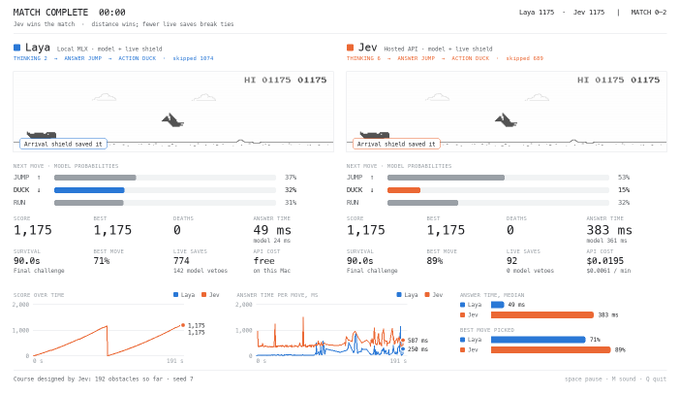
Laya: 86.5 decisions/sec, P50 ~9ms, score 46
Jev: 3.2 decisions/sec, 317ms API round-trip, score 1
Ships with:
— 421M params
— ~1GB inference memory
— Millisecond local calls, no network
— Typed decisions in one forward pass
— Apache-2.0 and self-hosted
While the cloud waits, local decides.
Yes but not with Jev. I used another classifier, locally, just as fast, just as good.
Example: setup a "server" in python that loads the classifier model. Add a hook in Claude that fires on "pre-tool-use" and next time you ask Claude a random question like "how do I lint check a project?" and it tries to freelance and read your entire repo only to intoxicate itself and pollute its context, the classifier will slap its hand, say "no sir, you answer from knowledge" and deny the tool call.
I tested this yesterday with success, but need to refine it as it misfires.
Basically I was able to identify general queries, instances where I would ask something and Claude would rush ahead and run pip install without me asking or just write code instead of answering.
A classifier is hypercheap compared to a regular LLM and would catch all of these.
The model I used was DeBERT large. It's still stupid fast, I tested it on an Apple with M1 (regular) and you don't feel it running.
🔥 looks like Jev just got an open-source alternative.
Laya is a 421M parameter model built for making decisions instead of generating text.
the interesting part:
- runs locally on your laptop or phone
- uses less than 1GB of memory
- supports structured decisions (yes/no, scoring, multiple choice)
- free + open source
in a 30-second Snake benchmark against cloud-based Jev:
Laya: 86.5 decisions/sec, score 46
Jev: 3.2 decisions/sec, score 1
the catch? Laya has a 512–1024 token context window and doesn't generalize as well as Jev without additional tuning.
so we already have an open source alternative to jev... and it's 6-7x faster?!
it's a typed-decision classification system: no chat, no generated text, just fast yes/no, scoring, or choice answers.
> runs in under 1gb of memory
> free on hugging face
> runs on a laptop, or even a phone
there's a real demo where it plays snake live, making a fresh decision every single move.
two honest limits, straight from the project itself:
> only 512-1,024 token context, some cases won't fit
> weaker generalization than jev out of the box
all things Jev in one place
a GitHub collection just dropped packed with hundreds of tools, libraries, and projects built on top of Jev, from teams treating decision-making as its own primitive, separate from language generation entirely.
github.com/AnotiaWang/awe…
An open-source Jev-like model is playing Flappy Bird in real time on a standard CPU.
Laya is a 421M-parameter System-1 decision model running on a 12th-gen Intel i7 with OpenVINO INT8.
No GPU. No token-by-token generation.
It receives the game state and chooses an action in a single forward pass.
LLMs can handle planning and reasoning. Small decision models can provide the fast reflexes.
The best agent stack may not be one giant model.
It may be a slow brain paired with fast reflexes.
Laya is making a pretty strong case for local AI agents.
On a 16GB MacBook Air, local Laya is reportedly making decisions in around 45ms.
Cloud-based Jev is closer to 300ms per decision.
That puts Laya roughly 7 to 11x faster in this Tetris setup.
And the hardware is just a MacBook Air.
No dedicated GPU server.
No API round trips.
No per-token bill.
Laya runs locally, so once the model is on the machine, the inference cost is effectively $0 per decision.
Jev has the opposite tradeoff. You get a cloud model, but every decision depends on the network and the API response coming back.
Tetris makes this painfully obvious.
The agent has to constantly:
see the board → decide → act → see the new state → decide again.
When every move takes hundreds of milliseconds, the delay compounds.
At 45ms, Laya can keep that loop moving much faster.
And there’s another piece I find important:
Laya’s weights are open-source.
That means you’re not just renting access to an AI agent through an API. You can actually run the model yourself, inspect the setup, and build around it locally.
For benchmarks, you can argue about accuracy and scores all day.
But put two agents inside a real-time environment and latency becomes impossible to ignore.
Same Tetris board.
One model waits on the cloud.
The other is sitting on your laptop making decisions almost immediately.
In this particular test, the difference is pretty brutal.
Local inference isn’t just about saving API costs.
Sometimes the biggest advantage is simply that the model is already there when you need it.
Laya just mogged Jev at Tetris.
The interesting part isn’t just that a local model won.
Laya is an open-weights System One model running locally on a 16GB MacBook Air.
Jev, meanwhile, is cloud-based and built with Grok 4.7.
Same game. Same objective. Completely different setup.
And Laya was making decisions about 11x faster.
That matters a lot in games like Tetris.
The model has to constantly look at the board, decide where the next piece should go, and act before the situation changes.
Every bit of latency gets exposed.
With Jev running through the cloud, each decision has network and API overhead.
Laya keeps the entire loop on the machine.
No round trip to a server.
No waiting for another request to come back.
The model sees the board, reasons about the move, and acts locally.
And this is happening on a 16GB MacBook Air.
That’s the part I find more interesting than the Tetris score itself.
We’re getting closer to a world where you don’t necessarily need a massive GPU server sitting somewhere in a data center to run useful AI agents.
A laptop can run an open model locally, interact with an environment, and make decisions fast enough for real-time tasks.
Tetris is obviously a toy environment.
But the underlying test is much more interesting:
How much can local inference accomplish when latency becomes almost irrelevant?
Laya vs Jev is a pretty fun way to show the difference. https://x.com/atomic_chat_hq/status/2102160983409955244/video/1
Benchmarked Laya locally on an ancient laptop:
💻 i5-5200U (2 cores) | 12GB RAM | 5400 RPM HDD
Kept it resident in RAM and got sub-second (~630ms) typed decisions on pure CPU! 🔥
Great open-weight release by @Nandakishorm1. No GPU or cloud LLM needed for fast routing.
#laya #jev
Meet Open JEV DeBERTa V3 Large: a text classification model that doesn't just label, it makes typed decisions. Calibrated, open, and built for real-world trust. Here's why this model is turning heads.
Jev @typesafeai, but with thinking?
TypeLLM can think before producing a type-safe output. It dramatically boosts accuracy without any fine-tuning—surpassing Jev and GPT-5.6 Luna, and coming close to GPT-6 Astra!
Open-source: github.com/TypeLLM/TypeLLM
Do check out this public repo (github.com/M37Labs/laya-m…) by @m37labs for those interested in understanding Laya-MLX, a new kind of encoder-only architecture and its application. Emerging systems like Jev, Laya can serve as a `System 1` brain in different implementations.
After seeing so much Hype around Jev, I started using it inside my Hermes as a decision and routing mechanism for a AI video pipeline I was working on
But now, I am Changing that thought.
Laya is a 421M local decision model by @Nandakishorm1 .
Same job as Jev -> choice, score, yes/no with a probability,
But it runs on my machine. No API hop. No per-token meter. ~33ms. Weights stay here.
For an AI film pipeline, that is the actual bottleneck.
>Not “write a better prompt.”
>The expensive part is sending the wrong shot to the wrong generator.
Before Seedance / Kling / Minimax / Veo / Flux / GPT Image burns a credit, Laya now answers four things in one pass:
→ which model gets this shot
→ text-only, character-ref, or first-frame
→ is the brief ready, or does the enhancer skill run first
→ how hard is identity lock
Sol still writes. Kimi still helps. Video models still generate. Laya only decides.
Jev was a good hosted nervous system. For shot routing I don’t need a hosted brain.
I need a local one that sits in front of the generate button and says go / wait / switch model.
421M. Local first. That is the router now.
🥊Laya vs Jev
He diseñado un experimento para probar que modelo es mejor, si Jev o Laya, y lo hice poniendolos a jugar ajedrez.
La verdad es que ambos son bastante tontos para esto, y no va de mejorar prompts, aunque seguiré probando algunas formas de mejorar las partidas.
Metí a Jev en un chat. 🤖
Para que no tengas que volverte loco/a adivinando cómo probarlo.
probalo sin instalar nada y sin registrarte.
👉 Probalo acá:
lnkd.in/dhFX5XYY
Y si querés armar tu propia versión, el código está abierto:
lnkd.in/dXSu6ki3
😉
Another Jev competitor just dropped: CLM-8B from @jackyk02 and the Stanford/NVIDIA team, with open weights under Apache 2.0.
They claim it's comparable to Jev with up to 9x faster inference
We went from zero options to a new one almost every day!
Seguí con dos consultas: un código de verificación que no llega y cómo navegar con el teclado. Jev eligió seguridad y manual de usuario; Laya, privacidad y términos. En ambos casos me convencen más las elecciones de Jev, aunque Laya volvió a responder más rápido con mi setup.
Empecé a escribir: "¿Qué precio tiene la suscripción anual?". Antes de pulsar Enviar Jev y Laya ya sugerían planes_y_precios.md. Eso es lo que quería probar: si el agente puede tener una pista de qué consultar antes de que le llegue la pregunta, con mi setup Laya fue más velóz
Explorando qué se puede hacer con Jev y Laya, que (los de moda), me pregunté si podrían ayudar a un agente de soporte a preparar el contexto mientras el usuario escribe su mensaje. El contexto es clave para un LLM, así que armé una startup ficticia con 7 documentos. 🧵
I RAN A DECISION MODEL ON MY LAPTOP TODAY
1. Kev: tiny Jev-style models built on Qwen3.5, 0.8B up to 9B
2. 4B/9B fit a 32GB Mac, also CUDA and ROCm
3. Answered a support ticket in 495ms with probabilities
#OpenSource #LocalAI #ML
Jev vs Laya-MLX isn't really a rivalry.
Jev is the original, commercial model.
Laya-MLX is a local, open-source take on the same idea, running natively on your Mac.
Same core concept: "System One" models. No chatting, no text generation. Just fast, typed decisions.
#Jev #Laya
Jev is all over my timeline rn 👀
Went looking into it and stumbled across Laya.
Open-source System 1 decision model.
They even have a Jev comparison 👀
7.8× faster.
3× better calibrated.
45/51 languages.
Self-hosted.
And the weights are right there. 😂
Yeah… I am watching this space.
https://huggingface.co/convaiinnovations/laya
After seeing Jev everywhere on the feed lately, we had to try this direction ourselves.
We’re bringing Laya to Insight O Mate.
A fast, open-source, local decision model that fits perfectly with our privacy-first approach to querying NoSQL databases.
Your data stays local.
Your decisions stay local.
Insight O Mate + Laya is coming.
Try Insight O Mate at https://insightomate.lunamic.co
Laya just mogged Jev at Tetris.
The interesting part isn’t just that a local model won.
Laya is an open-weights System One model running locally on a 16GB MacBook Air.
Jev, meanwhile, is cloud-based and built with Grok 4.7.
Jev but for images? I built a local model to try it out! 63ms for a 512x384 image and fast enough for 15fps video.
Birthday 94%. Golden retriever 78%. Sprinkles 93%. Candles lit 67%. Dog about to eat the cake? 52%.
was trying to figure out how to make these 2 models fight each other, so I put jev vs laya in chess lol
script picks the 10 best moves, captures, and moves that put pieces under attack. still wip but jev feels way smarter