What is Jev?
Jev is the first System One model from TypeSafe AI, released on 15 September 2026. You send it some text and typed questions about that text. It returns typed answers, a probability for each option, and a confidence score.
Updated · by Jon Kraayenbrink
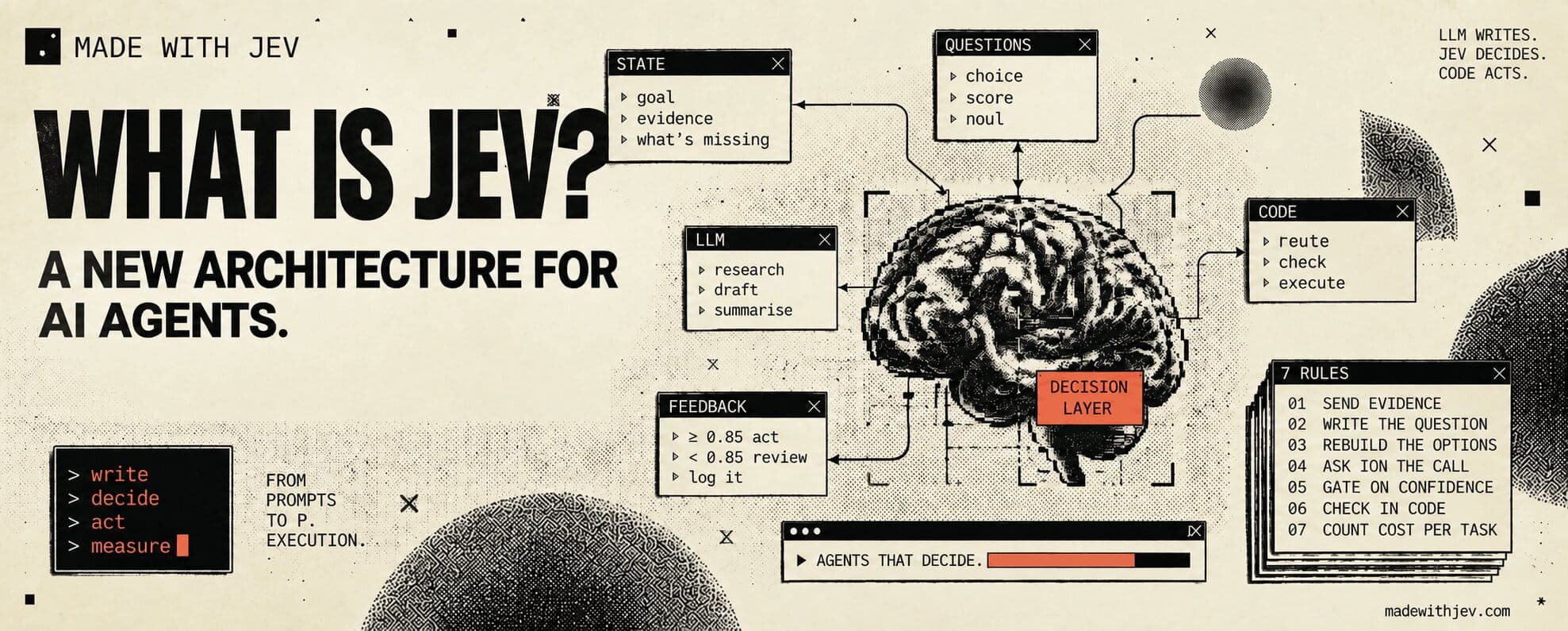
In short
- Jev makes decisions. It does not write text, code or explanations.
- You ask Choice, Score and Noul questions. Jev answers them all in parallel, in 70 to 500 ms.
- Input costs $0.042 per million tokens. Output is free.
- Choice and Score answers come with a confidence; a Noul's probability is its own measure. Your code decides what to do with the unsure ones.

Diogo Almeida
@CompleteSkeptic
After co-inventing ChatGPT, I kept asking myself: why have superhuman chat models not led to AGI? I’ve spent the last 2 years in stealth building a new way to train models (RLCD), and a new type of frontier AI model that we are releasing today: Jev • 20-200x faster • 40-400x cheaper (w/ output tokens free) • Frontier composable intelligence optimized for decisions AFAICT the shortest path to AI-based economic revolution

Sep 15, 2026 · 76.6K likesOpen on X
How a call works
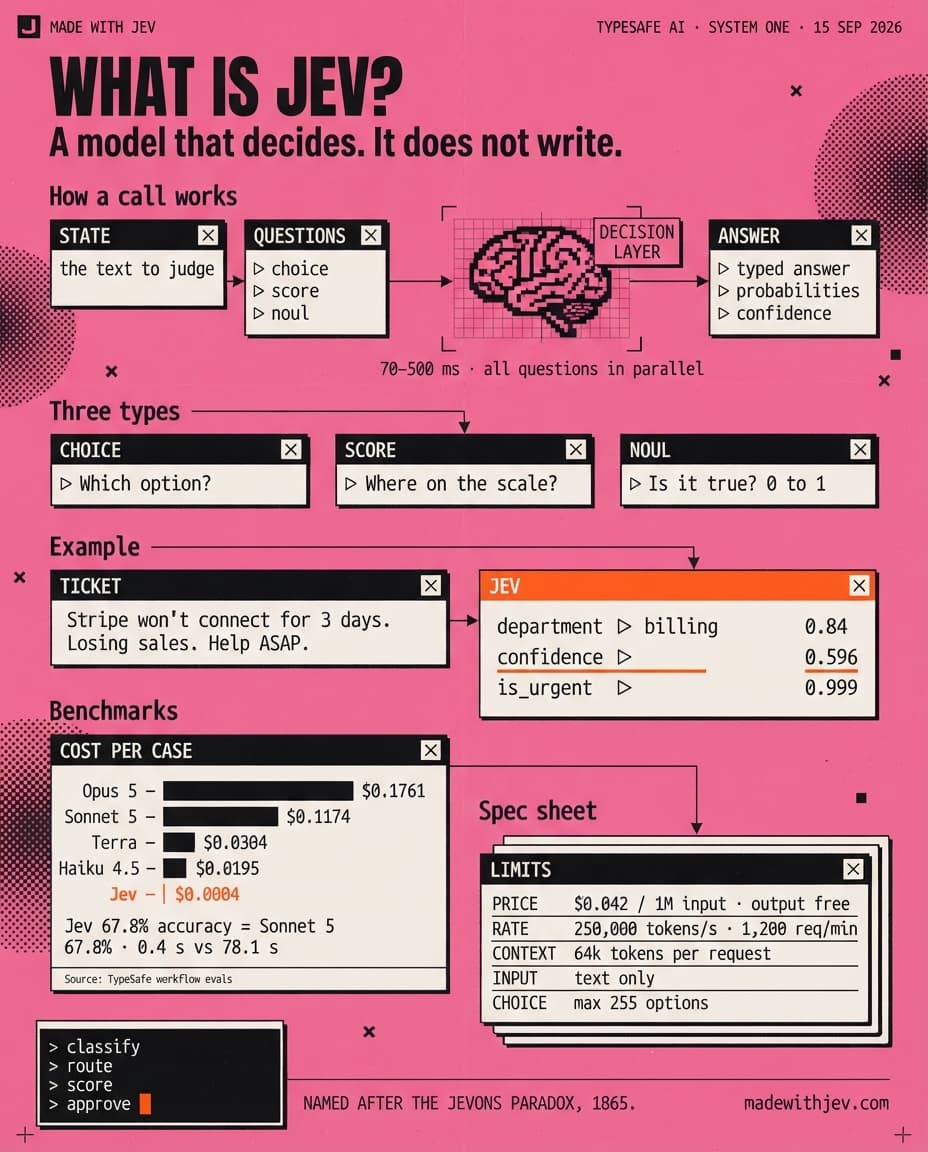
A call has two parts: the state, which is the text to judge, and the questions about it. There are three question types, and one call can mix them. Jev answers all the questions in parallel against the same state, so 60 questions cost about the same as one.
| Type | Asks | Returns |
|---|---|---|
| Choice | Which of these options? | The chosen option, a probability for each, and a confidence |
| Score | Where on this scale? | A level, a probability for each level, and a confidence |
| Noul | Is this statement true? | A probability between 0 and 1 |
Here is a support ticket with two questions: which team gets it, and is it urgent.
{
  "state": "Hi, I've been trying to connect my Stripe account for 3 days and the integration keeps failing. I'm losing sales. Please help ASAP.",
  "model": "jev-latest",
  "questions": {
    "department": {
      "type": "choice",
      "instructions": "Which team should handle this",
      "criteria": {
        "billing": "Payment or subscription issues",
        "technical": "Bugs or integration problems",
        "sales": "Pricing or account questions"
      }
    },
    "is_urgent": {
      "type": "noul",
      "instructions": "The message conveys urgency or time-sensitivity"
    }
  }
}{
"model": "jev-1.13.0",
"answers": {
"department": {
"type": "choice",
"choice": "technical",
"probabilities": { "technical": 0.85, "billing": 0.15, "sales": 0.0 },
"confidence": 0.78
},
"is_urgent": { "type": "noul", "noul": 1.0 }
}
}Abridged from TypeSafe’s quickstart.
Read the department answer closely. Jev picked technical with a probability of 0.85, and its confidence is 0.78. The probabilities show which option Jev picked. The confidence shows how sure it is, and that is the number your code uses: act on the confident answers automatically, and send the rest to a person or to a larger model. Confidence docs
One detail catches people out: the question ID, such as is_urgent, never reaches the model. Write the whole question in the instructions. Choice docs
Speed, cost and accuracy
Input costs $0.042 per million tokens. Output is free. Answers take 70 to 500 milliseconds. In TypeSafe's own workflow evals, Jev matches Sonnet 5 on accuracy (67.8%) at $0.0004 per case, against $0.1174 for Sonnet 5. What that works out to on real work is on the pricing page.
| Model | Mean accuracy | Cost per case | Time per case |
|---|---|---|---|
| Opus 5 | 73.1% | $0.1761 | 37.8 s |
| Terra | 67.9% | $0.0304 | 10.1 s |
| Sonnet 5 | 67.8% | $0.1174 | 78.1 s |
| Jev | 67.8% | $0.0004 | 0.4 s |
| Haiku 4.5 | 53.6% | $0.0195 | 12.5 s |
Source: TypeSafe workflow evals. The reference answers in these evals come from two large reasoning models, not from people. So 67.8% means Jev agrees with those two models 67.8% of the time.
Time per case
Lower is better. At this scale Jev’s bar is almost invisible.
- Sonnet 578.1 s
- Opus 537.8 s
- Haiku 4.512.5 s
- Terra10.1 s
- Jev0.4 s
Cost per case
Lower is better. Same four workflows.
- Opus 5$0.1761
- Sonnet 5$0.1174
- Terra$0.0304
- Haiku 4.5$0.0195
- Jev$0.0004
Models and limits
- Model
- Jev 1.13 (jev-1.13.0). jev-latest points to it.
- Price
- $0.042 per million input tokens. Output is free.
- Rate limits
- 100,000 tokens per second and 80 requests per second as of 8 Oct 2026. TypeSafe says the limits are adjusting and can change without notice; going over returns 429.
- Context
- 64k tokens per request; 32k for the state plus the longest question. 262k for both with the opt-in long-context header (preview)
- Input
- Text: a string, a JSON object, or an array of text values. PNG and JPEG images in preview since Jev 1.14. No audio or video
Source: TypeSafe models. The SDKs retry with backoff when a request goes over a limit.
As of Oct 2026 signups are open. TypeSafe reopened them on 27 Sep 2026 after pausing them for capacity; new accounts no longer get free credits. Sources: X announcement, credits notice.
The model aliases jev-latest and jev-preview both point to jev-1.13.0, and there is no separate preview build right now. Pin jev-1.13.0 once your thresholds are tuned; the response model field shows the versioned ID. Source: TypeSafe models.
Jev vs ChatGPT, Cursor, Codex and Claude Code
Jev decides: it returns typed answers plus confidence. ChatGPT, Cursor, Codex and Claude Code generate text or code, or edit files.
Jev is not a drop-in model for a coding agent; you use the coding agent to write code that calls Jev.
| Tool | What it does | Where Jev fits |
|---|---|---|
| ChatGPT | Conversational AI that generates text responses | Jev makes the routing, filtering and approval decisions; ChatGPT writes the text |
| Cursor | AI code editor that generates and edits code | Cursor writes code that calls Jev for runtime decisions |
| Codex | OpenAI model that turns natural language into code | Codex generates code; Jev decides which code path to take at runtime |
| Claude Code | Coding agent that edits files and runs commands | Claude Code writes the agent; Jev handles its fast, repeated decisions |
Sources: TypeSafe coding agents, OpenAI Codex, Claude Code docs, Cursor docs.
Why it is called Jev
Jev is named after the Jevons paradox, TypeSafe’s founder Diogo Almeida wrote in his launch thread. In 1865, William Stanley Jevons argued that as steam engines used coal more efficiently, Britain would burn more coal, not less. Make a decision cheap enough, and software starts making far more of them.
“System One” comes from Daniel Kahneman’s Thinking, Fast and Slow: System 1 is fast and intuitive, System 2 slow and deliberate. Jev is built for the fast kind. System One docs

darkzodchi
@zodchiii
Jev Founder (ex-OpenAI): "I believe JEV is the biggest breakthrough we've ever worked on This sounds too good to be true but it's beating everything" In 5 minutes, he breaks down why older LLMs were great at talking and terrible at deciding and building. Watch it and then read the guide below on how to use it at it's fullest 👇🏼

Sep 19, 2026 · 466 likesOpen on X
What people build with it
This site lists 855 builds. Most use Jev in one of a few ways: choosing the next action in an agent, sorting a queue into buckets, scoring every item in a large set, or stopping a risky step unless the confidence is high. In each case the system makes the same decision many times, so the speed and cost of each one add up.
- Agents and browsers181
- Open source179
- Benchmarks and evals168
- SDKs and integrations131
- Games and real time83
- Routing and model choice68
- Social feeds55
- Tools and apps51
- Coding and code review50
- Search43
- Context and memory37
- Security and abuse37
- Documents and OCR36
- Trading and markets26
- Inbox and support25
- Ads and marketing24
- UI19
- Sales and leads15
- Robotics and devices15
- SEO and GEO10
- Ecommerce7
Diogo Almeida
@CompleteSkeptic
We love how this doomo doomonstrates real-time intelligence and what can be doone with code + AI! ~10 calls/sec = ~$7/hour


Gregor Zunic
@gregpr07
Breaking: Browser Use + Jev = Ultrafast ⚡ Findings flights took 7s and cost only $0.0039 🤯 > new action space every step > DOM state space > small LLM fallback to type (this video is at 1x speed btw) Built a tiny open source browser agent. try it below ↓


Hassan
@nutlope
I used Jev to classify 1,018 AI research papers. The result: $0.08 total cost and 256ms median end-to-end latency per paper. The pipeline was: 1. Summarize each paper with DeepSeek V4 Flash 2. Send the title + summary + 24 possible topics to Jev 3. Use Jev to classify each paper 4. Visualize everything on http://1kpapers.com The summaries cost $3.99 on @togethercompute. The classifications cost $0.08 on @typesafeai. So for just over $4 of inference, I ended up with a pretty useful way to explore the top AI research papers from the past year. I think this is where things are heading: different models for different parts of the workflow, instead of using one model for everything. I’m running evals on the Jev classifications before replacing the current ones, but the site is already live: http://1kpapers.com


tamara
@tamarajtran
found the perfect use case for @typesafeai Jev: instant compaction in 2026, why is compaction still a summarization prompt? Jev can make it instant by scoring every tool call and dropping what’s irrelevant

XContext and memory
PickInstant compaction for Claude
Grouped by the job Jev does rather than by taxonomy, they are on Jev use cases. The way these builds split the work, an LLM writes, Jev decides and code acts, now has a name: Jev Engineering. The two jobs most people try first are picking the model for each turn, on the Jev router page, and shrinking a long session, on Jev compaction. The code that holds it together is an agent harness, and the model itself cannot be fine-tuned — here is what people train instead.
Where it does not fit
- It does not write text. Drafts, summaries and code still need an LLM.
- You define the possible answers. A Choice holds at most 255 options.
- Input is text — strings, JSON objects and lists of strings — and, in preview since Jev 1.14, PNG and JPEG images behind a header. No audio or video. TypeSafe says image input is not production-ready yet — can Jev read images?
- “Cannot hallucinate” means the answer always has the right type. It can still be wrong. Test the confidence scores on your own data before you choose a threshold.
Watch the founder explain it

Codez
@0xCodez
Jev Founder, Diogo Almeida (ex-OpenAI): "The next era is not the Claude Code or Codex era, they are still part of the assistance era with human in the loop - JEV is what comes next for LLMs x200 faster, x400 cheaper, 0 hallucination, no human in the loop - that's JEV, this is how LLMs will look like" in 36-minute tech talk, Jev Founder explained why RLHF isn't a thing anymore and how modern LLMs will be built this talk is worth more than a Stanford Machine Learning degree watch today no matter what, then learn how to become a Jev Engineer in the article below

Sep 19, 2026 · 2.3K likesOpen on X
Start here
The docs, the launch post, two plain explanations, our guide to Jev Engineering and the list that tracks the rest. Our own writing has an index of its own: all 39 Jev guides on one page, grouped by the question each one answers.

Guidedocs.typesafe.ai
Quickstart: state, questions, typed answers
The three question types, Choice, Score and Noul, in one support-ticket example.
Guidetypesafe.ai
Introducing System One Models and Jev
TypeSafe’s launch post: the model, the evals, and their caveats.

Akshay 🚀
@akshay_pachaar
LLMs vs. Jev, clearly explained! TL;DR The key difference is not that Jev generates faster. Jev does not generate text at all. A traditional LLM receives context and produces an answer one token at a time. Even when the output is a small JSON object, every token depends on those generated before it. Jev receives the same context but evaluates predefined decisions directly. When those decisions are independent, it can evaluate all of them in parallel. Consider an agent handling a failed deployment. It may need to determine: → Whether the incident is urgent → Which team should handle it → Whether the proposed command is risky → Whether the task is complete An LLM generates a response containing these answers sequentially. The application then parses and validates it. With Jev, you define the questions and expected answer types upfront. It evaluates them together and returns typed answers with probabilities. Jev supports three decision primitives: 1. **Choice** selects from known options, such as engineering, billing, or sales. 2. **Score** places the input on an ordered scale, such as low, medium, or high risk. 3. **Noul** evaluates a yes-or-no condition and returns the probability that it is true. The probabilities matter as much as the selected answers. If engineering receives 91% probability and billing receives 9%, automatic routing may be reasonable. If the probabilities are 52% and 48%, the system can escalate, gather more context, or call a stronger model. This keeps control inside ordinary software. Code owns the thresholds and consequences. Jev supplies the semantic judgment that a normal `if` statement cannot derive from unstructured text. It works best when the possible answers are known, the decision depends on meaning, and a careful person could judge the input quickly. It is not designed for writing, summarization, code generation, arithmetic, or decisions requiring several dependent reasoning steps. Independent questions can run in parallel, but decisions that depend on earlier results must remain sequential. Jev also cannot return an option outside the declared schema, but it can still select the wrong valid option. Type safety prevents malformed outputs, not incorrect judgments. The clean mental model is this: LLMs generate new language when the answer space is open. Jev evaluates known paths when the answer space is bounded. I wrote the full breakdown explaining Jev and where it fits. The article is quoted below.

Guidex.com
LLMs vs. Jev, clearly explained
Akshay Pachaar: Jev does not generate text at all. It answers Choice, Score and Noul questions in parallel, and your code owns the thresholds.

Nathan Flurry 🔩
@NathanFlurry
hype-free explanation of jev: jev does not replace gpt / claude jev is just a *really* smart switch statement like if 2016 ml classifiers got 2026 levels of intelligence it's a new* type of tool that will make a lot of workloads insanely fast, cheap, and accurate * = and by new, i mean rebranded ~~~ it needs a predefined set of options and it will tell you which one to take it cannot: - write code - generate natural language - reason step by step / show its work - produce any output you didn't define in advance - pick from more than ~255 options in one shot but it can: - classify, route, score, rank - give confidence - pick the right branch, tool, model, or sub-agent - judge / verify / guardrail an llm's output - label tons and tons of rows ~~~ i'd imagine a lot of workflows that look like: llm proposes options → jev decides → code executes and i see this fitting *really* well with code mode and mcp ~~~ implying this will lead to agi seems incredibly far fetched to me, but i don't want to discount the types of applications that this will make possible
Guidex.com
A hype-free explanation of Jev
Nathan Flurry: Jev does not replace GPT or Claude. It works like a very smart switch statement.
Our guidemadewithjev.com
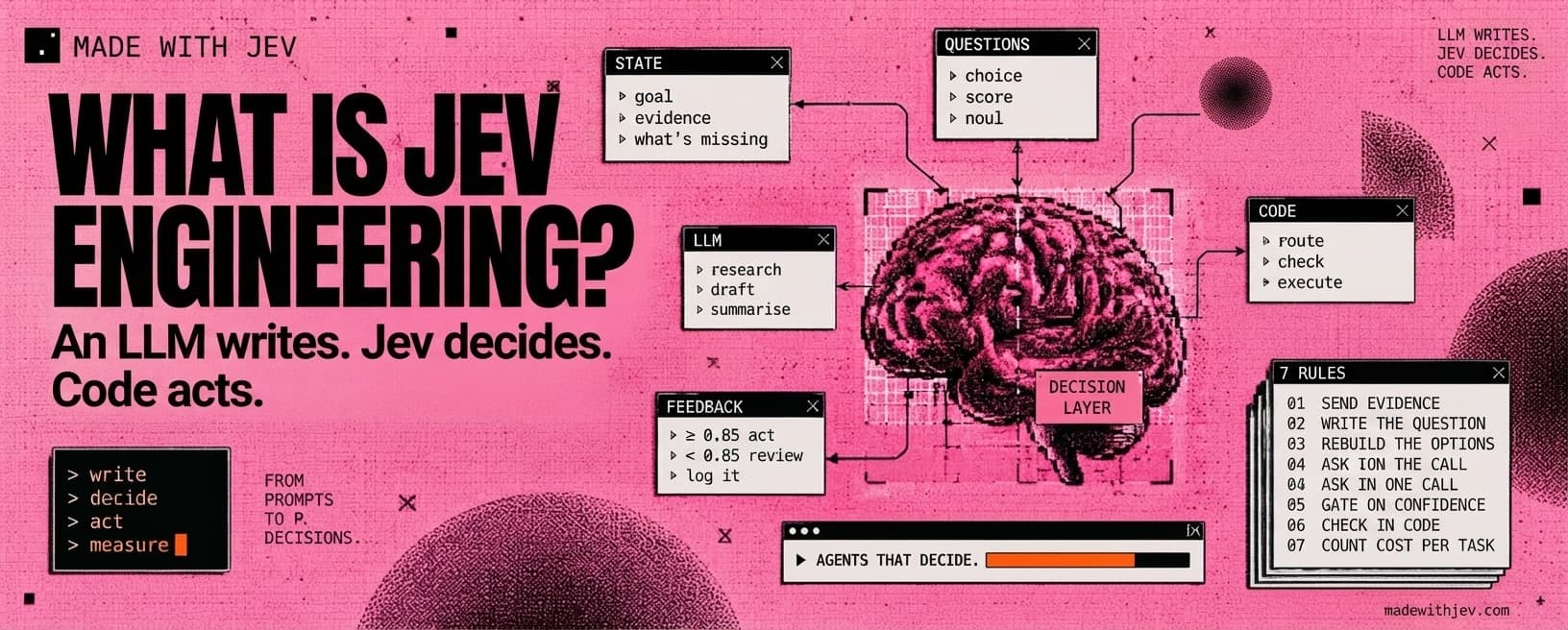
What is Jev Engineering?
Our guide to the term: split an agent into an LLM that writes, Jev that decides and code that acts, with the rules the builds on this site have in common.
Guidegithub.com
Awesome Jev
The GitHub awesome list for Jev: use cases, projects, SDKs, tools and learning resources, with pricing, limits and a quick start.
Common questions
- What is a System One model?
- A type of model built for fast decisions that other software uses directly. The name comes from System 1, the fast, intuitive thinking in Daniel Kahneman’s Thinking, Fast and Slow. It does not write text, generate code or explain its reasoning.
- Can Jev hallucinate?
- It cannot return a value outside the type you asked for, so you never get broken JSON or an invented field. The answer can still be wrong. The confidence score tells you how far to trust it.
- What does Jev cost?
- Input costs $0.042 per million tokens. Output is free. A response takes 70 to 500 milliseconds.
- Does Jev replace an LLM?
- No. It handles small decisions that repeat, such as classify, route, score, filter or approve a tool call. A larger model still writes anything that needs writing.
- How do I call it?
- With one POST request to TypeSafe’s API, or through the Python or JavaScript SDK. You can try a question in the TypeSafe Playground first, without writing code.
- What is Jev Engineering?
- A way to build agents that took off on X three days after launch: an LLM writes, Jev makes the small decisions, and code acts on them.
- Is Jev open source, can I run it locally?
- No. Jev’s weights are not published and it runs only on TypeSafe’s API. The SDKs are MIT. More at /open-source-jev.
Made with Jev is independent and not affiliated with TypeSafe AI.