Jev agent orchestration
A multi-agent system is a coordination loop full of small bounded questions: who goes next, is this good enough, are we done, should we retry, does a person need to see this. A frontier model answers them slowly and expensively. Jev answers them in one typed call with a confidence. This page is the layer as it was actually wired, in 9 builds — and the place the evidence stops.
Updated 24 Sept 2026 · by Made with Jev
In short
- The workers already exist. The thing that is missing in most multi-agent setups is the fork between them, not another specialist.
- Jev chooses from a menu that exists right now, so an unavailable worker is simply not on the list — and a required human is.
- The strongest published pattern is a gate: no proof, no done. A research claim and a finished objective both have to clear a typed review before they move on.
- Almost none of this has a published benchmark. The measured figures are single-call, and the honest label for the rest is architecture, not result.
The five routing decisions in a multi-agent system
Every multi-agent workflow, whatever it is called, keeps asking the same handful of questions. Each has fewer than five valid answers, which is exactly the shape a decision model is built for and a reasoning model is not.
| The fork | The answer space | Where it belongs |
|---|---|---|
| Who acts next | One of N workers, or human_review | A Choice over the workers available this turn |
| Is the research good enough | accept / verify_more / reject | A gate between the researcher and the writer |
| Is the objective finished | complete / verify_more / incomplete | A completion gate before anything returns to a person |
| Should this action proceed | allow / confirm / human_review / deny | A guard, with the real approval still in the host |
| Is this command safe to run | A probability from 0 to 1 | A Noul check in front of the tool |
TypeSafe exposes these as three primitives — choice, score and noul — that can be mixed in one request, so a single call can route the work and flag the risky part together, the way the routing example on Jev Engineering does.
The orchestration builds, by what they route
The Grok Bot decision layer
Grok Bot ships the workers; Jev is asked what happens between them. The same three shapes recur: a usage router that asks before a browser run, a research or retry decision, and a Noul guard that keeps irreversible actions with a person.

codila
@0xCodila
Jev + GrokBot is the best AI agent system I’ve built in my life It just made my setup CHEAPER and FASTER than what 95% of people are running... setup takes literally 7 minutes: prompt → GrokBot → Jev decision → GrokBot execution → result step 1 → open @typesafeai , create API key (keep it off chat paste) step 2 → tell Grok Bot: store TYPESAFE_API_KEY in the secure field step 3 → prompt Grok Bot: install typesafe-sdk on Agent Computer + smoke system_one (Choice) step 4 → tell Grok Bot: build the usage lab (router, dry-run, config, logs) - or clone Github below step 5 → add skill jev-usage-router: before browser / research / retry / extra bot → call the router, honor action step 6 → stay shadow first, read logs, then active when you trust it - kill switch: bypass jev or enabled: false step 7 → flip active: GrokBot obeys route - Jev decides - GrokBot executes - humans control irreversible actions the result: Jev + GrokBot the best and fastest agent running directly on your computer rn, I’ve already tested it on routine tasks - and the results are genuinely incredible You can come up with endless ways to use Jev + GrokBot - but the most important thing is to install it as soon as possible Copy this 2028 setup, explore my repo below - then read the full Jev deep dive ↓

XRouting and model choice
A usage router for Grok Bot

RazeDen
@razeden0
i just merge Grok 4.7 + Jev and got the smartest thing i've ever owned grok 4.7 does the thinking. jev does the deciding. together they cost less than my coffee prompt → grok bot → jev asks 6 questions → grok 4.7 opens only the good ones → campaign jev doesn't write anything. it only answers simple questions: yes or no, pick one, or a score. it can't make things up, because it can only pick from answers you allowed i gave it 3,412 leads from x, linkedin and youtube. 6 questions each is 20,472 decisions, done in 15.7 seconds for $0.41 the same reading by hand took me 6h 12m. people say 400x faster. i did the math and it's 1,421x that's $0.00012 per lead, and grok 4.7 only reads the ones worth reading the big mistake: sending everything straight to the new model. you pay the smartest thing you own to say "skip" all day setup took me 9 minutes: key in the secure field, sdk on the agent computer, one router skill, test mode first jev decides, grok bot does the work, and i still press the button on anything i can't undo everyone is talking about the new model. the cheap one deciding what it reads is where the money is


Coach Shweta Bajaj
@shwetabjaj
What stands out to me in the Jev + Grok Bot setup is the division of work: Jev decides. Grok Bot acts. Human stays in control for anything irreversible. That’s a much cleaner agent architecture than asking one model to do everything. Cheaper, faster, and easier to reason about. @typesafeai @grok

XAgents and browsers
Jev decides, Grok acts

Chris Adcock MD 🍊💊
@ChrisAdcockMD
Took Gregor’s Ultrafast idea and wired it into Grok Bot. @bot @OpenRouter @typesafeai @gregpr07 Your bots can now use Jev to drive the real Chrome on the machine instead of slow look-and-click. Drop in the API key you already have (OpenRouter or TypeSafe), and it gets going. It also walks your existing bot workflows and flags which decisions Jev can take over — the quick yes/no and “pick one of these options” calls — so you’re not guessing where it helps. Share link if you want to try it: https://x.ai/bot/sM_Xi4OF09cGU8KGyLvlC
XAgents and browsers
Jev driving real Chrome from Grok Bot

Oliver Prompts
@oliviscusAI
grok 4.7 thinks. jev reacts. together, one ai agent now thinks twice before every move, and pays a fraction of the price for it. grok-jev-reflex is a free, open source router that pairs the two: grok 4.7 plans and acts, jev makes the cheap yes/no calls in between, at $0.042 per million tokens, answered in about 239ms. > 25 tools sent on every call, cut down to 8 > first prompt: 17.8k tokens → 9.5k tokens > bill: up to 40% less, same speed > numbers measured independently on xAI's grok build setup is 5 messages, no code, about 7 minutes: make a key, install, add one rule, run a shadow day watching only, then go live. jev can only make the agent do less or ask more, it can never approve anything irreversible on its own. 100% free. open source.

XRouting and model choice
PickGrok-Jev Reflex

امیرحسین ثقه الاسلامی
@AHSeslami
اولین تجربهی خودم با JEV 👀 این تجربه برای ۳ روز پیشه؛ وقتی JEV هنوز توی حالت Waiting List بود. من کلاً هر ابزاری که سختافزارم بتونه بکشه رو تست میکنم 😄 برای همین توکن JEV رو از OpenRouter گرفتم و به Grok Bot دادم. ماجرا چی بود؟ از GITEX کلی ویدیو گرفته بودم و نمیدونستم کدومها رو اول منتشر کنم. از اون طرف هم برای هرکدوم کلی کاور طراحی کرده بودم و واقعاً حوصله انتخاب و مرتبکردنشون رو نداشتم 😂 به JEV گفتم: «خودت انتخاب کن، دستهبندی کن و فولدربندیشون کن.» در کمتر از چند دقیقه همهچیز رو مرتب کرد و حتی پیشنهاد داد کدوم ویدیوها رو اول منتشر کنم. Grok Bot هم بقیهی توضیحات و تحلیلها رو انجام داد. برای اولین تجربه، واقعاً از JEV راضی بودم 🔥 هنوز Laya-Max چینی رو هم تست نکردم؛ نصبش هنوز تموم نشده. اونم که آماده شد، تجربهام رو میگم 👀

XRouting and model choice
First JEV experience: OpenRouter plus a Grok bot
The same layer, without a vendor
A pipeline with Jev at the core, a simulation driving many agents at once, and a judge that grades what the agents produced. Each one is a decision loop rather than a more capable model.

Mentis 🇦🇺
@adam_x_mentis
Gonna be… Massive! Here’s the pipeline architecture for the agentic pipeline. @typesafeai’s Jev super fast decision engine at the core. 👀🕳️🐇 🔥🚀🤖

XAgents and browsers
An agentic pipeline with Jev at the core

Xiang Wei
@xgwei
Great minds! I've been building a stylized SF with Opus too, just without the pets. My cars follow rules on the real street network, lanes and traffic lights included. Jev driving pedestrians is tempting though. How many agents can it run at once?

XGames and real time
Driving pedestrians in a multi-agent simulation

Akshay 🚀
@akshay_pachaar

Grok Bot with a Jev router, taken apart
The most quoted write-up is a 12-step article that installs Grok Bot’s marketplace workers — a project manager, a researcher, a writer, an outbound rep and more — and puts a decision layer between the manager and the crew. Its best idea is the cleanest sentence in the genre: Grok does the job, Jev decides where the job goes next.
Read it as a design, because that is what it is. Three parts are worth keeping whatever platform you use, and one is a caution the article itself makes.
A live menu, not an org chart. If a specialist is unavailable, it is not on the list; if a project has no video, the clip desk is not on the list; if the next step needs a signature, human_review is. The routing then chooses from what exists, not from what might.
Stop the researcher grading its own homework. The same agent that finds a claim usually decides the claim is good enough, and the same mistake survives the chain. A gate that can only return accept, verify_more or reject gives a weak fact somewhere to go.
No proof, no done. Before a non-trivial objective returns, restate it, list the required outputs, show where each one exists, show what was verified, list every gap, and only then ask. The article is careful that typed output does not mean a correct judgement — the shape is guaranteed, the answer inside is not.
The caution: the article opens by saying it will not put fake benchmark numbers in, and then does not. That is the right call and it is also the whole state of the field. What exists is a working layer and a set of policies; what does not exist is a published measure of routing accuracy, false completion or recovered failures that someone else could re-run.
Autonomy levels for a Jev-routed system
The part of the genre most likely to fail is the jump from “the agent can research” to “give it your card.” The useful pattern is a small ladder, and Jev helps classify the rung rather than erase the boundary.
| Level | What it does | Who approves |
|---|---|---|
| Read | Search, inspect, analyse | Nobody; it runs |
| Prepare | Draft, create a file, recommend | Nobody; nothing leaves |
| Reversible write | Update a draft or an internal record | The platform’s own permissions |
| External action | Send, publish, contact a customer | A person |
| Money or irreversible | Buy, sign, delete, change production | A person, always |
Jev can score an action against that ladder. It cannot approve the rung, and it should not. A decision model that returns a high confidence has told you it is sure, not that it is allowed.
How to add a Jev routing layer to a system you already run
- Start with one fork. Routing is the usual first one, because it runs at the top of every workflow and its answer is cheap to check.
- Build the menu from live state. Only workers that exist, tools that are installed, and actions the host can actually run.
- Run it in shadow first. Let Jev answer and let the real system do what it already did; log the disagreements, then switch it on.
- Keep irreversible actions behind a person and let the guard classify, not decide.
- Automate one loop, once it works once. A routine that is a skill is reusable; a routine that is a hope is a bill.
The concept behind the split is on Jev Engineering; the single-agent version is on the agentic harness page; and the coding stack most people start from is Jev with Claude Code. For routing as its own use case, see the use cases.
The orchestration write-ups, in reading order
The Company-in-a-Box roadmap this page takes apart, then the routing and decision-brain pieces that describe the same layer from other angles.

unicode
@unicodef1wn
x.com/i/article/2102…
Guidex.com
AI Company-in-a-Box: Grok Bot + Jev
unicode’s 12-step roadmap for a self-managing company: the Grok Bot marketplace supplies the workers, and Jev answers the five forks between them — who goes next, is the research good enough, continue or stop, is it done, does this need a person.

Harry Tandy
@HarryTandy
TypeSafe founder Diogo Almeida: "I want to automate the easy work before the hard work" In this 2-hour interview, he explains how Jev uses choices, scores, and yes/no probabilities to route work inside agent loops The guide below has 3 builds: a skill router, a codebase linter, and a retrieval reranker Watch the interview, then copy the builds below

Guidex.com
How Jev routes agents
In a two-hour interview, TypeSafe founder Diogo Almeida explains how Jev uses choices, scores and yes-or-no probabilities to route an agent.

Ricker
@0xRicker
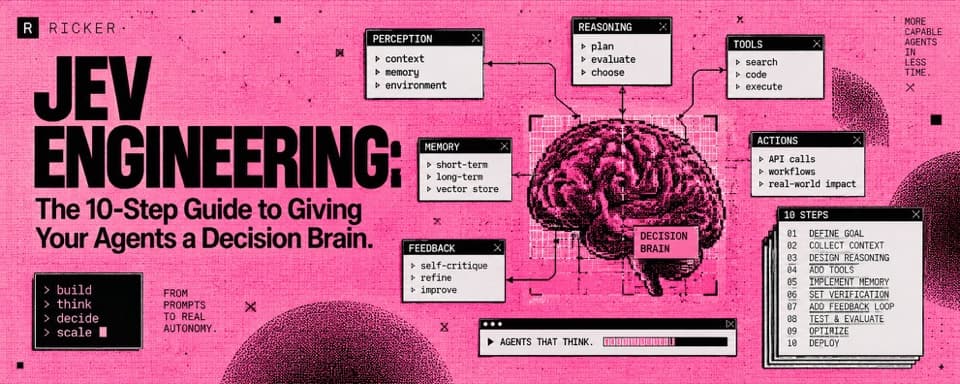
Jev could become the control layer AI agents have been missing. Instead of spending 5–20 seconds and expensive LLM calls deciding every next step, it can route actions in milliseconds at near-zero cost. In this article, I break down how
Guidex.com
Giving your agents a decision brain
Ricker’s X article: a 10-step guide to moving an agent’s yes-or-no, routing and relevance calls from an expensive LLM to Jev.

Movez
@0xMovez
Guidex.com
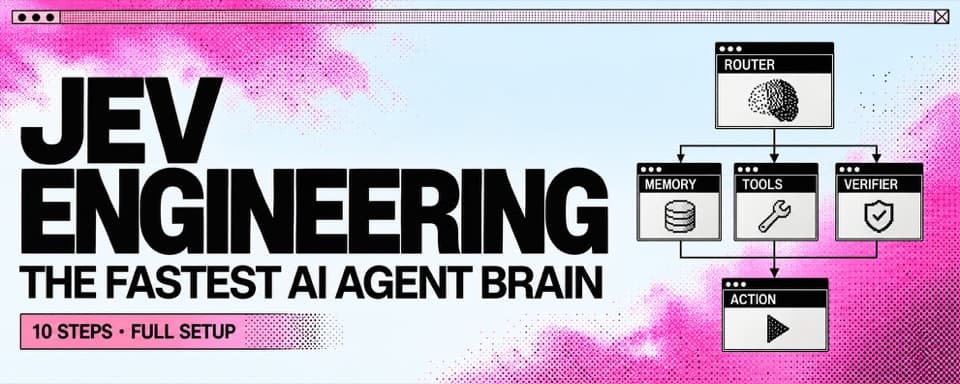
Building the fastest agent brain in 10 steps
Movez’s X article on Jev Engineering: move every yes-or-no, routing and scoring call out of the LLM, then add a model router and a gate for risky tool calls.

david fant
@da_fant
jev will make agents 10x faster and cheaper, here's how: 1/ model routing: pick the right model for each task, without training a custom router https://x.com/mdlahfir/status/2100314182201802811?s=20 2/ computer use: faster, cheaper and more reliable for action-heavy tasks https://x.com/gregpr07/status/2100411066966749359 3/ auto review: ask jev whether an action is safe, instead of using a slow and expensive LLM https://x.com/fazxes/status/2100300097695232164?s=20 4/ less obvious: subagent orchestration long-running agents (cursor projects, grokbot, energy) parallelize work with subagents. but every user message, email, or subagent reply can wake the expensive orchestrator. example: it costs $1 to wake up gpt 6 astra w 100k input tokens jev can decide what each event needs: - route directly to a subagent - queue for later - wake the orchestrator
Guidex.com
How Jev makes agents faster and cheaper
David Fant on model routing, computer use and more, with links to examples.
Common questions
- What does Jev do in a multi-agent system?
- It answers the forks between the agents: who owns the next unit of work, did the research clear the bar, is the objective finished, should the system retry, and does this action need a person. Each one is a bounded question with a confidence, not a generated plan.
- Does Jev replace the orchestrator?
- No. The surrounding system owns the workflow. Jev owns one fuzzy decision inside it: given the current state and a menu of options that exist right now, which one, or abstain. The host still decides what the menu is.
- Should Jev control every agent?
- No. An agent that runs its own tool loop keeps that loop, and a system that hands Jev the routing decision has not handed it permission to act. The useful boundary is the same as in a single-harness build: only the choices your code can check.
- Is there a measured multi-agent result?
- Not one anyone has published as a benchmark. The Grok Bot builds are architecture sketches with a working router or two; the figures here are single-call ones, like a usage router deciding before a browser run spends anything. Treat the rest as a design, not a result.
- Which decision model should the routing use?
- Jev or an open one like Laya, which answers the same three primitives locally. The routing question is a classification, so a decision model fits it whether it runs at TypeSafe or on your own machine.
Made with Jev is independent and not affiliated with TypeSafe AI. Every figure on this page is the one its author published, linked to where it can be checked.