Our guidemadewithjev.com
What is Jev Engineering?
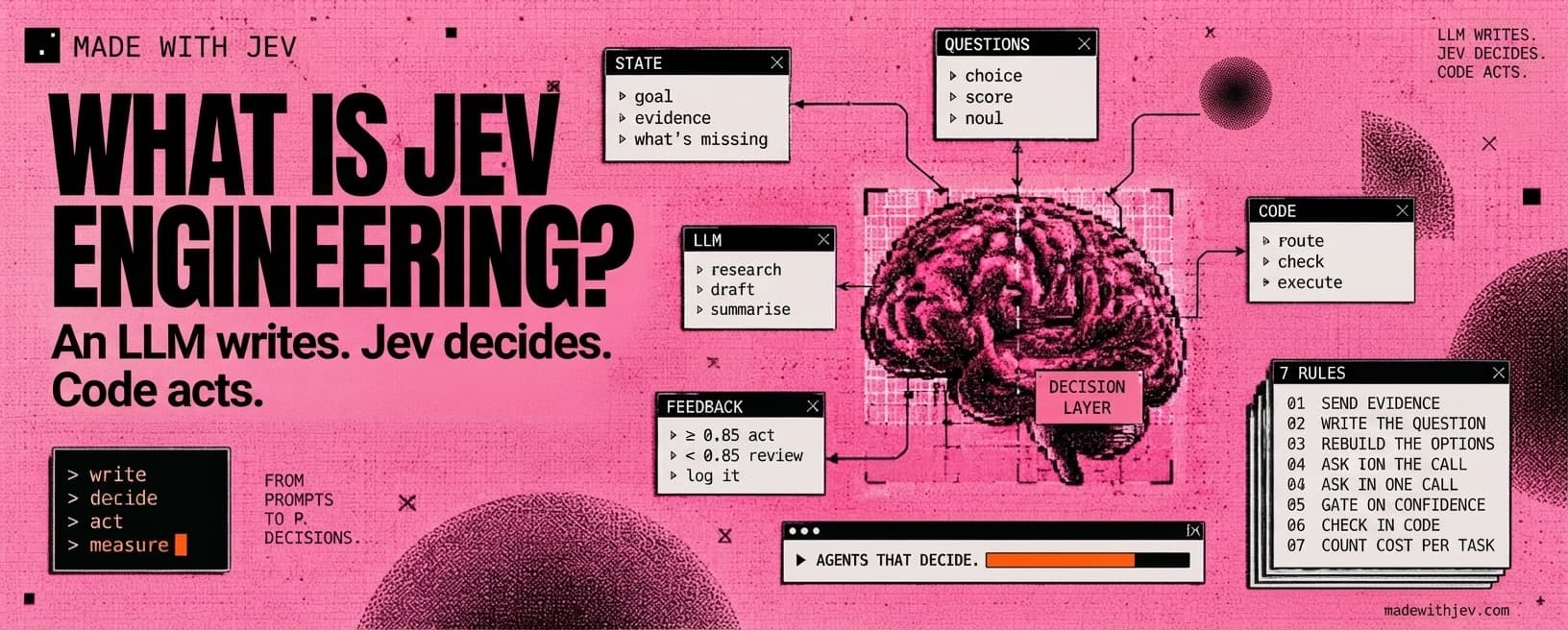
Our guide to the term: split an agent into an LLM that writes, Jev that decides and code that acts, with the rules the builds on this site have in common.
Updated Sep 18, 2026
Projects, posts and guides about Jev, the System One model from TypeSafe AI. Each entry links to its source and shows the cost and speed its author reported.
Launching today


Diogo Almeida
@CompleteSkeptic
After co-inventing ChatGPT, I kept asking myself: why have superhuman chat models not led to AGI? I’ve spent the last 2 years in stealth building a new way to train models (RLCD), and a new type of frontier AI model that we are releasing today: Jev • 20-200x faster • 40-400x cheaper (w/ output tokens free) • Frontier composable intelligence optimized for decisions AFAICT the shortest path to AI-based economic revolution

Our guidemadewithjev.com
Our guide to the term: split an agent into an LLM that writes, Jev that decides and code that acts, with the rules the builds on this site have in common.

codila
@0xCodila
Jev is the "Internet" moment for the AI industry It tells your agents and LLMs what to do next, in milliseconds and at almost zero cost If you set it up correctly, you will have the AI engineer’s stack for 2028 In this article, I show you how x.com/i/article/2077…
Guidex.com
codila’s X article on what Jev is, how to set it up, and where its speed and cost advantage comes from.

Movez
@0xMovez
x.com/i/article/2100…
Guidex.com
Movez’s X article on Jev Engineering: move every yes-or-no, routing and scoring call out of the LLM, then add a model router and a gate for risky tool calls.

Ricker
@0xRicker
Jev could become the control layer AI agents have been missing. Instead of spending 5–20 seconds and expensive LLM calls deciding every next step, it can route actions in milliseconds at near-zero cost. In this article, I break down how x.com/i/article/2101…
Guidex.com
Ricker’s X article: a 10-step guide to moving an agent’s yes-or-no, routing and relevance calls from an expensive LLM to Jev.

Charly Wargnier ♨️
@DataChaz
Jev might genuinely be an “Internet moment” for AI. TypeSafe reports up to 193x faster and 444x cheaper performance in tests with Claude Fable 5.1 and GPT-6 Astra. @0xCodila just wrote a great 10-page article explaining what Jev is, how to use it, and where its 100x advantage comes from. Here are the 10 steps: 1 → LLMs create. Agents act. Jev decides the next move. 2 → Turn agent forks into three primitives: Choice, Score and probability. 3 → Build with OpenAI, Anthropic or xAI first, then swap Jev in without rebuilding the graph. 4 → Start with shared state, parallel decisions, risk thresholds and an execution queue. 5 → Batch decisions instead of making them sequentially. In one test, 13 questions were 10x faster and 12.2x cheaper. 6 → Put Jev at bounded forks: agent, model, tool, browser action or human escalation. 7 → Benchmark the whole loop, not just individual model calls. 8 → Rank wide, read narrow: shortlist first, then spend compute on what matters. 9 → Reuse the same system: State → Questions → Action → Verify. 10 → Keep Jev out of math, writing and irreversible execution. Code computes, LLMs create, Jev decides. The result: A slow, expensive agent loop becomes a much faster decision system that can route, score and escalate in milliseconds. Full breakdown below ↓

Guidex.com
Charly Wargnier’s thread condenses codila’s article: batch decisions, put Jev at bounded forks, and keep it out of math, writing and irreversible actions.

Codez
@0xCodez
Jev Founder, Diogo Almeida (ex-OpenAI): "The next era is not the Claude Code or Codex era, they are still part of the assistance era with human in the loop - JEV is what comes next for LLMs x200 faster, x400 cheaper, 0 hallucination, no human in the loop - that's JEV, this is how LLMs will look like" in 36-minute tech talk, Jev Founder explained why RLHF isn't a thing anymore and how modern LLMs will be built this talk is worth more than a Stanford Machine Learning degree watch today no matter what, then learn how to become a Jev Engineer in the article below

Guidex.com
A 36-minute talk by TypeSafe’s founder, shared by Codez: why he thinks agents with no human in the loop come next, and how models like Jev are trained.

darkzodchi
@zodchiii
Jev Founder (ex-OpenAI): "I believe JEV is the biggest breakthrough we've ever worked on This sounds too good to be true but it's beating everything" In 5 minutes, he breaks down why older LLMs were great at talking and terrible at deciding and building. Watch it and then read the guide below on how to use it at it's fullest 👇🏼

Guidex.com
A short clip shared by darkzodchi: TypeSafe’s founder on why older LLMs were good at talking and bad at deciding.

Gregor Zunic
@gregpr07
Breaking: Browser Use + Jev = Ultrafast ⚡ Findings flights took 7s and cost only $0.0039 🤯 > new action space every step > DOM state space > small LLM fallback to type (this video is at 1x speed btw) Built a tiny open source browser agent. try it below ↓

GitHubAgents and browsers
PickBrowser Use’s browser agent, with Jev choosing each next step.
Browser Use
~2.9k
Hassan
@nutlope
I used Jev to classify 1,018 AI research papers. The result: $0.08 total cost and 256ms median end-to-end latency per paper. The pipeline was: 1. Summarize each paper with DeepSeek V4 Flash 2. Send the title + summary + 24 possible topics to Jev 3. Use Jev to classify each paper 4. Visualize everything on http://1kpapers.com The summaries cost $3.99 on @togethercompute. The classifications cost $0.08 on @typesafeai. So for just over $4 of inference, I ended up with a pretty useful way to explore the top AI research papers from the past year. I think this is where things are heading: different models for different parts of the workflow, instead of using one model for everything. I’m running evals on the Jev classifications before replacing the current ones, but the site is already live: http://1kpapers.com

Hassan
@nutlope
Jev + Kimi K3 for fraud detection! TLDR: Jev classified 100 emails in 1.42 seconds, then I routed the uncertain cases to Kimi K3. The full pipeline got 96/100 correct for only ~$0.07. Video is not sped up, check out the live run! Here was my process: I gave Jev 100 emails to classify (a mix of 50 legit & 50 fraudelent emails). It classified all of them in 1.42 seconds. An underrated feature about Jev is it will give you the confidence score for a classification, so I routed any prediction under 95% confidence to Kimi K3 to be fully sure. 31 emails fell below that threshold. After routing those to Kimi K3, the combined pipeline reached 96% accuracy. The full run took 16 seconds & ~$0.07 in inference costs: - $0.068 from Kimi K3 on @togethercompute - $0.003 (1/3 of a cent) from Jev on @typesafeai. I think this is a really interesting pattern: use a fast specialized model like Jev for the narrow task, then route the uncertain cases to a larger LLM. I feel like this kind of approach could be a game changer for use cases like fraud or anything realtime. You can use the speed & low cost of Jev while having a larger LLM as a fallback to ensure high accuracy.

X postTriage and routing
Pick
Riley Brown
@rileybrown
Yeah Jev by @typesafeai is very cool. It classified 500 emails in seconds. And it costed 3.5 cents.


tamara
@tamarajtran
found the perfect use case for @typesafeai Jev: instant compaction in 2026, why is compaction still a summarization prompt? Jev can make it instant by scoring every tool call and dropping what’s irrelevant

X postTools and apps
Pick
Alex Volkov
@altryne
This is actually insane. This uses @typesafeai Jev model, as a plugin in Claude to review all the un-nesseasary tool calls, and it takes 1s to run! Like, literally, 1 second to take my Claude session from nearly 1M to ... 86K tokens! 😮 Ask your claude to install it and be amazed Use this prompt ``` Install, and configure : https://github.com/tamaratran/fast-jev-compaction ```

Guidex.com
Alex Volkov: a Claude session went from nearly 1M tokens to 86K in about one second.

Guidelangchain.com
Routing between models, and blocking risky tool calls with a Jev decision.
Jev Engineering splits an agent into three parts: an LLM writes, Jev decides and code acts. These are the guides that named it, the talks behind it and the builds they use as examples.
6 builds and 9 guides