What is Jev Engineering?
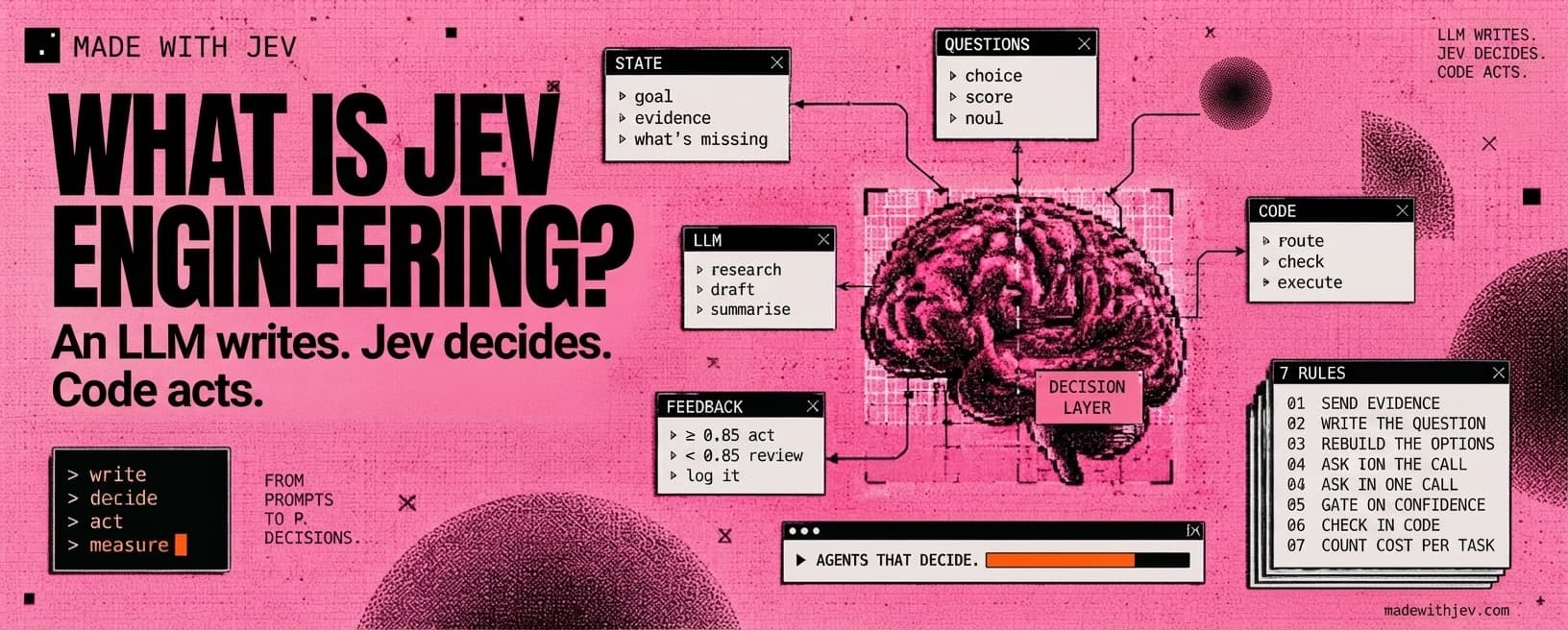
Jev Engineering is a way to build AI agents: an LLM writes, Jev decides, and code acts. Every point where an agent picks a worker, scores a source or approves a tool call goes to Jev, TypeSafe AI’s System One model, instead of to a model that generates text.
Published 19 Sep 2026 · by Made with Jev
In short
- The term comes from three X guides published on 18 and 19 September 2026, three days after Jev launched.
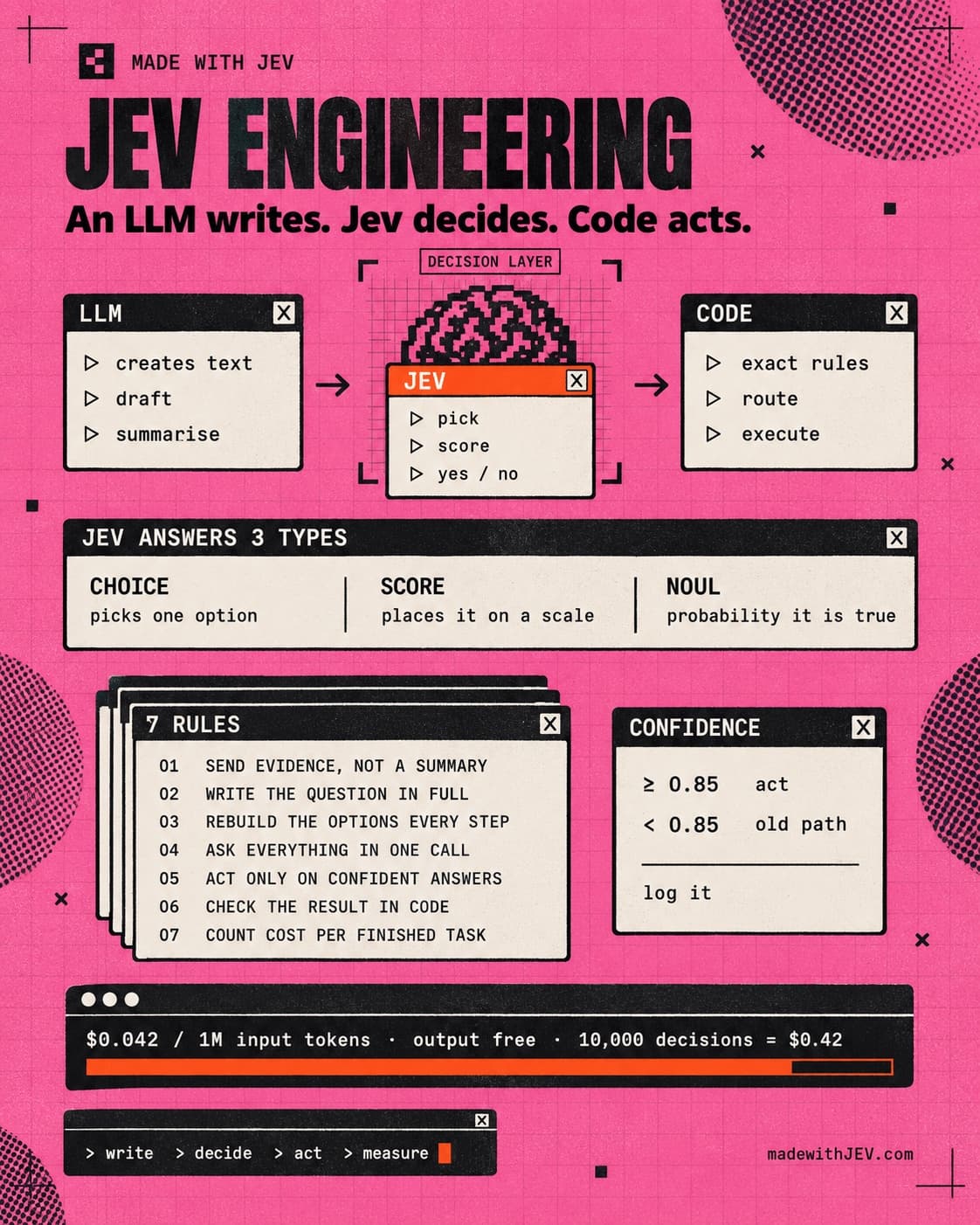
- The test for each step: if it creates text, an LLM does it. If it picks, scores or answers yes or no, Jev does it. If it follows an exact rule, code does it.
- Jev costs $0.042 per million input tokens, and output is free.
- The call is the easy part. The work is in the state you send and the confidence threshold you act on.

Charly Wargnier ♨️
@DataChaz
Jev might genuinely be an “Internet moment” for AI. TypeSafe reports up to 193x faster and 444x cheaper performance in tests with Claude Fable 5.1 and GPT-6 Astra. @0xCodila just wrote a great 10-page article explaining what Jev is, how to use it, and where its 100x advantage comes from. Here are the 10 steps: 1 → LLMs create. Agents act. Jev decides the next move. 2 → Turn agent forks into three primitives: Choice, Score and probability. 3 → Build with OpenAI, Anthropic or xAI first, then swap Jev in without rebuilding the graph. 4 → Start with shared state, parallel decisions, risk thresholds and an execution queue. 5 → Batch decisions instead of making them sequentially. In one test, 13 questions were 10x faster and 12.2x cheaper. 6 → Put Jev at bounded forks: agent, model, tool, browser action or human escalation. 7 → Benchmark the whole loop, not just individual model calls. 8 → Rank wide, read narrow: shortlist first, then spend compute on what matters. 9 → Reuse the same system: State → Questions → Action → Verify. 10 → Keep Jev out of math, writing and irreversible execution. Code computes, LLMs create, Jev decides. The result: A slow, expensive agent loop becomes a much faster decision system that can route, score and escalate in milliseconds. Full breakdown below ↓

Sep 19, 2026 · 407 likesOpen on X
Where the term comes from
On 18 September 2026, codila published an X article called “Jev Engineering: Full 10-Step Roadmap to Set Up and Use a New Brain for AI”. By the next day it had passed 340,000 views. Movez published a 10-step guide with the same name an hour and a half later, and Ricker a third one the next day. All three use the same example: an agent that researches three AI tools and drafts a morning briefing.

codila
@0xCodila
Jev is the "Internet" moment for the AI industry It tells your agents and LLMs what to do next, in milliseconds and at almost zero cost If you set it up correctly, you will have the AI engineer’s stack for 2028 In this article, I show you how x.com/i/article/2077…
Sep 18, 2026 · 1.8K likesOpen on X
The name plays on the model’s own. Jev is named after the Jevons paradox, TypeSafe’s founder Diogo Almeida wrote in his launch thread. In 1865, William Stanley Jevons argued that as steam engines used coal more efficiently, Britain would burn more coal, not less. The guides apply it to agents: each model call gets cheaper, agents make more of them, and the bill keeps growing.
The problem: every fork is a full model call
Take the job the three guides start from:
Research three new AI-agent tools and draft tomorrow’s briefing. Save the draft for my review.
Writing the briefing is one task. Getting there takes a dozen small decisions. Do we have enough sources? Is this one relevant? Which worker goes next? Is the draft ready for review?
In most agents, a frontier LLM answers every one of them. It writes a few sentences, your code parses them, and the loop waits seconds for each answer. None of those answers needed writing. Each is a pick from a short list, a point on a scale, or a yes or no, and you pay a generation price for all of them.

darkzodchi
@zodchiii
Jev Founder (ex-OpenAI): "I believe JEV is the biggest breakthrough we've ever worked on This sounds too good to be true but it's beating everything" In 5 minutes, he breaks down why older LLMs were great at talking and terrible at deciding and building. Watch it and then read the guide below on how to use it at it's fullest 👇🏼

Sep 19, 2026 · 42 likesOpen on X
The split: write, decide, act
Jev Engineering sorts every step of the loop into one of three kinds and gives each kind to the part built for it.
| If the step | It goes to | For example |
|---|---|---|
| Creates text | An LLM | Draft the briefing, summarise a paper, fill in a form field |
| Picks, scores or answers yes or no | Jev | Which worker acts next, how relevant is this source, is this command safe |
| Follows an exact rule | Code | Stop after ten actions, never publish without approval |
Jev reads a state and answers typed questions about it: a Choice picks one option, a Score places the state on a scale you define, and a Noul gives the probability that a statement is true. Each Choice and Score answer comes with a confidence. Jev cannot write the briefing, and it is not meant to. The basics are on What is Jev?
Seven rules the working builds share
This site lists 186 builds. 42 are agents and browsers, and 20 sort queues into buckets. The rules below come from TypeSafe’s docs and from how those builds are made.
- Send evidence, not a summary. Jev decides on the state you send and nothing else. “The researcher finished” tells it less than the sources, what they found and what is still missing. State docs
- Write the question out in full. The question ID never reaches the model, so a field called
safe_to_publishtells Jev nothing. Put the requirement in the instructions and describe each option so it is clearly different from the others. Choice docs - Rebuild the options at every step. Browser Use’s agent builds a new list of actions from the page after each click, and a small LLM types only when a field needs text. Gregor Zunic’s demo A list fixed at the start makes Jev choose from options that no longer exist.

Gregor Zunic
@gregpr07
Breaking: Browser Use + Jev = Ultrafast ⚡ Findings flights took 7s and cost only $0.0039 🤯 > new action space every step > DOM state space > small LLM fallback to type (this video is at 1x speed btw) Built a tiny open source browser agent. try it below ↓
Sep 17, 2026 · 8.7K likesOpen on X
Browser Use’s flight search, shown at 1x speed - Ask everything in one call. Questions about the same state run in parallel, so adding one barely changes the response time. In TypeSafe’s own test, 13 questions in one call were 11.5 times cheaper and 9.6 times faster than 13 separate calls. Questions cannot read each other’s answers, so if one needs a search result, search first. Fan-out pattern
- Act only on confident answers. Your code sets the threshold, and a destructive action gets a higher one than a read. Hassan’s fraud check sent the emails Jev was unsure about to Kimi K3 and got 96 of 100 right for about $0.07. Confidence is not accuracy: set the threshold from labeled examples of your own. Confidence docs

Hassan
@nutlope
Jev + Kimi K3 for fraud detection! TLDR: Jev classified 100 emails in 1.42 seconds, then I routed the uncertain cases to Kimi K3. The full pipeline got 96/100 correct for only ~$0.07. Video is not sped up, check out the live run! Here was my process: I gave Jev 100 emails to classify (a mix of 50 legit & 50 fraudelent emails). It classified all of them in 1.42 seconds. An underrated feature about Jev is it will give you the confidence score for a classification, so I routed any prediction under 95% confidence to Kimi K3 to be fully sure. 31 emails fell below that threshold. After routing those to Kimi K3, the combined pipeline reached 96% accuracy. The full run took 16 seconds & ~$0.07 in inference costs: - $0.068 from Kimi K3 on @togethercompute - $0.003 (1/3 of a cent) from Jev on @typesafeai. I think this is a really interesting pattern: use a fast specialized model like Jev for the narrow task, then route the uncertain cases to a larger LLM. I feel like this kind of approach could be a game changer for use cases like fraud or anything realtime. You can use the speed & low cost of Jev while having a larger LLM as a fallback to ensure high accuracy.
Sep 17, 2026 · 846 likesOpen on X
Hassan’s fraud check: the unsure cases go to Kimi K3 - Check the result in code. A confident “done” does not prove the file was saved or the message was sent. Check the outcome itself before the loop moves on.
- Count the cost per finished task. A cheap decision that sends a worker down the wrong branch costs more than the call it replaced. Measure the whole run, not the decision.


What it looks like in real builds
These are the builds the guides point to. The figures are the ones each author reported. The flight search and the fraud check are above.
GitHubAgents and browsers
Pickjev-ultrafast
Browser Use’s browser agent, with Jev choosing each next step.
Browser Use
~2.9kHassan
@nutlope
I used Jev to classify 1,018 AI research papers. The result: $0.08 total cost and 256ms median end-to-end latency per paper. The pipeline was: 1. Summarize each paper with DeepSeek V4 Flash 2. Send the title + summary + 24 possible topics to Jev 3. Use Jev to classify each paper 4. Visualize everything on http://1kpapers.com The summaries cost $3.99 on @togethercompute. The classifications cost $0.08 on @typesafeai. So for just over $4 of inference, I ended up with a pretty useful way to explore the top AI research papers from the past year. I think this is where things are heading: different models for different parts of the workflow, instead of using one model for everything. I’m running evals on the Jev classifications before replacing the current ones, but the site is already live: http://1kpapers.com


Riley Brown
@rileybrown
Yeah Jev by @typesafeai is very cool. It classified 500 emails in seconds. And it costed 3.5 cents.


tamara
@tamarajtran
found the perfect use case for @typesafeai Jev: instant compaction in 2026, why is compaction still a summarization prompt? Jev can make it instant by scoring every tool call and dropping what’s irrelevant

X postTools and apps
PickInstant compaction for Claude

Alex Volkov
@altryne
This is actually insane. This uses @typesafeai Jev model, as a plugin in Claude to review all the un-nesseasary tool calls, and it takes 1s to run! Like, literally, 1 second to take my Claude session from nearly 1M to ... 86K tokens! 😮 Ask your claude to install it and be amazed Use this prompt ``` Install, and configure : https://github.com/tamaratran/fast-jev-compaction ```

Guidex.com
The compaction plugin, tried
Alex Volkov: a Claude session went from nearly 1M tokens to 86K in about one second.

Guidelangchain.com
Building a harness with Jev
Routing between models, and blocking risky tool calls with a Jev decision.
How to start: move one decision
- Log every model call in one run of your agent. Mark each one as text, decision or rule.
- Pick the decision that runs most often.
- Write its state: the goal, the work done, the evidence and what is missing.
- Ask it once in the TypeSafe Playground before you write any code. If the answer is wrong, fix the state first.
- Call it from code with a threshold, and send anything below it down the old path.
- Run the old and new paths on the same labeled cases. Compare accuracy, time and cost per finished task.
- Then move the next one.
Step five in Python, with pip install typesafe-sdk. One call asks all three questions:
from typesafe_sdk import Choice, Noul, Score, TypeSafeClient

state = {
    "goal": "Compare three AI-agent tools in a morning briefing.",
    "completed_work": "Two sources collected. Nothing on pricing yet.",
    "available_workers": ["research", "write"],
}

with TypeSafeClient() as client:  # reads TYPESAFE_API_KEY
    response = client.system_one(
        state=state,
        questions={
            "next_worker": Choice(
                instructions="Which worker should act next on this briefing?",
                criteria={
                    "research": "Evidence the goal needs is still missing.",
                    "write": "There is enough evidence to draft.",
                    "review": "The goal is unclear or the work is done.",
                },
            ),
            "urgency": Score(
                instructions="How urgent is this briefing?",
                criteria=["can wait", "today", "within the hour"],
            ),
            "publishes": Noul(
                instructions="The next step publishes something outside the team.",
            ),
        },
    )

step = response.choices["next_worker"]
worker = step.choice if step.confidence >= 0.85 else "review"
0.85 is a starting point, not a rule. Set it from your own labeled examples. Calls use jev-latest unless you pass a model. Models and pricing
What it is not
- It does not replace the LLM. Drafts, code and summaries still need one.
- It is not “zero hallucination”. Jev cannot return an answer outside the type you asked for, but the answer can still be wrong. That is what the confidence is for.
- The “200x faster, 400x cheaper” figures quoted in the guides come from a founder’s talk, not from your workload. TypeSafe’s published evals are on What is Jev?, and your own labeled cases are the test that counts.
- It is not a ten-step install. The setup is short. The engineering is choosing which decisions to move and measuring each one.
Common questions
- What is Jev Engineering?
- A way to build AI agents that gives each kind of work to the part built for it. An LLM writes. Jev, TypeSafe AI’s System One model, makes the small decisions: route, score, approve or escalate. Code carries out the decision and enforces the exact rules.
- Who came up with the term?
- The earliest use we found is codila’s X article “Jev Engineering: Full 10-Step Roadmap to Set Up and Use a New Brain for AI”, published on 18 September 2026, three days after Jev launched. Movez and Ricker published their own 10-step guides under the same name within a day.
- How is it different from prompt engineering?
- Prompt engineering shapes what an LLM writes. Jev Engineering takes the decisions out of the LLM and puts the effort into the state Jev reads, the options it chooses from and the confidence threshold your code acts on.
- What does it cost?
- Jev costs $0.042 per million input tokens, and output is free. At 1,000 input tokens per decision, 10,000 decisions cost $0.42.
- Do I need an agent framework?
- No. A decision is one HTTP call, and TypeSafe has Python and JavaScript SDKs. If you already use LangChain, it has middleware that routes between models and checks tool calls with Jev.
Sources and further reading

Codez
@0xCodez
Jev Founder, Diogo Almeida (ex-OpenAI): "The next era is not the Claude Code or Codex era, they are still part of the assistance era with human in the loop - JEV is what comes next for LLMs x200 faster, x400 cheaper, 0 hallucination, no human in the loop - that's JEV, this is how LLMs will look like" in 36-minute tech talk, Jev Founder explained why RLHF isn't a thing anymore and how modern LLMs will be built this talk is worth more than a Stanford Machine Learning degree watch today no matter what, then learn how to become a Jev Engineer in the article below

Sep 19, 2026 · 153 likesOpen on X
Made with Jev is independent and not affiliated with TypeSafe AI.