Docs and reading for a first Jev call: TypeSafe’s quickstart and cookbooks, the LangChain harness guide, the awesome-jev lists and the launch coverage.
After co-inventing ChatGPT, I kept asking myself: why have superhuman chat models not led to AGI?
I’ve spent the last 2 years in stealth building a new way to train models (RLCD), and a new type of frontier AI model that we are releasing today: Jev
• 20-200x faster
• 40-400x cheaper (w/ output tokens free)
• Frontier composable intelligence optimized for decisions
AFAICT the shortest path to AI-based economic revolution
jev will make agents 10x faster and cheaper, here's how:
1/ model routing: pick the right model for each task, without training a custom router
https://x.com/mdlahfir/status/2100314182201802811?s=20
2/ computer use: faster, cheaper and more reliable for action-heavy tasks
https://x.com/gregpr07/status/2100411066966749359
3/ auto review: ask jev whether an action is safe, instead of using a slow and expensive LLM
https://x.com/fazxes/status/2100300097695232164?s=20
4/ less obvious: subagent orchestration
long-running agents (cursor projects, grokbot, energy) parallelize work with subagents.
but every user message, email, or subagent reply can wake the expensive orchestrator.
example: it costs $1 to wake up gpt 6 astra w 100k input tokens
jev can decide what each event needs:
- route directly to a subagent
- queue for later
- wake the orchestrator
David Fant on model routing, computer use and more, with links to examples.
Matt Van Horn
@mvanhorn
TL;DR of my new article: WTF is Jev by @typesafeai, and the 9 things people are already building with it. The thesis: 𝗮 𝗰𝗼-𝗰𝗿𝗲𝗮𝘁𝗼𝗿 𝗼𝗳 𝗖𝗵𝗮𝘁𝗚𝗣𝗧 𝘀𝗽𝗲𝗻𝘁 𝘁𝘄𝗼 𝘆𝗲𝗮𝗿𝘀 𝗶𝗻 𝘀𝘁𝗲𝗮𝗹𝘁𝗵 𝗼𝗻 𝗮 𝗺𝗼𝗱𝗲𝗹 𝘁𝗵𝗮𝘁 𝗰𝗮𝗻𝗻𝗼𝘁 𝘄𝗿𝗶𝘁𝗲 𝗮 𝘀𝗲𝗻𝘁𝗲𝗻𝗰𝗲, 𝗮𝗻𝗱 𝗶𝗻𝘀𝗶𝗱𝗲 𝟳𝟮 𝗵𝗼𝘂𝗿𝘀 𝗱𝗲𝘃𝗲𝗹𝗼𝗽𝗲𝗿𝘀 𝘄𝗶𝗿𝗲𝗱 𝗶𝘁 𝗶𝗻𝘁𝗼 𝗲𝘃𝗲𝗿𝘆 𝗰𝗵𝗲𝗮𝗽 𝗷𝘂𝗱𝗴𝗺𝗲𝗻𝘁 𝗰𝗮𝗹𝗹 𝗮𝗻 𝗮𝗴𝗲𝗻𝘁 𝗺𝗮𝗸𝗲𝘀.
Think AI multiple choice, not AI essay writing. It doesn't chat. You hand it app state plus a typed question, it hands back a decision with a probability attached. 𝟯𝟭.𝟰𝗠 𝘃𝗶𝗲𝘄𝘀 on the launch post in two days (@CompleteSkeptic, who co-invented RLHF). I ran @slashlast30days on it 11 times, then checked every big post by hand.
🌐 𝗔 𝘁𝗶𝗻𝘆 𝗼𝗽𝗲𝗻 𝘀𝗼𝘂𝗿𝗰𝗲 𝗯𝗿𝗼𝘄𝘀𝗲𝗿 𝗮𝗴𝗲𝗻𝘁 𝗳𝗼𝘂𝗻𝗱 𝗳𝗹𝗶𝗴𝗵𝘁𝘀 𝗶𝗻 𝟳 𝘀𝗲𝗰𝗼𝗻𝗱𝘀 𝗳𝗼𝗿 $𝟬.𝟬𝟬𝟯𝟵. New action space every step, DOM as state, Jev picks the click, a small LLM only wakes up to type. The Browser Use founder built it (@gregpr07, 7.2K likes, 1.8M views) and had to note the video is 1x speed
🧹 The sleeper: instant compaction. Score every tool call, drop the junk, skip the summarization prompt entirely. "𝘪𝘯 2026, 𝘸𝘩𝘺 𝘪𝘴 𝘤𝘰𝘮𝘱𝘢𝘤𝘵𝘪𝘰𝘯 𝘴𝘵𝘪𝘭𝘭 𝘢 𝘴𝘶𝘮𝘮𝘢𝘳𝘪𝘻𝘢𝘵𝘪𝘰𝘯 𝘱𝘳𝘰𝘮𝘱𝘵?" asked @tamarajtran, 5K likes, then shipped the answer that afternoon. Run as a Claude plugin it took a session 𝗳𝗿𝗼𝗺 𝟭𝗠 𝘁𝗼𝗸𝗲𝗻𝘀 𝘁𝗼 𝟴𝟲𝗞 𝗶𝗻 𝗼𝗻𝗲 𝘀𝗲𝗰𝗼𝗻𝗱 (@altryne). Diogo's reply: "𝘧𝘳𝘦𝘦 𝘤𝘰𝘥𝘪𝘯𝘨 𝘢𝘨𝘦𝘯𝘵𝘴 𝘧𝘳𝘰𝘮 𝘥𝘦𝘴𝘪𝘨𝘯𝘪𝘯𝘨 𝘢𝘳𝘰𝘶𝘯𝘥 𝘵𝘩𝘦 𝘒𝘝 𝘤𝘢𝘤𝘩𝘦"
🛡️ Vercel put it in production as the safety reviewer in fx auto mode. 𝗨𝗽 𝘁𝗼 𝟭𝟴𝘅 𝗳𝗮𝘀𝘁𝗲𝗿 𝗮𝘁 𝗽𝟵𝟱 𝗮𝗻𝗱 𝗺𝗼𝗿𝗲 𝗮𝗰𝗰𝘂𝗿𝗮𝘁𝗲 than the model it replaced, per @rauchg, 3.7K likes. LangChain open-sourced the same idea the next day as AutoModeMiddleware. The closed danger classifier inside every coding harness is now a 100ms primitive
🚦 Model routing as middleware instead of a paragraph in a system prompt. About a dozen lines, probabilities left in agent state so you can audit the choice. The LangChain writeup by @sydneyrunkle is the cleanest how-to-wire-it piece anyone has published
🔎 RAG precision, solved the dumb way: retrieve as usual, run Jev on every chunk, delete the irrelevant ones. "𝘢𝘭𝘴𝘰 𝘥𝘪𝘥 𝘢𝘯𝘺𝘰𝘯𝘦 𝘳𝘦𝘢𝘭𝘪𝘻𝘦 𝘫𝘦𝘷 𝘴𝘰𝘭𝘷𝘦𝘥 𝘱𝘳𝘦𝘤𝘪𝘴𝘪𝘰𝘯 𝘪𝘯 𝘙𝘈𝘎?" (@kushbhuwalka, 416 likes)
🎮 Minecraft in real time: 𝗝𝗲𝘃 𝗿𝗲𝗮𝗰𝘁𝘀, 𝗚𝗣𝗧-𝟲 𝗔𝘀𝘁𝗿𝗮 𝗽𝗹𝗮𝗻𝘀, and they fight multiple zombies at once (@wuyang_zhou). A launcher that reads intent on every keystroke in about 100ms (@dabit3). TypeSafe's own demo is Doom at 10 decisions a second, roughly $7 an hour
📬 Email triage at scale: 1,500 emails in batches of 100 with 8 workers, 60,996 views on the demo. "𝘞𝘦 𝘰𝘯𝘭𝘺 𝘩𝘢𝘷𝘦 𝘢 𝘣𝘢𝘭𝘢𝘯𝘤𝘦 𝘰𝘧 $5 𝘥𝘰𝘸𝘯 𝘩𝘦𝘳𝘦, 𝘸𝘩𝘪𝘤𝘩 𝘫𝘶𝘴𝘵 𝘴𝘩𝘰𝘸𝘴 𝘩𝘰𝘸 𝘤𝘩𝘦𝘢𝘱 𝘵𝘩𝘪𝘴 𝘮𝘰𝘥𝘦𝘭 𝘪𝘴"
🗂️ 𝟳𝟳𝟳 𝗷𝘂𝗱𝗴𝗺𝗲𝗻𝘁𝘀 𝗶𝗻 𝘂𝗻𝗱𝗲𝗿 𝟬.𝟳 𝘀𝗲𝗰𝗼𝗻𝗱𝘀 𝗳𝗼𝗿 𝗮 𝗾𝘂𝗮𝗿𝘁𝗲𝗿 𝗼𝗳 𝗮 𝗰𝗲𝗻𝘁. Every's head of evals asked 21 questions of 37 documents in one request, and that is what came back
🧪 Jev in your browser: Reflex, a Qwen model doing structured decisions on WebGPU, built at Shopify by @kshetrajna and passed around by @tobi. Three independent clones inside 72 hours. 𝗧𝗵𝗲 𝗶𝗻𝘁𝗲𝗿𝗳𝗮𝗰𝗲 𝗶𝘀 𝘁𝗵𝗲 𝗶𝗻𝘃𝗲𝗻𝘁𝗶𝗼𝗻, 𝗻𝗼𝘁 𝘁𝗵𝗲 𝘄𝗲𝗶𝗴𝗵𝘁𝘀
🔌 Already behind the gateways you use: @vercel AI Gateway inside 48 hours (2,341 likes, the company's second-biggest post), Cloudflare, and @OpenRouter in beta
💸 𝟱,𝟬𝟬𝟬 𝗿𝗲𝗾𝘂𝗲𝘀𝘁𝘀 𝗳𝗼𝗿 𝗮𝗯𝗼𝘂𝘁 $𝟮. That was one developer counting his bill on day one (@MichaelLee04, 3,060 likes). Input is $0.042 per million tokens. Output is free
🧨 The honest part: Every's second test came out 𝟮𝟱𝘅 𝗳𝗮𝘀𝘁𝗲𝗿, 𝗻𝗼𝘁 𝟮𝟬𝟬𝘅, and Jev caught 6 of 7 planted defects to Fable 5.1's 7. The HN launch thread (1,863 points) spent most of its length on "can't hallucinate." Top critical comment: "𝘪𝘵 𝘤𝘢𝘯'𝘵 𝘦𝘮𝘪𝘵 𝘢𝘯 𝘪𝘯𝘷𝘢𝘭𝘪𝘥 𝘵𝘺𝘱𝘦, 𝘣𝘶𝘵 𝘪𝘵 𝘤𝘢𝘯 𝘴𝘵𝘪𝘭𝘭 𝘦𝘮𝘪𝘵 𝘢 𝘤𝘰𝘮𝘱𝘭𝘦𝘵𝘦𝘭𝘺 𝘸𝘳𝘰𝘯𝘨 𝘷𝘢𝘭𝘪𝘥 𝘷𝘢𝘭𝘶𝘦." Diogo called the "it's a zero-shot classifier" read "𝘷𝘦𝘳𝘺 𝘢𝘤𝘤𝘶𝘳𝘢𝘵𝘦!" And the biggest Reddit thread is someone who open-sourced the same architecture a year ago, 1,568 upvotes. Top reply: "𝘉𝘶𝘵 𝘥𝘪𝘥 𝘺𝘰𝘶 𝘱𝘰𝘴𝘵 𝘪𝘵 𝘴𝘢𝘺𝘪𝘯𝘨 𝘪𝘵'𝘴 𝘵𝘩𝘦 𝘯𝘦𝘹𝘵 𝘣𝘪𝘨 𝘵𝘩𝘪𝘯𝘨? 𝘙𝘰𝘰𝘬𝘪𝘦 𝘮𝘪𝘴𝘵𝘢𝘬𝘦"
Bonus: the name is not Kahneman. It's William Stanley Jevons, of Jevons paradox. Make a resource cheaper and people consume far more of it. Naming your decision model after that is a thesis statement.
𝗞𝗲𝗲𝗽 𝘁𝗵𝗲 𝗯𝗶𝗴 𝗺𝗼𝗱𝗲𝗹 𝗳𝗼𝗿 𝘁𝗵𝗲 𝗵𝗮𝗿𝗱 𝘁𝗵𝗶𝗻𝗸𝗶𝗻𝗴 𝗮𝗻𝗱 𝘄𝗿𝗶𝘁𝗶𝗻𝗴. 𝗨𝘀𝗲 𝗝𝗲𝘃 𝗳𝗼𝗿 𝘁𝗵𝗲 𝗿𝗮𝗽𝗶𝗱-𝗳𝗶𝗿𝗲 𝗱𝗲𝗰𝗶𝘀𝗶𝗼𝗻𝘀 𝗶𝗻 𝗯𝗲𝘁𝘄𝗲𝗲𝗻. That's the whole article.
jaffa’s X article on the marketing work Jev takes over once the decisions, not the writing, are the bottleneck.
Ross Simmonds
@TheCoolestCool
Jev is freaking ridiculous for SEO 🤯
8 SEO workflows you can put it to work on:
1. Internal links → Finds page pairs that have a real reason to link to each other
2. Cannibalization → Spots pages targeting the same search intent and flags which ones to merge
3. Thin content → Scores pages for originality before they go live
4. Search intent → Tags queries as learn, compare, or buy, and finds pages that don't match
5. Content audits → Sorts every URL into keep, update, merge, or remove
6. Redirect maps → Matches old URLs to the best new ones and flags uncertain matches for review
7. Schema → Checks whether your structured data matches what's actually on the page
8. AI visibility → Checks whether ChatGPT, Claude, and Gemini recommend your brand or your competitors
Ross Simmonds: internal links, cannibalisation, thin content, search intent, content audits, redirect maps, schema checks and AI visibility, with what Jev decides in each one.
Paul Vengeons
@VengeonsP
JEV est une révolution pour le SEO
Les bonnes décision, en une fraction de seconde, en masse :
La rédaction n’est plus le goulot
Le goulot, c’est tout ce qu’il faut décider après :
- quelle page doit recevoir ce lien
- quel mot-clé mérite sa propre URL
- quel contenu garder, mettre à jour ou fusionner
- quel brouillon doit être relu
Le guide pour automatiser les décisions SEO avec Jev AI repose sur 5 étapes :
1/ Transforme chaque décision en choix, score ou oui/non
Jev renvoie une réponse et un niveau de confiance
2/ Donne-lui des options fermées
Pour le maillage, présélectionne au maximum 255 cibles pertinentes
3/ Groupe les contrôles indépendants
Intention, cannibalisation, sources et liens internes peuvent être évalués dans une même passe
4/ Calibre ton seuil sur des cas déjà relus
Au-dessus : automatisation
En dessous : revue humaine
5/ Garde une validation humaine pour publier, fusionner ou supprimer
Un score n’est jamais une autorisation irréversible
Sur un test cité dans le guide :
- 586 pages analysées
- 584 liens placés
- 45,1 secondes
- 0,21 $ de coût
Tu peux appliquer le même principe au tri de mots-clés, aux audits de contenu, à la prospection et au routage entre modèles
1. Follow
2. Like + signet
3. Commente "jev"
(guide dispo en français et en anglais)
Paul Vengeons, in French: writing is no longer the bottleneck, the decisions after it are. Five steps to automate them, and a cited test of 586 pages analysed and 584 links placed in 45.1 seconds for $0.21.
codila
@0xCodila
Jev is the "Internet" moment for the AI industry
It tells your agents and LLMs what to do next, in milliseconds and at almost zero cost
If you set it up correctly, you will have the AI engineer’s stack for 2028
In this article, I show you how
Movez’s X article on Jev Engineering: move every yes-or-no, routing and scoring call out of the LLM, then add a model router and a gate for risky tool calls.
Ricker
@0xRicker
Jev could become the control layer AI agents have been missing.
Instead of spending 5–20 seconds and expensive LLM calls deciding every next step, it can route actions in milliseconds at near-zero cost.
In this article, I break down how
Ricker’s X article: a 10-step guide to moving an agent’s yes-or-no, routing and relevance calls from an expensive LLM to Jev.
Charly Wargnier ♨️
@DataChaz
Jev might genuinely be an “Internet moment” for AI.
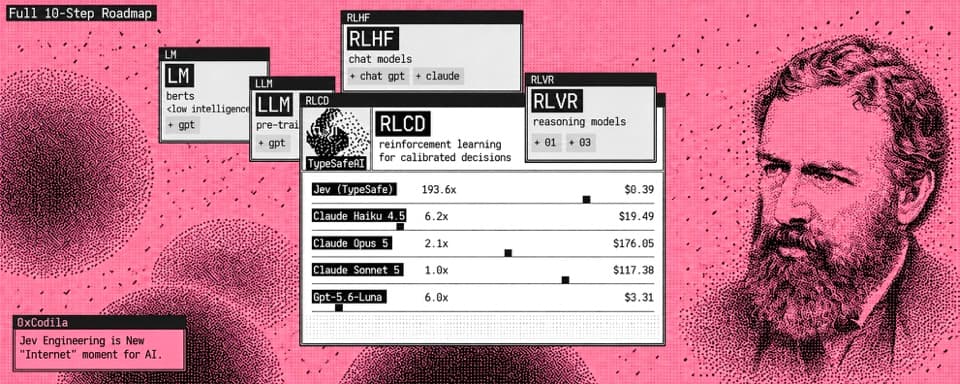
TypeSafe reports up to 193x faster and 444x cheaper performance in tests with Claude Fable 5.1 and GPT-6 Astra.
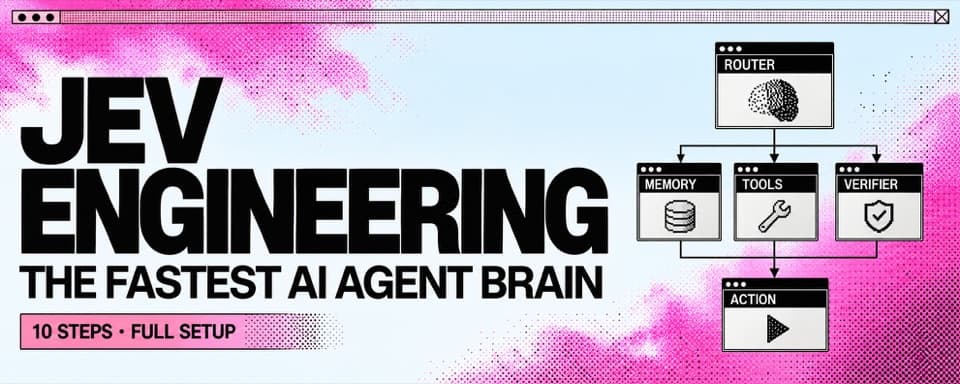
@0xCodila just wrote a great 10-page article explaining what Jev is, how to use it, and where its 100x advantage comes from.
Here are the 10 steps:
1 → LLMs create. Agents act. Jev decides the next move.
2 → Turn agent forks into three primitives: Choice, Score and probability.
3 → Build with OpenAI, Anthropic or xAI first, then swap Jev in without rebuilding the graph.
4 → Start with shared state, parallel decisions, risk thresholds and an execution queue.
5 → Batch decisions instead of making them sequentially. In one test, 13 questions were 10x faster and 12.2x cheaper.
6 → Put Jev at bounded forks: agent, model, tool, browser action or human escalation.
7 → Benchmark the whole loop, not just individual model calls.
8 → Rank wide, read narrow: shortlist first, then spend compute on what matters.
9 → Reuse the same system: State → Questions → Action → Verify.
10 → Keep Jev out of math, writing and irreversible execution. Code computes, LLMs create, Jev decides.
The result:
A slow, expensive agent loop becomes a much faster decision system that can route, score and escalate in milliseconds.
Full breakdown below ↓
Charly Wargnier’s thread condenses codila’s article: batch decisions, put Jev at bounded forks, and keep it out of math, writing and irreversible actions.
Codez
@0xCodez
Jev Founder, Diogo Almeida (ex-OpenAI):
"The next era is not the Claude Code or Codex era, they are still part of the assistance era with human in the loop - JEV is what comes next for LLMs
x200 faster, x400 cheaper, 0 hallucination, no human in the loop - that's JEV, this is how LLMs will look like"
in 36-minute tech talk, Jev Founder explained why RLHF isn't a thing anymore and how modern LLMs will be built
this talk is worth more than a Stanford Machine Learning degree
watch today no matter what, then learn how to become a Jev Engineer in the article below
A 36-minute talk by TypeSafe’s founder, shared by Codez: why he thinks agents with no human in the loop come next, and how models like Jev are trained.
darkzodchi
@zodchiii
Jev Founder (ex-OpenAI):
"I believe JEV is the biggest breakthrough we've ever worked on
This sounds too good to be true but it's beating everything"
In 5 minutes, he breaks down why older LLMs were great at talking and terrible at deciding and building.
Watch it and then read the guide below on how to use it at it's fullest 👇🏼
A short clip shared by darkzodchi: TypeSafe’s founder on why older LLMs were good at talking and bad at deciding.
Scott Williams
@swill1ams
Prediction: millionaires will be made using custom Jev style models (parallel constrained decoding) to make the agent systems companies already run more token efficient.
Let me explain with a scenario:
Imagine a company already has an agent workflow running where an llm reviews every item before it moves on: a support ticket gets triaged, an invoice gets approved or held, a claim gets flagged.
Every one of those goes through a frontier model today, a few seconds and a few cents each, on the way to a decision that in most cases is obvious. Behind that flow sits years of humans (or agents) making the exact same call, with the outcome attached.
Now imagine you first run each item through a custom PCD or similar model that costs a fraction of the llm and returns a classification of what to do at that step, with a mathematically accurate probability attached.
When it's confident, the item skips the llm entirely.
When it isn't, the llm handles it as normal.
The model has seen years of your team making this exact decision, usually a constrained set of decisions, so it should be right most of the time. Say it comes back confident on 6 out of 10 items. That's more than half your llm spend potentially gone from that step, likely with comparable accuracy.
This pre processing idea works in a bunch of other use cases too, such as:
- model/request routing: cheap model, frontier model, or a human
- picking which skill or subagent to load for a turn instead of stuffing the whole catalog into context
- reranking retrieved context so only the relevant chunks reach the window
- guardrails on every agent turn: contradictions, policy issues, prompt injection
- extracting typed fields from unstructured data emails, PDFs and transcripts before anything expensive touches them
Every one of those is a decision an llm makes today, that could potentially be done by another, cheaper model class. Very excited to see Jev/PCD-based pre processing use cases get deployed to agents at scale.
Scott Williams on using parallel constrained decoding to make existing agent systems use fewer tokens.
Alex Volkov
@altryne
This is actually insane. This uses @typesafeai Jev model, as a plugin in Claude to review all the un-nesseasary tool calls, and it takes 1s to run!
Like, literally, 1 second to take my Claude session from nearly 1M to ... 86K tokens! 😮
Ask your claude to install it and be amazed
Use this prompt
```
Install, and configure :
https://github.com/tamaratran/fast-jev-compaction
```
梭哈.AI’s write-up of Tamara Tran’s compaction plugin for Claude Code.
Erick
@ErickSky
Este tipo de herramientas empieza a hacer que el contexto de los agentes parezca menos una ventana limitada y más una memoria que se administra dinámicamente.
[fast-jev-compaction]
No resume, hace que Jev analice cada tool call y su resultado para decidir qué sigue siendo necesario.
- Lo que importa se queda verbatim.
- Lo que ya no aporta, se elimina.
- Y los resultados que todavía pueden ser útiles permanecen intactos.
Además:
• Funciona como plugin de Claude Code
• También puedes usarlo como librería npm
• Las decisiones se toman sobre el contexto completo
• Puede truncar resultados o eliminarlos junto con su llamada
• Mantiene intactos los mensajes de usuario y assistant
• Tiene fallback al compaction tradicional de Claude Code
En otras palabras:
En vez de resumir tu memoria, intenta podarla.
REPOOO👇
Erick on fast-jev-compaction: instead of summarising the context, Jev prunes it, keeping what matters word for word.
Theo - t3.gg
@theo
This is a terrible compaction strategy that fundamentally doesn't understand how compaction and context management work.
Seems like a lot of people are confused so let's break this down.
1. Compaction isn't a filter
The role of compaction is to clean up history to keep the agent focused, not just deleting noise. It should be used sparingly when context gets too long, not constantly to keep context small.
2. Jev doesn't even know what it's deciding on!
Models use the context of the thread to decide what to keep or not keep in a summary. This implementation goes through on a "line-by-line" (per tool call) basis to decide what should be left or deleted.
Not only does this 32k token context model know very little of what happened before, but (in this implementation) it doesn't even know what the result of the tool call is!
Deleting these things randomly will keep the model from knowing what it's tried and dooms you to end up in "stupid loops" where the model keeps trying the same thing over and over.
3. You're giving up the reasoning entirely
Frontier models from OpenAI, Anthropic, XAI, and Google do not share reasoning traces over the API. They share encrypted payloads, which Jev cannot see (and often will drop).
Anthropic is even stricter with this, requiring you to preserve the entire history in order to get any of the reasoning data. As a result, using this in Claude Code guarantees the model will act way dumber.
4. Models are tuned on their compaction flows
For the last year, Frontier Labs have been including compaction and long runs as part of the training process. These models have learned ways to compact that are more effective than any rudimentary solution.
Fun fact: If you switch models in Codex and compaction is necessary, compaction will run on the model that was previously used in the thread.
5. Cache writes are more expensive than cache reads.
Cache writes are the biggest cost by far for agents. I often see cache write costs go over 60% of my total LLM spend in my personal use of Claude Code and Codex.
Cache writes are insanely expensive when data earlier in the history is changed (because the old cache is invalidated when things change at the top). Every history edit requires a cache rewrite for ANY data past the history edit.
If your history is "1,2,3,4,5,6" and you delete "2", you have to rewrite "3,4,5,6". This is more expensive than leaving "2" in the history.
Good news. Since we're already killing all of the reasoning tokens by doing this stupid compaction strategy, the rewrite cost won't actually be that high because the model is missing so much data! 🙃🙃
6. The implementation is hot garbage.
> "Whatever is not kept is deleted permanently, but the assistant can always re-run a tool or re-read a file."
Good luck with that one.
To be clear: this is a cool experiment and I find it genuinely interesting. That said, if you think this style of bs filtering on a probability threshold is actually a compaction strategy, I highly recommend you just use the defaults in tools like Claude Code and Codex.
You're much less likely to hurt yourself that way.
Sam Witteveen on System 1 thinking, then demos of Choice, Score and Noul, a practical example, and chained actions.
Tonino Catapano (tonnoz)
@tonnoz
You still don't understand the use cases Jev unlocks.
I've been waiting for something like this since early ChatGPT models.
prediction: we will see the fastest-growing SaaS by MRR in history within the next month or two
Tonino Catapano’s demo, and his prediction: the fastest-growing SaaS by MRR within a month or two.
Ian Nuttall
@iannuttall
Unsure how to get started with Jev?
Install the skill:
npx skills add typesafe-ai/skills --skill typesafe-ai
Then prompt in your project:
use /typesafe-ai to see how Jev can be used to replace slow, expensive LLM usage and find possible new features it would enable for users.
Ian Nuttall: add the official skill, then run /typesafe-ai in your project to find where Jev can replace slow, expensive LLM calls.
OpenRouter
@OpenRouter
Jev by @typesafeai is now on OpenRouter, in beta.
Jev is a System One model. Instead of generating text, it takes your app's state plus a typed question and returns a typed decision with a probability attached. There is no JSON prompting, parsing layer, and nothing to validate against.
Jev is live on OpenRouter in beta: app state and a typed question in, a typed decision with a probability out.
rari🈀
@0xwhrrari
Jev + Laya + any AI agent is an absolutely insane stack
Jev became one of the most talked-about AI releases almost overnight, but most people still have no idea how to use it beyond isolated demos - especially together with Laya, Grok Bot, Claude Code and Codex
So I mapped the complete architecture into a 12-page guide explaining how to combine all of them into one decision-and-execution system - and the result is genuinely ridiculous:
step 1 → stop asking one LLM to do five different jobs: state, judgment, generation, execution and authority should be separate layers
step 2 → use Jev as the escalation layer: it handles difficult routing, evidence verification, completion checks and high-consequence decisions through typed answers
step 3 → use Laya as the local fast path: it handles frequent classification, scoring, filtering and worker selection without sending every decision to a cloud model
step 4 → put both behind one decision gateway: Laya and Jev can accept similar choice, score and yes-or-no questions, but their confidence values need separate thresholds
step 5 → keep project state outside the agents: goals, artifacts, evidence, gaps, risks, budgets and approvals become the shared source of truth
step 6 → build the worker menu before asking a model to choose: only include agents that exist, are available, have the required tools and are allowed to access the data
step 7 → give every executor a different job: Grok Bot handles apps, browsers and routines; Claude Code handles deep repository work; Codex handles implementation, testing and review
step 8 → turn every assignment into a bounded packet: one owner, one objective, approved inputs, expected artifacts, forbidden actions and an exact definition of done
step 9 → run the hybrid decision loop: Laya answers locally first, Jev receives uncertain or high-risk cases, and a human reviews consequential disagreements
step 10 → never average confidence blindly: if Laya and Jev disagree, preserve both distributions, inspect the evidence and route the case through an explicit review policy
step 11 → gate effects instead of tool names: reading, searching, testing and drafting can run automatically; publishing, deploying, spending, deleting and exposing secrets still require approval
step 12 → test the whole system before giving it autonomy: run shadow mode, measure disagreements, inject failures, test rollback and automate only the safest branches first
the result: Laya filters routine decisions, Jev judges difficult boundaries, Grok Bot, Claude Code and Codex execute the work, deterministic code controls the system and you approve the consequences
Save this, then send the complete 12-page Jev + Laya + AI Agents guide to your Claude Code or Codex instance and build the stack ↓
rari’s guide to one decision-and-execution stack: Laya answers routine decisions locally, Jev takes the uncertain and high-risk ones, and Claude Code, Codex and Grok Bot do the work behind approval gates.
Cloudflare Developers
@CloudflareDev
Jev from @typesafeai is now live on @CloudflareDev AI Gateway. Try the first System One model — send state and typed questions; get structured answers your code can use directly. developers.cloudflare.com/ai/models/type…
LiteLLM’s pass-through docs for calling TypeSafe from an existing LiteLLM proxy.
Jev docs and cookbooks
What to read before you build: TypeSafe’s own quickstart, docs and cookbooks, the LangChain harness guide, the awesome-jev lists other builders keep, and the launch coverage.