Guide · x.com
Jev + Laya + AI agents, in 12 steps
rari’s guide to one decision-and-execution stack: Laya answers routine decisions locally, Jev takes the uncertain and high-risk ones, and Claude Code, Codex and Grok Bot do the work behind approval gates.

rari
@0xwhrrari
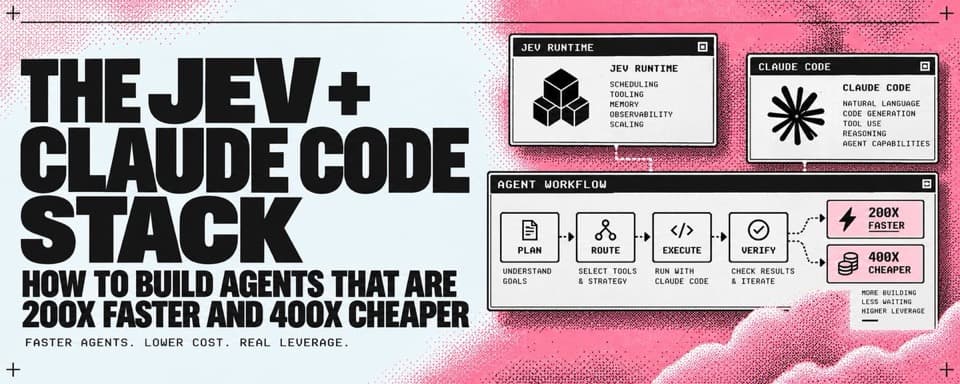
Jev + Laya + any AI agent is an absolutely insane stack Jev became one of the most talked-about AI releases almost overnight, but most people still have no idea how to use it beyond isolated demos - especially together with Laya, Grok Bot, Claude Code and Codex So I mapped the complete architecture into a 12-page guide explaining how to combine all of them into one decision-and-execution system - and the result is genuinely ridiculous: step 1 → stop asking one LLM to do five different jobs: state, judgment, generation, execution and authority should be separate layers step 2 → use Jev as the escalation layer: it handles difficult routing, evidence verification, completion checks and high-consequence decisions through typed answers step 3 → use Laya as the local fast path: it handles frequent classification, scoring, filtering and worker selection without sending every decision to a cloud model step 4 → put both behind one decision gateway: Laya and Jev can accept similar choice, score and yes-or-no questions, but their confidence values need separate thresholds step 5 → keep project state outside the agents: goals, artifacts, evidence, gaps, risks, budgets and approvals become the shared source of truth step 6 → build the worker menu before asking a model to choose: only include agents that exist, are available, have the required tools and are allowed to access the data step 7 → give every executor a different job: Grok Bot handles apps, browsers and routines; Claude Code handles deep repository work; Codex handles implementation, testing and review step 8 → turn every assignment into a bounded packet: one owner, one objective, approved inputs, expected artifacts, forbidden actions and an exact definition of done step 9 → run the hybrid decision loop: Laya answers locally first, Jev receives uncertain or high-risk cases, and a human reviews consequential disagreements step 10 → never average confidence blindly: if Laya and Jev disagree, preserve both distributions, inspect the evidence and route the case through an explicit review policy step 11 → gate effects instead of tool names: reading, searching, testing and drafting can run automatically; publishing, deploying, spending, deleting and exposing secrets still require approval step 12 → test the whole system before giving it autonomy: run shadow mode, measure disagreements, inject failures, test rollback and automate only the safest branches first the result: Laya filters routine decisions, Jev judges difficult boundaries, Grok Bot, Claude Code and Codex execute the work, deterministic code controls the system and you approve the consequences Save this, then send the complete 12-page Jev + Laya + AI Agents guide to your Claude Code or Codex instance and build the stack ↓

Sep 26, 2026 · 196 likesOpen on X