
Movez
@0xMovez
Guidex.com
Building the fastest agent brain in 10 steps
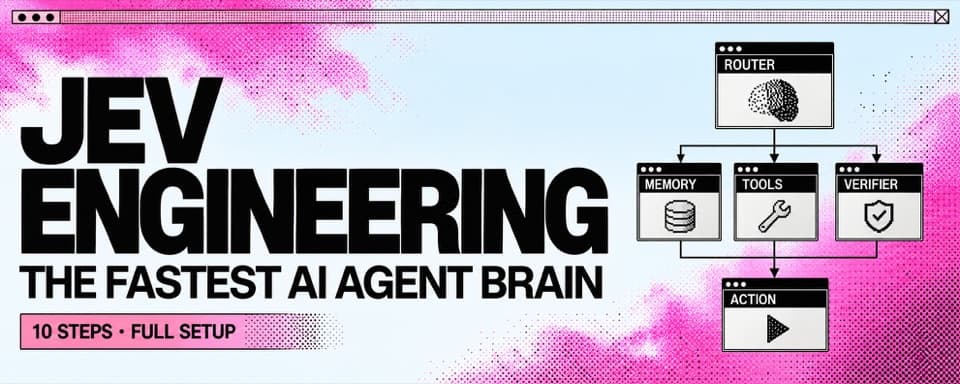
Movez’s X article on Jev Engineering: move every yes-or-no, routing and scoring call out of the LLM, then add a model router and a gate for risky tool calls.
Updated Nov 10, 2026
855 projects, posts and guides about Jev, the System One model from TypeSafe AI. Each entry links to its source and shows the cost and speed its author reported.

Diogo Almeida
@CompleteSkeptic
After co-inventing ChatGPT, I kept asking myself: why have superhuman chat models not led to AGI? I’ve spent the last 2 years in stealth building a new way to train models (RLCD), and a new type of frontier AI model that we are releasing today: Jev • 20-200x faster • 40-400x cheaper (w/ output tokens free) • Frontier composable intelligence optimized for decisions AFAICT the shortest path to AI-based economic revolution

Newest first, 332–364 of 1072. All 1072 in curated order
Movez
@0xMovez
Guidex.com
Movez’s X article on Jev Engineering: move every yes-or-no, routing and scoring call out of the LLM, then add a model router and a gate for risky tool calls.

Kiyoro
@0xKiyoro
OPUS 5.5 IS MAKING YOUR AGENT DUMBER RIGHT NOW AND IT WILL NEVER TELL YOU. JEV CAUGHT IT. The default effort on Opus 5.5 dropped from high to medium. If your agent never set effort explicitly, it is now reasoning at a lower setting than the one you tested it on. No error, no warning, every health check still green. Jev sets effort on every single message, so the requests that went through it never changed. The ones that relied on the default did. That gap is how it showed up. The rest of the migration is loud. Each of these returns a 400 on the first call: > thinking: disabled, now rejected. Drop the field and set effort > tool_choice any and tool, removed. Use auto + strict > computer_20251124, retired. Use computer_toolset_20260801 > editing above a thinking block, rejected. Append only, or drop_block You will find all four in five minutes. The effort change you will not find at all. The cache has its own quiet trap. Hop Opus 5.5 to Sonnet 5 and back and a session that cost 3.32 costs 4.36, +31%, because Sonnet cannot read Opus's reasoning. Change effort at the top of a request or switch fast to standard mid-session and the cache is gone again. Jev picks speed once on turn one and sets effort per message, so it survives. The upgrade is still worth it. $4 / $20 per 1M instead of $5 / $25, cache reads at $0.20 instead of $0.50, and 66.4% on Terminal-Bench 4.0 against 57.9% for GPT-6 Astra. Write effort into every request before you touch the model ID. The default stopped meaning what you think.

XBenchmarks and evals

Aron | TomorrowLab
@AronTomorrowLab
Jev is actually insane 605,461,046 tokens later: only 47% of the leads in our live campaigns actually fit the client's ICP we used to check ICP fit by sending agents to read every website (Claude Code or Clay). 409 companies took 38 minutes. fine for one campaign, but ofc not scalable for a whole database. now we write the client's ICP once (client.md), and Jev runs every company against it. 100k companies in a few minutes less volume, but better leads (and only relevant replies)


Arthur Marques
@ArthurLabMRP
Benchmarks suck. So I made Jev and Laya play chess instead ♟️ Insomnia project. Repo in the thread

XGames and real time

Ricker
@0xRicker
Jev could become the control layer AI agents have been missing. Instead of spending 5–20 seconds and expensive LLM calls deciding every next step, it can route actions in milliseconds at near-zero cost. In this article, I break down how

Guidex.com
Ricker’s X article: a 10-step guide to moving an agent’s yes-or-no, routing and relevance calls from an expensive LLM to Jev.

B.AI
@BAI_AGI
📢 TypeSafe AI · Jev Is Now Live on http://B.AI API As the first System One model from @typesafeai, Jev is built for fast, structured decisions inside software. It does not generate text: send app state plus a typed question, and get a typed decision with probability and confidence—no JSON prompting, no output parsing. It evaluates Choice, Score, and Noul questions in parallel, responds in about 70–500ms, and costs $0.042 per million input tokens (output free), making it a fit for ticket routing, moderation, risk scoring, and agent branching. Now available on the http://B.AI API (access via Jev-1.13.0 or Jev-Latest)! 👉 Try now: https://chat.b.ai/chat 🔗 Learn more: https://docs.b.ai/llmservice/models/jev-1.13.0/

XSDKs and integrations

MalluCuler
@Farhan60291312
Benchmarked Laya locally on an ancient laptop: 💻 i5-5200U (2 cores) | 12GB RAM | 5400 RPM HDD Kept it resident in RAM and got sub-second (~630ms) typed decisions on pure CPU! 🔥 Great open-weight release by @Nandakishorm1. No GPU or cloud LLM needed for fast routing. #laya #jev


Hugging Models
@HuggingModels
Meet Open JEV DeBERTa V3 Large: a text classification model that doesn't just label, it makes typed decisions. Calibrated, open, and built for real-world trust. Here's why this model is turning heads.

XOpen source

Charly Wargnier ♨️
@DataChaz
Jev might genuinely be an “Internet moment” for AI. TypeSafe reports up to 193x faster and 444x cheaper performance in tests with Claude Fable 5.1 and GPT-6 Astra. @0xCodila just wrote a great 10-page article explaining what Jev is, how to use it, and where its 100x advantage comes from. Here are the 10 steps: 1 → LLMs create. Agents act. Jev decides the next move. 2 → Turn agent forks into three primitives: Choice, Score and probability. 3 → Build with OpenAI, Anthropic or xAI first, then swap Jev in without rebuilding the graph. 4 → Start with shared state, parallel decisions, risk thresholds and an execution queue. 5 → Batch decisions instead of making them sequentially. In one test, 13 questions were 10x faster and 12.2x cheaper. 6 → Put Jev at bounded forks: agent, model, tool, browser action or human escalation. 7 → Benchmark the whole loop, not just individual model calls. 8 → Rank wide, read narrow: shortlist first, then spend compute on what matters. 9 → Reuse the same system: State → Questions → Action → Verify. 10 → Keep Jev out of math, writing and irreversible execution. Code computes, LLMs create, Jev decides. The result: A slow, expensive agent loop becomes a much faster decision system that can route, score and escalate in milliseconds. Full breakdown below ↓

Guidex.com
Charly Wargnier’s thread condenses codila’s article: batch decisions, put Jev at bounded forks, and keep it out of math, writing and irreversible actions.

Loutchone
@LiorNsnd
bon un peu de serieux, jev peut etre vraiment utile... pour préparer un workflow de qualification de leads après un audit client, je veux un premier tri de ce que l’agent propose avant de mettre les étapes dans Obsidian. j’ai donné à Jev le contexte de qualification avec les étapes candidates. À lui de choisir pour chacune : retenir, clarifier ou écarter. sur cet appel API, il retient la qualification par téléphone et le rappel des prospects injoignables. Par contre le rappel à J+2 ressort « à clarifier » : le contexte fourni ne fixe aucun délai. L’enrichissement LinkedIn est écarté, il était hors périmètre. la première image, c’est sa réponse réelle avec les probabilités. La deuxième, le workflow qu’on en a tiré, avec le délai toujours à confirmer. dans mon process, je garde la main sur cette présélection : je vérifie et je valide avant de l’intégrer à l’audit. Voilà où je vois l’intérêt de Jev dans mon taf.

XSales and leads

MajdAICode
@MajdAICode
Following up on my earlier comment: I mapped out the coding-agent workflow I’m exploring in a short video—Cursor, a separate worktree for each feature, and Jev for narrow decisions 👇 x.com/MajdAICode/sta…
XCoding and code review
MajdAICode
@MajdAICode
One coding-agent pattern I’m exploring: /ticket-triage asks Jev where to look; Cursor checks the repo; Jev flags possible test gaps after the diff. PHPUnit/Playwright verify behavior, and I review before commit. Video: x.com/MajdAICode/sta…
XCoding and code review

Codez
@0xCodez
Jev Founder, Diogo Almeida (ex-OpenAI): "The next era is not the Claude Code or Codex era, they are still part of the assistance era with human in the loop - JEV is what comes next for LLMs x200 faster, x400 cheaper, 0 hallucination, no human in the loop - that's JEV, this is how LLMs will look like" in 36-minute tech talk, Jev Founder explained why RLHF isn't a thing anymore and how modern LLMs will be built this talk is worth more than a Stanford Machine Learning degree watch today no matter what, then learn how to become a Jev Engineer in the article below

Guidex.com
A 36-minute talk by TypeSafe’s founder, shared by Codez: why he thinks agents with no human in the loop come next, and how models like Jev are trained.

mindshub
@MindsHub
Jev, TypeSafe’s decision model, joins MindsHub's free tier. API docs: docs.mindshub.ai/inference/deci…

XSDKs and integrations

Ram Vinjamuri
@RamV2003
(1/5) trying out jev this week with all the hype. kept it apples to apples vs the fast models it competes with: llama 3.1 8b and deepseek v4 flash same labelled inputs. jev: 235ms median, 82% accurate. llama: 497ms, 68%. deepseek flash was accurate but ~2s genuinely cool. then some odd emergent behaviour: no position or label invariance


Artificial Intelligence Papers
@SciFi
Jev-Mem: System-One-Controlled Agentic Memory for Efficient AI Agents Dongming Jiang, Yi Li, Bingzhe Li arxiv.org/abs/2609.23986 [𝚌𝚜.𝙰𝙸 𝚌𝚜.𝙻𝙶]

XContext and memory

darkzodchi
@zodchiii
Jev Founder (ex-OpenAI): "I believe JEV is the biggest breakthrough we've ever worked on This sounds too good to be true but it's beating everything" In 5 minutes, he breaks down why older LLMs were great at talking and terrible at deciding and building. Watch it and then read the guide below on how to use it at it's fullest 👇🏼

Guidex.com
A short clip shared by darkzodchi: TypeSafe’s founder on why older LLMs were good at talking and bad at deciding.

TypeLLM
@TypeLLM
Jev @typesafeai, but with thinking? TypeLLM can think before producing a type-safe output. It dramatically boosts accuracy without any fine-tuning—surpassing Jev and GPT-5.6 Luna, and coming close to GPT-6 Astra! Open-source: github.com/TypeLLM/TypeLLM

XOpen source

Ishwar
@WesternCube
Instant Claude Code compaction is my favorite use of Jev so far For people going to complain about me letting my context get so long, this was a server redeploy task because Oracle terminated my free VPS with no explanation so it had a lot of moving pieces

XContext and memory

Zorawar Purohit
@ZorawarPurohit
Do check out this public repo (github.com/M37Labs/laya-m…) by @m37labs for those interested in understanding Laya-MLX, a new kind of encoder-only architecture and its application. Emerging systems like Jev, Laya can serve as a `System 1` brain in different implementations.

XOpen source

Scott Williams
@swill1ams
Prediction: millionaires will be made using custom Jev style models (parallel constrained decoding) to make the agent systems companies already run more token efficient. Let me explain with a scenario: Imagine a company already has an agent workflow running where an llm reviews every item before it moves on: a support ticket gets triaged, an invoice gets approved or held, a claim gets flagged. Every one of those goes through a frontier model today, a few seconds and a few cents each, on the way to a decision that in most cases is obvious. Behind that flow sits years of humans (or agents) making the exact same call, with the outcome attached. Now imagine you first run each item through a custom PCD or similar model that costs a fraction of the llm and returns a classification of what to do at that step, with a mathematically accurate probability attached. When it's confident, the item skips the llm entirely. When it isn't, the llm handles it as normal. The model has seen years of your team making this exact decision, usually a constrained set of decisions, so it should be right most of the time. Say it comes back confident on 6 out of 10 items. That's more than half your llm spend potentially gone from that step, likely with comparable accuracy. This pre processing idea works in a bunch of other use cases too, such as: - model/request routing: cheap model, frontier model, or a human - picking which skill or subagent to load for a turn instead of stuffing the whole catalog into context - reranking retrieved context so only the relevant chunks reach the window - guardrails on every agent turn: contradictions, policy issues, prompt injection - extracting typed fields from unstructured data emails, PDFs and transcripts before anything expensive touches them Every one of those is a decision an llm makes today, that could potentially be done by another, cheaper model class. Very excited to see Jev/PCD-based pre processing use cases get deployed to agents at scale.
Guidex.com
Scott Williams on using parallel constrained decoding to make existing agent systems use fewer tokens.

Adam Chester 🏴☠️
@_xpn_
Turns out Jev is also good (and sooo quick) at picking out "sensitive files" from a file share 👀

XSecurity and abuse

Adithya Thatipalli
@adithatipalli
After seeing so much Hype around Jev, I started using it inside my Hermes as a decision and routing mechanism for a AI video pipeline I was working on But now, I am Changing that thought. Laya is a 421M local decision model by @Nandakishorm1 . Same job as Jev -> choice, score, yes/no with a probability, But it runs on my machine. No API hop. No per-token meter. ~33ms. Weights stay here. For an AI film pipeline, that is the actual bottleneck. >Not “write a better prompt.” >The expensive part is sending the wrong shot to the wrong generator. Before Seedance / Kling / Minimax / Veo / Flux / GPT Image burns a credit, Laya now answers four things in one pass: → which model gets this shot → text-only, character-ref, or first-frame → is the brief ready, or does the enhancer skill run first → how hard is identity lock Sol still writes. Kimi still helps. Video models still generate. Laya only decides. Jev was a good hosted nervous system. For shot routing I don’t need a hosted brain. I need a local one that sits in front of the generate button and says go / wait / switch model. 421M. Local first. That is the router now.

XOpen source

► Alex Rivas | Joseador y Desarrollador ☻
@alex_rivas_v
🥊Laya vs Jev He diseñado un experimento para probar que modelo es mejor, si Jev o Laya, y lo hice poniendolos a jugar ajedrez. La verdad es que ambos son bastante tontos para esto, y no va de mejorar prompts, aunque seguiré probando algunas formas de mejorar las partidas.

XGames and real time

Alex Volkov
@altryne
This is actually insane. This uses @typesafeai Jev model, as a plugin in Claude to review all the un-nesseasary tool calls, and it takes 1s to run! Like, literally, 1 second to take my Claude session from nearly 1M to ... 86K tokens! 😮 Ask your claude to install it and be amazed Use this prompt ``` Install, and configure : https://github.com/tamaratran/fast-jev-compaction ```

Guidex.com
Alex Volkov: a Claude session went from nearly 1M tokens to 86K in about one second.

Carlos
@alg0agent
Endless possibilities. Dynamic UI generated on the fly by detecting your input intent. Powered by Jev. Check out the demo & repo in the thread
XUI
Pick
BurstingBagel 🥯
@burstingbagel
Built a jev filter to catch mercenary farmers before TGE. 40k wallets screened in 4 seconds. Community size after: 2. Pre-TGE teams DMs open

XRouting and model choice

梭哈.AI
@SUOHA_AI
连 JEV 的联合创始人 @CompleteSkeptic 都亲自下场转发点赞:这是 JEV 正确的打开方式! 大家在 Claude Code 里写长代码,最恶心的就是上下文一满,系统就卡住 10 秒去写总结小作文 开发者 @tamarajtran 刚刚开源了这个插件:利用 JEV 的打分能力,几十毫秒内精准识别并清空所有没用的终端垃圾与冗余日志 Github:https://github.com/tamaratran/fast-jev-compaction 它的作用是: • 彻底治好 Agent 失忆症:几千行终端废话和文件内容让 JEV 毫秒级打分,没用的直接扔,核心代码与状态 100% 原样保留 • 彻底消灭卡顿与账单:几十毫秒无感完成瘦身,不花一分钱废话 Token @typesafeai 的联合创始人 Diogo Almeida 也公开实名认可:这就是编码 Agent 绕过传统 KV 缓存的最佳解法🧐

Guidex.com
梭哈.AI’s write-up of Tamara Tran’s compaction plugin for Claude Code.

CyrilXBT
@cyrilXBT
With a single prompt, the Jev + Claude Code stack can make AI agents 200× faster and 400× cheaper. The secret: agents that run wide not long. I broke down the complete system in 3 visuals. Save this. You’ll want it later. Follow @cyrilxbt for more AI updates.

XAgents and browsers

erKam 🅰️
@erkamyaman_ng
in 2026, why is CLAUDE.md still a suggestion? one @typesafeai Jev request checks every Claude Code reply and edit against every rule you wrote. break a rule, Claude gets it quoted back and rewrites. 348ms per check. 93.3% of broken rules caught on our benchmark.


Chris Goldammer
@floor_per_area
Technical idea, just brainstorming: Make chat responses 10x faster using Jev and pre-structured SQL. Any idea if this could work?

XSDKs and integrations

Erick
@ErickSky
Este tipo de herramientas empieza a hacer que el contexto de los agentes parezca menos una ventana limitada y más una memoria que se administra dinámicamente. [fast-jev-compaction] No resume, hace que Jev analice cada tool call y su resultado para decidir qué sigue siendo necesario. - Lo que importa se queda verbatim. - Lo que ya no aporta, se elimina. - Y los resultados que todavía pueden ser útiles permanecen intactos. Además: • Funciona como plugin de Claude Code • También puedes usarlo como librería npm • Las decisiones se toman sobre el contexto completo • Puede truncar resultados o eliminarlos junto con su llamada • Mantiene intactos los mensajes de usuario y assistant • Tiene fallback al compaction tradicional de Claude Code En otras palabras: En vez de resumir tu memoria, intenta podarla. REPOOO👇

Guidex.com
Erick on fast-jev-compaction: instead of summarising the context, Jev prunes it, keeping what matters word for word.
Same directory, different order: the entries added most recently, rather than the curated order the home page opens in. The date on a card is the day it was added here, not the day its author published it — this directory is newer than most of the work in it.