Projects, posts and guides about Jev, the System One model from TypeSafe AI. Each entry links to its source and shows the cost and speed its author reported.
After co-inventing ChatGPT, I kept asking myself: why have superhuman chat models not led to AGI?
I’ve spent the last 2 years in stealth building a new way to train models (RLCD), and a new type of frontier AI model that we are releasing today: Jev
• 20-200x faster
• 40-400x cheaper (w/ output tokens free)
• Frontier composable intelligence optimized for decisions
AFAICT the shortest path to AI-based economic revolution
Jev vs Laya-MLX isn't really a rivalry.
Jev is the original, commercial model.
Laya-MLX is a local, open-source take on the same idea, running natively on your Mac.
Same core concept: "System One" models. No chatting, no text generation. Just fast, typed decisions.
#Jev #Laya
Jev is all over my timeline rn 👀
Went looking into it and stumbled across Laya.
Open-source System 1 decision model.
They even have a Jev comparison 👀
7.8× faster.
3× better calibrated.
45/51 languages.
Self-hosted.
And the weights are right there. 😂
Yeah… I am watching this space.
https://huggingface.co/convaiinnovations/laya
Launching JevRelevanceRetriever
just $0.73 across 6,460 calls
Open src Jev LangChain BaseRetriever for rel scoring
Install and use it, no chain changes ;)
pip install jev-relevance
Repo-https://github.com/saksham-malhotra-27/jev-relevance
Open for issues and PRs, feel free to contribute
We built a Stanford Town powered by Jev.
It isn’t a game demo, there is no player.
The residents decide where to go, who to meet, and when to talk. Humans can only watch their pixel world unfold.
Demo + code:
github.com/NevaMind-AI/je…
#Jev #AIAgents
After seeing Jev everywhere on the feed lately, we had to try this direction ourselves.
We’re bringing Laya to Insight O Mate.
A fast, open-source, local decision model that fits perfectly with our privacy-first approach to querying NoSQL databases.
Your data stays local.
Your decisions stay local.
Insight O Mate + Laya is coming.
Try Insight O Mate at https://insightomate.lunamic.co
"לקוח יקר, זוהתה פעילות חריגה בחשבון הבנק שלך. החשבון יוקפא תוך 24 שעות. לאימות פרטים לחץ כאן."
רציתי לשחק עם Jev, המודל החדש של TypeSafe, וגם לבנות איתו משהו שיש בו תועלת אמיתית. אז בניתי ב-Skills IL כלי שבודק הודעות כאלה: מדביקים את ההודעה, מ-SMS, מוואטסאפ או ממייל, ומקבלים
And just when I thought I have a crazy idea with JEV that i will open source then this happened.
Please @typesafeai fix it ASAP, the curiosity inside me to build that thing is insanely high
scoreboar v8: 128 MB instead of 597, about 30 ms a post instead of a second. and more accurate.
guessing which of two X posts did better for its account size: 61.4%.
grok 4.7: 55.3%.
jev: 52.5%.
free, in your browser.
github.com/Siim/scoreboar…
Jev Engineers just released Jev, and the architecture is simple: state goes in, auditable decisions come out
I mapped the decision layer into a field blueprint: what Jev reads, what it returns, and how an agent uses those answers in a real loop:
step 1 → give each layer a job. The LLM plans and writes. Jev chooses between bounded options. Code carries out the action.
step 2 → build the state before asking for a decision. Include the goal, evidence, available actions, previous actions, and what the environment looks like now.
step 3 → define the questions in code. Choice selects an option. Score rates it. Noul estimates whether a condition is true. The answers are typed, so the runtime can use them directly.
step 4 → ask independent questions together. One state snapshot can support routing, risk, and relevance decisions in the same pass.
step 5 → use the answers to route work. A lookup, a complex reasoning task, and a tool call don’t need the same model or execution path.
step 6 → add a gate before the tool runs: allow, ask, or deny. A high-confidence answer still has to pass the action policy.
step 7 → execute the selected action and check the outcome. Record what the tool actually did, including failures.
step 8 → update the state with that result. Otherwise, the agent’s next decision is based on a world that no longer exists.
step 9 → apply the pattern where small decisions repeat: model routing, tool guardrails, inbox triage, research classification, browser actions, and context compaction.
step 10 → judge the whole task. Track whether the agent reached its goal alongside cost, latency, approvals, and failed actions.
the result: you can trace an action from the evidence Jev received to the decision it returned and the outcome your tools produced.
Save the Jev Decision Infrastructure blueprint for your next agent build ↓
i created a 404 page that fixes your typos for you, and redirects you to the correct page
built with @typesafeai jev
try it out: kobra.systems/cmr-table
Немного упоролся в Jev, но так у меня всегда бывает, когда на чем-то гиперфиксацию поймаю.
Вот, например, собрал подборщик нейросетей на базе тех, что есть у OpenRouter, под ваши задачи. Просто пишите, что хотите - получаете подборку нейросетей.
Is the Jev hype real,
so I made to test this on my movie recommendation engine, which is getting crazy results on Quen Re ranker , I used an open-source alternative of Jev , Laya.
But unfortunately Quen is way better, dekhlo!
@typesafeai
#jev #Jev
Jev Founder, Diogo Amogo, just released 12-page PDF on building a Jev Harness for coding agents
this is a 10-step blueprint on how to make your coding agents 200× faster and 400× cheaper:
step 1 → meet Jev: the LLM writes, the harness executes, Jev decides what each turn sees, where it routes and whether it runs
step 2 → ask the question that breaks every agent: how would you design one if LLMs had no KV cache?
step 3 → stop routing blind: Opus → Sonnet → Opus costs 6.19 vs 4.15 for pure Opus, because handing back reprocesses the whole context
step 4 → follow the tokens: reading and searching take 56.2% of tool turns and 46.5% of tokens. Writing code is under 10%
step 5 → score every chunk per query: hide, short summary, long summary or full. Compress after the question, not before
step 6 → disclose tools in tiers: one-line snippets for 100s of tools, schema on demand, docs for one-off queries. Batteries stop costing context
step 7 → load instructions by condition: touching *.tsx loads the style guide, billing/ loads its gotchas file, and compaction can't erase either
step 8 → route by trust, not just difficulty: secrets and infra stay on first-party frontier models, public docs go to the cheapest one
step 9 → share one retrieval pass: cross-model review, eval generation, ELI5 explainers and live progress pages all run read-only in the background
step 10 → gate every command: programmable allow / ask / deny policies that read a script before it runs, not just its name
Send this PDF and the article below to your Claude Code or Codex instance and start shipping 200× faster.
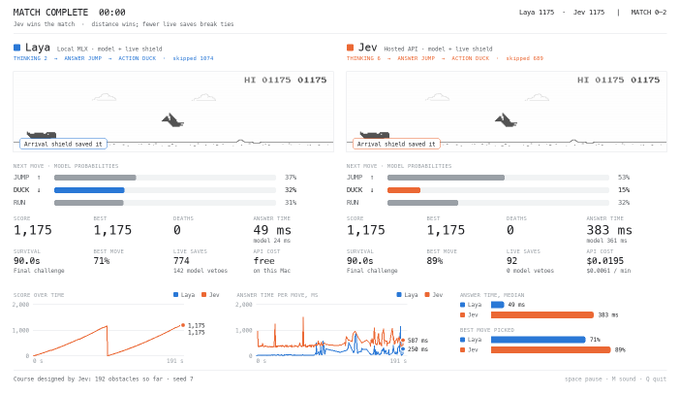
Laya just mogged Jev at Tetris.
The interesting part isn’t just that a local model won.
Laya is an open-weights System One model running locally on a 16GB MacBook Air.
Jev, meanwhile, is cloud-based and built with Grok 4.7.
JEV integration is not another demo.
It feeds live data to one ID with a hard risk cap.
The trace after execution is the moat — not the launch graphic.
Great minds! I've been building a stylized SF with Opus too, just without the pets. My cars follow rules on the real street network, lanes and traffic lights included. Jev driving pedestrians is tempting though. How many agents can it run at once?
you know how x feed is blasting you with promos, politics, rage baits, etc?
so i made a (tamper)monkey script that uses jev to classify and hide types of posts you don't want
I made a tool with Jev that reads my whole codebase to answer one question: what should I be looking at?
Every chunk of code in your project is scored for relevance.
The founder of Jev just dropped a 1-hour masterclass on how Jev actually works
LLMs → Decisions → Verification → Coding Agents
0% → 0:40 - why LLMs alone aren't enough
25% → 20:27 - the 3 primitives behind Jev
50% → 26:15 - turning huge AI tasks into tiny reliable decisions
75% → 45:04 - real systems: data, agents, verification
100% → 56:33 - the future of coding agents, memory and subagents
Most people are still learning prompts.
This explains the layer that decides what the model should do, checks whether it worked, and decides what happens next.
Basically: how you go from “AI chatbot” to software you can actually trust to run itself.
And it's explained by the guy building it.
Bookmark this.
Watch the full hour tonight.
Then read the guide below and steal the architecture for your own agents ↓
Opus 5.5 + Jev = Automatic scoring of 120 competitor ads, shortlisting the 10 worth adapting, and creating versions of each.
Both models came out in the recent days, so I tried them together on a marketing use case, playing to what each one is built for:
→ Claude Opus 5.5 built the pipeline: it found the competitors, ran the http://Pletor.ai workflow "Meta ads spyer", wrote the scoring script and built the interface.
→ Jev made the judgement calls on every ad
The use case: I picked Grüns, the greens gummy brand, as a test case.
I pulled 120 ads from 12 of its competitors on the Meta Ad Library, and had Jev score each one on 7 questions:
hook, clarity, message, concept fit, tone, angle, health claim risk.
Code then combined the scores and picked the 10 worth adapting, and created them, via Pletor MCP.
Working on a simple tool that uses JEV to help organise my bookmarks. The UI is awful and it’s nothing crazy, but it’s been nice to learn about JEV and how it works.
Jev but for images? I built a local model to try it out! 63ms for a 512x384 image and fast enough for 15fps video.
Birthday 94%. Golden retriever 78%. Sprinkles 93%. Candles lit 67%. Dog about to eat the cake? 52%.
What stands out to me in the Jev + Grok Bot setup is the division of work:
Jev decides. Grok Bot acts. Human stays in control for anything irreversible.
That’s a much cleaner agent architecture than asking one model to do everything.
Cheaper, faster, and easier to reason about.
@typesafeai @grok
Jev has been blowing up lately.
If you already have API access but don't know where to start, just copy this checklist:
1. jev-browser
Drives a real headless browser through MCP, CLI or a library. Jev picks one action per step from the page's clickable and typeable elements, and scores whether the goal is met or the run is stuck. https://github.com/jkudish/jev-browser
2. jev-browser-agent
Per-step browser decisions at about a second. One request asks "which operation" and "which target" together, and confidence under 0.6 escalates to a bigger model or to you. https://github.com/smartdio/jev-browser-agent
3. typesafe-jev-bridge
Zero-dependency OpenAI-compatible bridge. Use typed yes/no, choice and score judgments from Claude Code, Cursor, Cline or any OpenAI SDK, over CLI or HTTP. https://github.com/RevocGG/typesafe-jev-bridge
4. pilot-typesafeai-jev
Jev inside LangGraph and Deep Agents. One request asks three questions, plain code picks the route, and only the winning route spends chat model tokens. https://github.com/jyje/pilot-typesafeai-jev
5. building-with-jev-skill
An agent skill for writing programs that call Jev: question design, state structure, thresholds, and how to diagnose a question that answers wrong. https://github.com/dbreunig/building-with-jev-skill
6. jev-skill
Guided setup plus evaluation workflows, with a read-only presence check and no silent provider switches or fabricated probabilities. https://github.com/wuyoscar/jev-skill
7. awesome-jev
Source-backed catalogue of what people actually shipped, sorted by category, with limitations noted per entry. https://github.com/yibie/awesome-jev
8. awesome-typesafe-jev
Field guide with SDKs, live demos, agent tools and independent evaluations, including where the vendor numbers came from. https://github.com/AbdelStark/awesome-typesafe-jev
9. awesome-jev-by-typesafe
Evidence-backed use cases, patterns and starter code, with the 70 to 500 ms latency claim marked as vendor-reported. https://github.com/Anil-matcha/awesome-jev-by-typesafe
10. awesome-jev (cobanov)
The widest catalogue right now: SDKs in Go, Java and JS, MCP connectors, guardrail experiments and studies. https://github.com/cobanov/awesome-jev
Copy these complete Jev blueprints - then read the full Jev setup below ↓
Grok Bot does the job, Jev decides where the job goes next
That's the ai company split: a work model and a decision model
In this free 22-min tutorial they walk through jev, typesafe's "system one" model that makes decisions instead of chatting
You ask one question, Jev answers from a fixed menu: noul, choice, score
The demo: customer messages in, frustration score out. usable right in code
Not another chat model, it's the fork in the pipeline
Grok Bot keeps generating
Jev keeps deciding
Humans keep the approvals
The teams wiring in that third layer are quietly becoming one-person companies
Save this before your competitors put a decision layer between their bots
I launched a chatbot yesterday and used JEV as a 17-in-1 router, filter, classifier, intent judge for efficient tool calling.
Then further downstream is a relevance/context loop system.
Worked really well. No more unwanted spams and prompt injections.
اولین تجربهی خودم با JEV 👀
این تجربه برای ۳ روز پیشه؛ وقتی JEV هنوز توی حالت Waiting List بود.
من کلاً هر ابزاری که سختافزارم بتونه بکشه رو تست میکنم 😄
برای همین توکن JEV رو از OpenRouter گرفتم و به Grok Bot دادم.
ماجرا چی بود؟
از GITEX کلی ویدیو گرفته بودم و نمیدونستم کدومها رو اول منتشر کنم. از اون طرف هم برای هرکدوم کلی کاور طراحی کرده بودم و واقعاً حوصله انتخاب و مرتبکردنشون رو نداشتم 😂
به JEV گفتم:
«خودت انتخاب کن، دستهبندی کن و فولدربندیشون کن.»
در کمتر از چند دقیقه همهچیز رو مرتب کرد و حتی پیشنهاد داد کدوم ویدیوها رو اول منتشر کنم.
Grok Bot هم بقیهی توضیحات و تحلیلها رو انجام داد.
برای اولین تجربه، واقعاً از JEV راضی بودم 🔥
هنوز Laya-Max چینی رو هم تست نکردم؛ نصبش هنوز تموم نشده.
اونم که آماده شد، تجربهام رو میگم 👀
was trying to figure out how to make these 2 models fight each other, so I put jev vs laya in chess lol
script picks the 10 best moves, captures, and moves that put pieces under attack. still wip but jev feels way smarter
It has been a really interesting experience to build an eval suite for System One Models like Jev.
My first two attempts didn't work out. But I learned a lot in the process, and since Jev is so fast, and cheap, it's a lot easier to run quick tests than with an LLM.
I'm on attempt number three with this eval suite, and thought I'd share more about it.
The eval suite is called @VulcanBench Verdict, and here's the high-level on how it works:
I vibe coded more fun apps using @typesafeai AI jev on the backend. My fav one is probably JevedIn, which is an extension for linkedin that automatically detects and blocks AI slop (thank me later). But I am lowk afraid of my linkedin feed being empty at this rate lol.
Source code:
JevedIn: https://github.com/akshatnerella/jevedin
JevTube: https://github.com/akshatnerella/jevtube
(currently building jevvit for reddit lol)
comment what you want me to build next!
#TypesafeAI #jev #classificationmodel #extensions #aislop
What people posted on X while they built with Jev. Every card plays the original video or shows its images here, so you see the demo before you open the thread.