After co-inventing ChatGPT, I kept asking myself: why have superhuman chat models not led to AGI?
I’ve spent the last 2 years in stealth building a new way to train models (RLCD), and a new type of frontier AI model that we are releasing today: Jev
• 20-200x faster
• 40-400x cheaper (w/ output tokens free)
• Frontier composable intelligence optimized for decisions
AFAICT the shortest path to AI-based economic revolution
I benchmarked all the top Decision Models against Jev and there is a CLEAR WINNER.
Spoiler alert 🚨: GLiDE wins by a big margin over Jev, Cloudflare, and Perplexity's Decision Models.
You also have to understand that the decision index is the M.O.A.B for decisions.
M.OTHER O.F A.LL B.ENCHMARKS.
The Decision Index not just a benchmark, it's an amalgamation of a diverse set of very difficult benchmarks including AGI tests like Humanity’s Last Exam. It is the source of truth and the other benchmarks are just noise.
GLiDE was never trained on a single row of Decision Index so it's not benchmaxxed at all.
Also their " clef-flash runs ~13x faster than Jev" claim is dishonest because theyre comparing their local inference to the Jev API latency.
Sage by @LevantoLabs is the first decision model, launched in July, and currently the best on the market.
It wins across all the evals proposed by @perplexity_ai's CEO (nice job @AravSrinivas!), and it's first on JevBench, beating Jev and Google's models on every dimension.
BUT frankly, benchmarks are not what excites us.
I'm BORED by the dozens of new decision models launching every day with a tiny +0.02 on some eval. They all look the same.
The magic is somewhere else.
There are thousands of new things that could be invented in the space of decision models and models for machines. The invention space is huge!
After launching Sage, we also pioneered:
- The first guardrails and model routers built on decision models
- Automated context engineering with "grounding" (automatic web search when confidence is low). Decision models are only as smart as their context, especially because they can't make tool calls.
- Reasoning. In many use cases you don't know whether your question is System 1 or System 2. With reasoning, the model is as fast as a System 1 model when the question is System 1, and takes more time when it's needed. This enables hard, multi-step decisions. Our clients just want the correct answer, and in some use cases they're happy to wait 0.5s more. This will soon become the market standard (GLiDE/@george_onx and @TypeLLM already followed).
And *so* much is yet to come. Models for machines: it's just the beginning!
We're cooking. Follow @levantolabs for new product primitives that will surprise you.
Open innovation is HEALTHY.
Competition is HEALTHY.
Benchmark-race is BORING.
Product inventions are FUN.
Go go go!!!
I wanted to understand @typesafeai's Jev and where open source scores against it
The popular OpenJev's like Von were good but the tiny GLiNER models (some only 74M params) performed phenomenally — even beating Jev at Doom
Full breakdown...
You'd think an AI would turn when the option says THE SNAKE DIES.
Three new decision AIs. One game of Snake.
Amazon Strands Decider 2B.
Cloudflare Clef-flash.
Perplexity pplx-decider.
One of them keeps crashing into the thing it was just warned about.
Every move is a real call to the model.
Every option tells it what's there.
Game, snakes and video. All code, written by Claude Opus 5.5.
Jev now has an open competitor from an actual lab
Maincode just released Matilda Jev: a 26B decision model trained on their own infra in Australia.
it doesn’t generate text. give it a decision and you get probabilities for every option in one pass.
they claim it beats the original Jev on 27/43 benchmarks and the whole thing is open source under Apache 2.0.
Open decision models just keep leveling up.
Pour one out for @CompleteSkeptic. OpenAI, Cloudflare and Perplexity all have decision models now, and ruby_decision_model 0.2 talks to all of them, Jev included, through one Ruby client. Same support ticket, five models, results inside. x.com/i/article/2107…
I put OpenAI’s new Decisions API through the same 1,565-email benchmark I’ve been running on Jev, Perplexity and Clef.
6 models from 4 companies now.
Perplexity v1.1 came out best overall 🚀
OpenAI was the fastest⏱️
But the confidence behavior is still the most interesting part to me.
Jev was the only model that said “≥99% sure” hundreds of times without getting one of those answers wrong.
Its the cocky guy in the class who is also right most of the time🥲
Clef has massive imposter syndrome! it's much better than its confidence suggests.
And Perplexity changed a lot in just 4 days.
v1 gave just 3 answers at ≥99% confidence. Four days later, v1.1 gave 323.
It also got slightly more accurate and cut the price in half.
kudos @AravSrinivas and @perplexity_ai for making such massive strides and shipping so quickly!
There's no doubt now that @typesafeai has opened a pandora's box and as @CompleteSkeptic said, forked a new branch in the AI timeline with these decision models!
Meet Kev - open source version of Jev
Everyone is talking about Jev right now
But it is a proprietary model and you dont' know what goes behind the scences
Kev built on Qwen3.5 based on Jev's architecture. You can use pretrained weights or train your own
Open source and 100% local.
Shanghai AI Lab's Intern-Decision comes in 0.8B, 2B and 4B sizes and returns choices, scores and yes/no answers with probabilities; MetaX shipped Day-0 support. x.com/i/article/2107…
You can now train your own decision model in our platform AC2! Jev-like models, custom fit for your use case :)
We implement decision models through a language-model backbone with a small learned output layer called a decision head. The backbone processes the input, question, and answer choices, and the head produces scores which are softmaxed to produce a probability distribution over answer choices.
Our software interface makes it easy to add a variable-sized decision head to frontier open-weight models. Choose any open source model, and train it as a decision model using Brier loss or cross-entropy loss. Training updates both the decision head and the language backbone.
We tried it on 50k sampled training datapoints from the Civil Comments dataset, starting from Perplexity’s pplx-decider-v1-27b, and F1 for detecting toxic comments increased from 0.482 to 0.677 on 20k sampled eval datapoints. The training job took less than an hour on four B300 GPUs.
Reach out to get started with your own classification task: https://docs.appliedcompute.com/platform/training/decisions
I tested Google's new decision model for the browser, MediaPipe Decision Maker (Chrome's own Decisions API has no engine yet). On its own it gets 75%: below Gemini Nano (88%), OpenAI's Decisions API (83%) and Jev (92%).
Psss... it sends usage data back to Google 👀
ran microsoft-decision-1 on my private eval suite (n=3000).
Microsoft-Decision-1: 60% F1 VS Jev-1.13: 90% F1
draw your own conclusions but @CompleteSkeptic is right about public benchmarks
@satyanadella just put the jev in the bag please
Microsoft Decision 1 vs Jev 1.13 playing Contra.
Same gameplay settings: same prompt and starting state, 30 lives, 6 frames/action, 600 decisions each.
Microsoft on the left, Jev on the right. No lookahead or action overrides.
Jev got farther. Neither cleared Stage 1.
Jev raised $870M at $7.5B yesterday. On 262 of our real decisions it beat Claude Haiku 5.5, 204 to 177.
TypeSafe's decision model got that valuation weeks after launch, in the same week Anthropic shipped Haiku 5.5 at $0.10 per million input tokens. So we checked whether a cheap general model can do the deciding. Haiku 5.5 got the labeled holdout cases from 17 decision systems we run every day, with the same instructions, word for word.
→ Right picks: Jev 204/262, Haiku 5.5 177/262
→ By system: Haiku won 1, tied 5, lost 11
→ Cost of the 262 calls: $0.058 on Haiku, $0.022 on Jev (2.7x)
→ Median answer: 1.16 s vs 375 ms
→ Biggest gap: "which builder gets this task" 6/12 vs 10/12
The twist: the one system Haiku won is the one that asks for judgment. "Did the agent really finish the task": Haiku 11/11, Jev 9/11.
One caveat: those instructions were tuned on Jev for weeks. Haiku read them cold.
Would you put a general model or a decision model behind your agent's routing?
Repost this now, because "Haiku is cheap enough for everything" is turning into a default nobody measured.
Follow @stas_sorokin_ for numbers from AI systems running in real production.
Tried @typesafeai’s jev 1.14 preview on my doorbell cam’s alert-to-Discord pipeline. My old setup: Gemma 4 26B describes the frame, then DeepSeek V4.1 Flash writes the caption. It caught only 14 of 23 people in recent motion events and missed the mail carrier. Asking jev “is a person in this frame?” across 4 frames of each event got all 23 in a test, with zero false alarms, in about 200 ms. (!)
The new jev Box API then crops to the person, so Gemma can describe them far more reliably (21/23, up from 16).
Concept to live in less than an hour. This replaces a LOT of AI calls and bounding box tools. The jev call costs about $0.00008 per event. (!)
Things are changing so fast. 🚀🚀🚀
i just put Jev inside an open agent harness.
(150x cheaper decision-making than LLM)
agents burn a lot of tokens on decisions that are really just picking one option from a short list, like matching a client request to the right GitHub issue.
so i built a weekly client follow-up agent that does exactly that. i tested it on 40 requests, and it was as accurate as letting Opus make every match, at 150x lower decision cost.
here's the tech stack i used:
→ TrueForge as the agent harness
→ Jev for the matching decisions
→ Daytona as the sandbox for code execution
Jev is a decision model from TypeSafe AI. it takes the options from your app and returns a structured choice with a calibrated confidence score, without generating any text.
that confidence decides what gets a second look. low-confidence matches go back to Opus for review, and in my test, that review caught 5 wrong matches that would otherwise have gone through.
TrueForge is TrueFoundry's harness, and it keeps context small. it loads tool definitions only when needed, writes large tool outputs to files, and lets the agent process data in scripts instead of the conversation.
on DevRev's Enterprise Bench, it solved about as many tasks as Claude Managed Agents on roughly a third of the tokens. it also keeps credentials outside the sandbox and holds every write for approval.
if you want to try this out, TrueForge is fully open source (MIT-licensed) and runs on your own machine with a single command.
TrueForge GitHub: https://github.com/truefoundry/trueforge
(don't forget to star 🌟)
to help you reproduce my work and understand all the integration details, i wrote a detailed article. it's quoted below.
A model release with a literal "danger zone."
Jev 1.14 can locate a signature on a scanned form.
API: jev-1.14.0 + TypeSafe-Danger-Zone-Images: true
Prototype only: a valid box doesn't prove the target exists.
typesafe.ai/blog/jev-1-14
Every day this week, we're launching a new feature @GrepdotAI to help you automate the work that's slowing down your business.
𝗗𝗮𝘆 𝟮: 𝗗𝗲𝗰𝗶𝘀𝗶𝗼𝗻 𝗼𝘂𝘁𝗽𝘂𝘁𝘀 𝗽𝗼𝘄𝗲𝗿𝗲𝗱 𝗯𝘆 𝗝𝗲𝘃
Customers often ask why our agents don't attach confidence levels to their recommendations. My answer has been that LLM confidence levels don't mean much. The model writes a number after the answer, predicting what a confident-sounding score looks like, with a bias toward making humans happy. RLHF pushes models overconfident.
Decision models like Jev by @typesafeai change that. You declare the options up front. Jev returns a probability for each one in a single pass, plus a confidence score derived from how concentrated that distribution is. TypeSafe trained it with RLCD, which rewards calibration instead of rater approval, so decisions at 0.9 should be right about 90% of the time.
In Grep, you can now build agents that use frontier models for the research and diligence, then hand their findings to Jev to make the final decision against your criteria. You set the threshold: above it the agent acts, below it a human reviews.
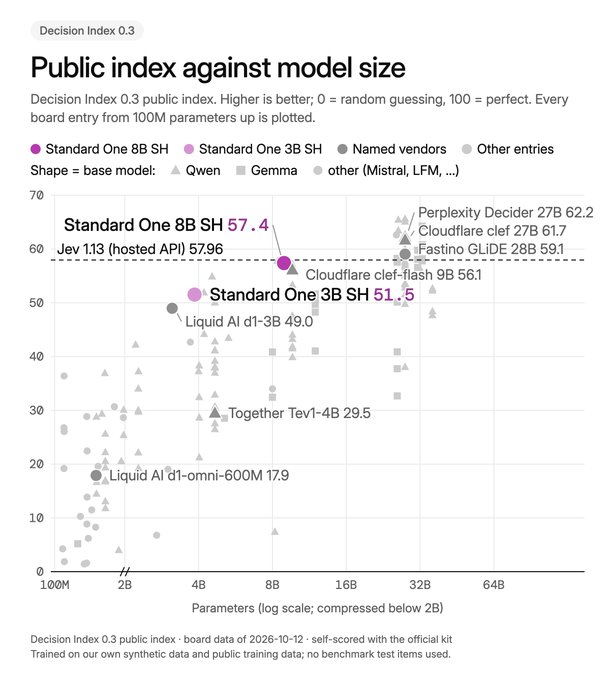
Introducing Standard One SH: open-weight decision models.
One pass. A probability per option. No text generation.
Decision Index 0.3 public index:
- 3B 51.5, highest under 4B vs the Oct 12 board;
- 8B 57.4
Self-scored with the official kit.
Open weights on @huggingface
🧵 1/6
What people posted on X while they built with Jev. Every card plays the original video or shows its images here, so you see the demo before you open the thread.