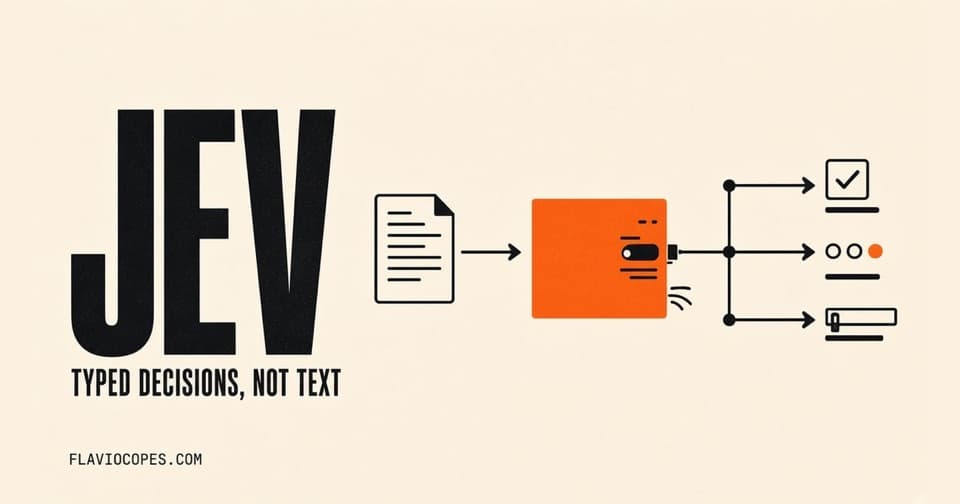
855 projects, posts and guides about Jev, the System One model from TypeSafe AI. Each entry links to its source and shows the cost and speed its author reported.
After co-inventing ChatGPT, I kept asking myself: why have superhuman chat models not led to AGI?
I’ve spent the last 2 years in stealth building a new way to train models (RLCD), and a new type of frontier AI model that we are releasing today: Jev
• 20-200x faster
• 40-400x cheaper (w/ output tokens free)
• Frontier composable intelligence optimized for decisions
AFAICT the shortest path to AI-based economic revolution
congrats on the release! i've included xor on the Decision Index 0.2 benchmark of jev-like models
we don't have a vision benchmark yet, but the text-only version got 8th place, strong in arts & human taste
x.com/multimodalart/…
No: TypeSafe has not released the weights. What works instead — a $17 fine-tune on Qwen3.5 4B, a $95 open reproduction, and the 14 replicas and no-training methods already in this directory.
congrats on the release, i've added it to the jev decision index 0.2, it's the #2 open weight jev-like model 🥳
and the strongest in chess and for its size
x.com/multimodalart/…
Been building an agent-agnostic permission gate: Jev (TypeSafe) + hooks.
Many harnesses copy Claude Code's hook format. Some barely have hooks at all.
This makes me happy: agy in YOLO mode. chmod -R gets blocked, the agent asks me, I say yes, it runs once. Again? Blocked again.
Flavio Copes on triage, RAG filtering, citation checks and confidence thresholds.
Muskan Paliwal
@PaliwalMuskan19
built this skill-picker for myself because apparently having 30+ agent skills also means remembering which one does what 😭
jev (@typesafeai), being the god that it is, ranks them for a given task and tells me and my agents which skills are actually worth using
phew. one less thing for my brain to cache.
https://github.com/MuskanPaliwal/skill-picker
Built Cortex, a local MCP server: Claude plans, a fast layer does the clicking.
Same Mac-app task: computer use 23 s → Cortex 0.8 s
One action: ~5 s Claude round → 0.25 s, no model
24 tools: browser, Mac apps, GitHub search, safety gate
Measured on my Mac. @typesafeai #JEV
The Jev-powered AutoScalper passed all Tests during the Testnet Live Test with an average win rate of 82% trading on the 1m chart, using a 120 candle lookback window.
So 2h structures get scalped top-to-bottom and bottom-to-top
Now its time to aim for mainnet deployment!
Yes, since Jev 1.14: PNG and JPEG on jev-1.13.0 and jev-1.14.0 behind a header, plus a Box answer type. Not production-ready yet. The limits, the price, and when OCR or a vision model still wins.
Awais.
@abbas_kazmi066
plenty of use-cases for JEV.
here's one: Hover Explanations.
This simple demo testing cost me around: $0.006.
Definitely very cheap and fast.
Now that I've collected so much data on System One models on my DGX Spark. Lets see if I can beat Jev on size, speed, and accuracy.
It will be MIT for anybody to build on. Everything I do on here is open source.
Jean-François Lépine on Choice, Noul and Score, calibrated confidence and batching questions, with a complete Python project.
Chris Brownridge
@chrisbrownridge
another @treg_ai /Jev demo to analyze data SUPER fast
used treg to pull meta ads and then Jev to teardown the landing pages so you can understand where brands are sending traffic to
categorizes the type of page, offers they're using and language used to sell
also shows ad creative launch velocity, creative mix
takes a few seconds to do it all end to end.
Four typed questions across four authored fictional notes, labels written before the calls. Jev 16/16, Laya 13/16. On the medication-conflict question alone: 4/4 vs 2/4. A useful diagnostic, not a clinical accuracy estimate.
Jev Engineering turns a static agent workflow into a graph that can rewrite itself while running.
the video is basically the problem at scale:
hundreds of routes
→ thousands of crossings
→ different agents
→ different tools
→ different confidence levels
Jev Engineering doesn’t control every step.
it controls the crossings.
when two paths compete:
→ score both
→ kill the weak route
→ reroute the task
so instead of one fixed chain, you get a live braid:
state
→ decision → parallel paths → crossings → Jev → next state
that’s the point of Jev Engineering:
more parallel execution without letting the system lose the objective.
the agents create the paths.
Jev decides which paths survive.
full breakdown below ↓
No: TypeSafe documents nine jagged edges in Jev 1.13, including maths, counting, dates, long irrelevant state, injected text and option order. The fix for each, and the builds here that already work around them.
Automater
@automater_ai
Claude Code Jev as MCP tools the agent can skip is not a gate. Put it in a PreToolUse hook that fails closed, with deny rules behind it.
automater.ai/intel/jev-clau…
A beautiful pattern can still be noise.
Here’s a JEV × Opus 5.5 workflow I’d test:
→ A data pipeline identifies candidate signals.
→ JEV selects which candidates to investigate using defined criteria.
→ Opus helps explore those candidates and propose explanations.
→ Statistical checks and human review test whether those explanations hold up.
The critical question: what evidence would change our mind?
That question belongs inside the workflow, before a promising pattern becomes a confident conclusion.
This animation illustrates the concept. The particles and activity are simulated.
Jev made competitor ad research 30x faster and ~90% cheaper.
Typed “game” as the category.
20 seconds later: 294 top TikTok ads across 68 brands analyzed.
Jev:
1/ pulled the top ads from the past 180 days
2/ scored every ad on stop-scroll, hook, format + trust
3/ clustered them into creative patterns
4/ classified winners, watches + dogs
5/ built a leaderboard of what’s winning
6/ recommended what to make next
20 sec · ~$0.02
For gaming:
Winning hooks: offer/promo, challenge accepted
Winning format: gameplay + UGC
This is what we’re building at @frevana_ai with Jev:
decode your category’s ads → know what to make next, in seconds.
Try it free. Link in the first comment 👇
Valyu’s practical guide to TypeSafe’s System One model, on DEV.
nicolay
@nicolaycz
Jev is the semantic if in your agent loop.
LLM writes. Jev (TypeSafe System One) answers typed questions on the same state (Noul, Choice, Score) with calibrated probs. Your code branches.
Pull the cheap decisions out of the LLM. Early access: console.typesafe.ai
the lead engineer at a research company used Jev + GPT-6 Astra to build a system that analyzes 12,000,000 source updates every 6 hours
the system processes massive streams of information, a process like this used to cost $1,000,000+, now Jev engineering does it for $200
the first version relied on GPT-6 Astra to interpret every result
it worked, but processing millions of routine decisions through a large model created unnecessary latency and huge inference costs
then the engineer rebuilt the decision layer around Jev
instead of explaining every source, Jev reads the saved task state and decides what should happen next: Research, Write or Review
Astra handles the open-ended work: comparing evidence, resolving contradictions and preparing the client brief
code controls the queue, permissions, budget, retries and files
at the core of this system is the same architecture I break down in the article: Jev routes the work, GPT-6 Astra handles the open-ended tasks, and code keeps the process running continuously
the full step-by-step build of a client research process that runs 24/7 is below ↓
would you let AI decide which findings deserve further research?
Here is another use case for Jev in DeFi.
Vault risk classification.
I pulled the signals that matter for Morpho vault risk (allocations, LLTV, utilization, idle, oracle, curator, APY sanity, liquidity and more) across 50 @Morpho vaults on Base, then asked Jev to score each one LOW / MEDIUM / HIGH / EXTREME.
50 judgments in 22.6s, ~452ms avg, ~60% median confidence, around $0.006 in costs
Result mix: 30 MEDIUM - 12 HIGH - 8 EXTREME - 0 LOW.
Jev also ranked curators and vaults by trust, who looks safest, who looks riskiest.
Claude, Codex and other models can do this as well but it takes much more time and money.
Side-by-side: TypeSafe Jev (documented Choice/Score/Noul, confidence, GA) vs OpenAI Decisions on GPT-6 Luna (vision, public beta on OpenRouter). When to use which — no invented stats.
keno
@kenonews
JEV can’t see images. So how do you give it eyes?
What’s possible? What can run locally? How far can you get for free?
The answers (and the catches) are in the full breakdown below:
Just trained Tev1 0.8B, a tiny Jev-like classifier.
Here it is running completely locally on my mac with @ollama & classifying some tasks.
It's extremely fast: only ~50ms E2E latency. Video is not sped up!
Releasing weights & benchmarks very soon so you can try it yourself :)
Skills Agentes’ guide in Spanish: what Jev does, what it costs, what the evals say, and where it fits in an agent.
Viv
@Vtrivedy10
Jev for RAG
in almost all cases you trust the semantic matching capability of Jev more than dot product similarity
very useful as the direct similarity metric in small data cases
and a great reranker with big data
I rebuilt CAPTCHA with Jev
The browser measures how you fill in the form. Server turns that into a few plain sentences, and Jev decides: person or bot.
Blog post with source code in the comments:
I think I just developed an additional income stream for everyone. Kalshi $BTC 15minute trading bot built with OPUS 5.5 + jev. Real time decisions in volatile short markets. Join the waitlist and track the real time PnL at https://vwapster.com Working on launching hosted subs by end of next week.
Same directory, different order: the entries added most recently, rather than the curated order the home page opens in. The date on a card is the day it was added here, not the day its author published it — this directory is newer than most of the work in it.