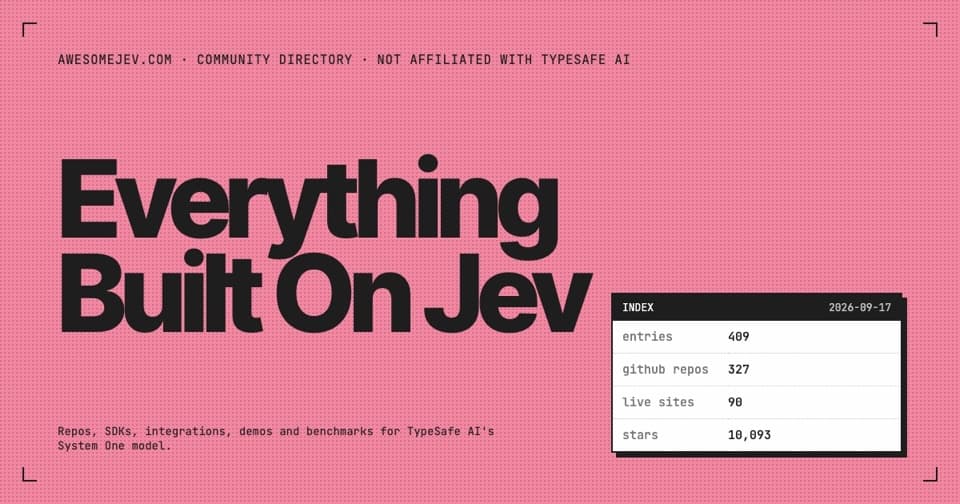
855 projects, posts and guides about Jev, the System One model from TypeSafe AI. Each entry links to its source and shows the cost and speed its author reported.
After co-inventing ChatGPT, I kept asking myself: why have superhuman chat models not led to AGI?
I’ve spent the last 2 years in stealth building a new way to train models (RLCD), and a new type of frontier AI model that we are releasing today: Jev
• 20-200x faster
• 40-400x cheaper (w/ output tokens free)
• Frontier composable intelligence optimized for decisions
AFAICT the shortest path to AI-based economic revolution
I launched a chatbot yesterday and used JEV as a 17-in-1 router, filter, classifier, intent judge for efficient tool calling.
Then further downstream is a relevance/context loop system.
Worked really well. No more unwanted spams and prompt injections.
اولین تجربهی خودم با JEV 👀
این تجربه برای ۳ روز پیشه؛ وقتی JEV هنوز توی حالت Waiting List بود.
من کلاً هر ابزاری که سختافزارم بتونه بکشه رو تست میکنم 😄
برای همین توکن JEV رو از OpenRouter گرفتم و به Grok Bot دادم.
ماجرا چی بود؟
از GITEX کلی ویدیو گرفته بودم و نمیدونستم کدومها رو اول منتشر کنم. از اون طرف هم برای هرکدوم کلی کاور طراحی کرده بودم و واقعاً حوصله انتخاب و مرتبکردنشون رو نداشتم 😂
به JEV گفتم:
«خودت انتخاب کن، دستهبندی کن و فولدربندیشون کن.»
در کمتر از چند دقیقه همهچیز رو مرتب کرد و حتی پیشنهاد داد کدوم ویدیوها رو اول منتشر کنم.
Grok Bot هم بقیهی توضیحات و تحلیلها رو انجام داد.
برای اولین تجربه، واقعاً از JEV راضی بودم 🔥
هنوز Laya-Max چینی رو هم تست نکردم؛ نصبش هنوز تموم نشده.
اونم که آماده شد، تجربهام رو میگم 👀
was trying to figure out how to make these 2 models fight each other, so I put jev vs laya in chess lol
script picks the 10 best moves, captures, and moves that put pieces under attack. still wip but jev feels way smarter
It has been a really interesting experience to build an eval suite for System One Models like Jev.
My first two attempts didn't work out. But I learned a lot in the process, and since Jev is so fast, and cheap, it's a lot easier to run quick tests than with an LLM.
I'm on attempt number three with this eval suite, and thought I'd share more about it.
The eval suite is called @VulcanBench Verdict, and here's the high-level on how it works:
A source-backed project directory, with a GitHub review workflow that uses only Jev.
Akshat
@akshatnerella
I vibe coded more fun apps using @typesafeai AI jev on the backend. My fav one is probably JevedIn, which is an extension for linkedin that automatically detects and blocks AI slop (thank me later). But I am lowk afraid of my linkedin feed being empty at this rate lol.
Source code:
JevedIn: https://github.com/akshatnerella/jevedin
JevTube: https://github.com/akshatnerella/jevtube
(currently building jevvit for reddit lol)
comment what you want me to build next!
#TypesafeAI #jev #classificationmodel #extensions #aislop
jev is insane 🫣
it makes realtime virtual try-on hauls possible.
built this experiment for Drape with @typesafeai
> i talk
> jev reads transcript + what i'm wearing
> picks from my closet
> changes my outfit in realtime
cost: $0.0011 per decision
time: ~620ms per decision
imagine getting ready like this:
🎇 I made a small Chrome extension: a side panel that drives any site's WebMCP tools with Jev!
When you type, on every keystroke it picks the relevant page's tool, fills in the arguments, and tells you how sure it is.
Here it is grocery shopping:
Jev (@typesafeai) is so insane & cheap for search!!
> 6000+ @ycombinator Startups indexed.
> Sub 1 second search results.
> 90M tokens & $2.7 in total testing costs.
Search any startup in a second, in any way!
- Color - Niche - Your Competitor - Age - Image - etc...
> watch the entire video, it's so freaking cool omg!
> this is the coolest thing i have ever built for fun! (worked on it for 2 days straight!)
you can turn any low-cost open-source LLM into a Jev like fast decision model without training it. Here's how to do it:
An LLM doesn't write text directly. At every step it scores every word in its vocabulary for how likely that word is to come next, and then it picks one. Those scores are called logits.
Suppose you want to know whether a customer email is angry.
The usual way is to ask the model, wait while it writes a paragraph, and then try to pull a yes or no out of the response.
The trick is to never let it write anything. Give it the email content and the question, and end your prompt with "Answer:". Your full prompt will look something like this:
[
Message: "Third time I've contacted you. Still broken."
Is this customer angry? Answer yes or no only.
Answer:
]
The model reads the prompt once and scores every possible next word. You look at two of those scores.
"yes" scores 8.1
"no" scores 5.9
Convert those two scores into probabilities and you get 90% yes and 10% no. (Use softmax function -- google it)
Your code then uses that number directly. If it's above 0.8, escalate the ticket.
Congrats, you have created your own Jev!
Here’s why it works:
1. It's fast. Reading a prompt happens in one parallel pass. Writing is the slow part because the model writes one word at a time. Here the model never writes.
2. It's cheap. Output tokens are the expensive ones, and this produces none.
3. There's nothing to parse. You always get a fixed output, and never a paragraph.
4. You get a confidence level along with the answer. A 0.55 means the case should go to a human or a bigger model. A 0.98 means you can act on it.
I tried running the code on llama 3.3 70b (via openrouter) and the accuracy was 21/22 (95%).
Cost per query: $0.000013, latency: ~500ms
Built a stock market scoring and decision engine and invested for the first time! 🚀
It includes portfolio-aware suggestions. Used @typesafeai's JEV for non-mathematical data analysis.
Open to the following positions btw.
👨💻 Senior Front-end | Product | Mobile (RN) Engineer.
Same directory, different order: the entries added most recently, rather than the curated order the home page opens in. The date on a card is the day it was added here, not the day its author published it — this directory is newer than most of the work in it.