Jev benchmarks, evals and calibration
Latency, accuracy and cost measured against other models, plus calibration audits and pre-registered tests. Every figure is the one its author published.
162 builds · page 4 of 5

Packapun
@packapun
New kid on the block typesafe.ai/blog/introduci…
XBenchmarks and evals
TypeSafe introduces System One models and Jev

Nikkhil Narang
@acenik10
Your agent doesn't need a bigger brain. It needs a faster one. Most agent decisions are tiny — urgent or not, which queue, yes/no. We run them through frontier models anyway. TypeSafe's new Jev does it in milliseconds for a fraction of the cost. #AIAgents #Jev
XBenchmarks and evals
TypeSafe launches Jev

Tuan N
@__tuan____
Sooner or later everyone will come to realize System One Paradox or Jev Paradox is real. The inevitable path forward is System One Plus or System One+. x.com/__tuan____/sta…
XBenchmarks and evals
The System One paradox

Han Keo
@KeoGrowth
En regardant Jev et Recursive Mass, je peut être sûr d'une chose les LLM ne sont pas la voie royal pour être le cerveau des agents, du moins pas pour longtemps. Jev même n'est pas encore au top du top sur ces probabilité montre déjà ces preuves pour ses prises de décision (plus rapide que des LLMs) Et Le Recursive Mass (pensées latentes sous forme de nombres) montrent qu'il est plus efficace pour les agents de communiquer entre eux partageant leu états internes plutôt que générer du texte compréhensible par des humains. Une chose est clair, on ne doit pas utiliser les IAs pour nos agent commet on les utilises pour nos discussions. Les Modèles n'ont pas fini d'évoluer :)
XSales and leads
A candidate for agent brains

Jim Merioles
@jimmerioles
Yep, best ELI5 on TypeSafe's Jev:
XBenchmarks and evals
An ELI5 for Jev

Zenko | NeuralFrame Labs
@NeuralFrameLabs
Local Laya beats Jev 100% #localai #ainews #ai #laya #jev
XOpen source
Local Laya beats Jev

𝗿𝗮𝗺𝗮𝗸𝗿𝘂𝘀𝗵𝗻𝗮— 𝗲/𝗮𝗰𝗰
@techwith_ram
TypeSafe Founder's Blueprint for Building with Jev. Check out the pdf here: drive.google.com/file/d/17h982x…
XBenchmarks and evals
TypeSafe’s blueprint for building with Jev

TypeSafe AI
@typesafeai
LLMs distilling Jev like
XOpen source
PickAn LLM distilling Jev

ASI Hub
@ASIHubHQ
DEEP DIVE REPORT: TYPESAFE AI LAUNCHES JEV SUB 100MS SYSTEM 1 DECISION ENGINE EXECUTIVE BRIEFING Routing routine classification tasks through a 70 billion parameter language model is architectural malpractice. TypeSafe AI has introduced Jev, a sub 100 millisecond deterministic decision engine proving that single pass probabilistic heads dramatically outperform bloated models on System 1 tasks. 1. THE ARCHITECTURAL DILEMMA Enterprise AI architectures suffer from catastrophic inference latency. Standard multi turn agentic loops invoke heavy reasoning models for simple deterministic gates, resulting in multi second roundtrips and unsustainable cloud compute costs. Jev restructures decision topology by executing fixed logit classification in single forward passes at 70 millisecond latency. 2. FOUR HUNDRED TIMES COST EFFICIENCY Empirical benchmarks demonstrate 400x reduction in compute expenditure per decision token. By constraining entropy to predefined domain spaces, Jev eliminates model hallucinations while providing mathematically verifiable confidence scoring across decision boundaries. 3. 2027 TO 2030 OUTLOOK By 2027, over 80% of autonomous software agent workflows will execute on dedicated System 1 kernels like Jev. Frontier multi modal models will operate purely as supervisory reasoning nodes, invoked only when high entropy creative synthesis is strictly required. Strategic takeaway: Compute efficiency dictates architectural survival. Split your system into fast reflex execution and slow deliberative reasoning.
XBenchmarks and evals
A sub-100 ms decision engine

GeethanTech
@GeethanTech
Jev returns bounded choices, scores and probabilities instead of prose. That limits out-of-schema output, not incorrect decisions. TypeSafe’s speed and cost claims still need independent testing. geethantech.com/posts/jev-type…
XSocial feeds
Bounded choices, not prose

CRYPTOFANZ💜💎
@cryptofanz12
𝗝𝗲𝘃 𝗜𝘀 𝗧𝘂𝗿𝗻𝗶𝗻𝗴 𝗔𝗜 𝗜𝗻𝘁𝗼 𝗔 𝗦𝘁𝗿𝘂𝗰𝘁𝘂𝗿𝗲𝗱 𝗗𝗲𝗰𝗶𝘀𝗶𝗼𝗻 𝗟𝗮𝘆𝗲𝗿 ⚡ As the first System One model launched by @typesafeai, Jev is designed for software that needs AI to make fast, structured decisions—not generate paragraphs of text. Traditional workflow: Prompt → Text → Parsing → Validation → Application Logic Jev takes a more direct route: Application State → Typed Question → Typed Decision No JSON prompting. No complex output parsing. Just typed decisions that applications can use directly, along with probability and confidence. Jev supports three decision patterns: 🔹 Choice — Select from predefined options 🔹 Score — Evaluate using a defined scoring framework 🔹 Noul — Handle structured decision problems built around application logic Speed is another key feature, with response times designed around roughly 70–500ms. Its pricing is also aimed at high-frequency inference: 💰 $0.042 per million input tokens 🆓 Output tokens free Potential use cases include: 🎫 Ticket routing 🛡️ Content moderation 📊 Risk scoring 🤖 Agent branching and workflow decisions The bigger idea is simple: AI doesn't always need to write something for a human to read. Sometimes, software just needs a fast, reliable decision. That makes models like Jev an interesting direction for AI agents, automation, and real-time application infrastructure. Available through the http://B.AI API as: Jev-1.13.0 Jev-Latest 🔗 http://chat.b.ai/chat @justinsuntron @BAI_AGI #TRONEcoStar #AI #Agents #B_AI
XBenchmarks and evals
A structured decision layer

ABNewswire
@ABNewswire
Jev Brings Fast, Structured Decision-Making to AI Workflows dlvr.it/TVcnJg #ComputersSoftware #Technology
XBenchmarks and evals
Fast, structured decision-making for AI workflows


Lilys.ai
@LilysAI_
@tetumemo 要約ノートができました👉 lilys.ai/digest/1147040… - Jevは次の行動を決めるためのAIエージェント用「脳」。 - 文章生成ではなく、選択・数値・はい/いいえの判断に特化。 - うまく設計すれば、品質を落とさずコスト削減が狙える。
XBenchmarks and evals
The decision-making brain for agents

echild
@eboppu
some more tests. jev for tool filtration is really good.
XBenchmarks and evals
Jev in tool filtration tests

James Pardoe
@JamesPardoe
If you're still scratching your head about Jev, this is the best explanation that I've seen.
XBenchmarks and evals
The best explanation of Jev

Dorian Smiley
@dsmiley411
Testing Jev’s accuracy tonight for next best action prediction. The results: Canonical accuracy: 98.6% Generalization accuracy: 41.5% We ask Jev to predict the next state in a program from the current partial program. The suite has 25 cases and we ran it 20 times. Seven cases are represented in the in context examples. The other 18 are held out cases that require Jev to generalize from those examples. The failures are not uniformly random. Jev generalizes perfectly on some unseen compositions and fails almost deterministically on others. That suggests there may be specific structural boundaries to what it can infer from context. Maybe some of this is prompt design. Maybe it is a capability boundary. We’re testing that now. But next best action prediction is important. A huge amount of software today contains really brittle decision logic: onboarding, payments, claims, revenue cycle, approvals, exception handling, etc. If Jev is a bet on software consuming intelligence, this is exactly the kind of high frequency, high value logic it needs to improve.
XBenchmarks and evals
Jev for next best action

Jason Alco
@Jasonalco
I put Jev vs 5.6 Sol head-to-head on a text categorization step in a platform I’m building. Surprised by the outcome. Aren’t text-based judgements the exact use case Jev is made for?
XBenchmarks and evals
Jev vs. Sol, on categorisation

Mendy
@MilkMendy
If you run a business, Jev might be a really good alternative to your heavier models. It's really good at classifying things and choosing between yes or no, and it could be 200X quicker and a lot cheaper than the other frontier models. #AI #AIAgents #AIAutomation
XBenchmarks and evals
A faster, cheaper path for business models

Sodeh Abadi
@irSodeh
Jev vs Laya-MLX isn't really a rivalry. Jev is the original, commercial model. Laya-MLX is a local, open-source take on the same idea, running natively on your Mac. Same core concept: "System One" models. No chatting, no text generation. Just fast, typed decisions. #Jev #Laya
XOpen source
Jev vs. Laya-MLX

WquGuru
@wquguru
Jev 发布才 8 天,开源替身已经一堆了,今天诺基亚也来蹭热闹了😅 我在 MacBook 上,让官方 Jev 和 3 个开源方案同跑 20 张中文工单🫱 Laya 25ms,比 Jev 快 50 倍 djev 509ms 官方 Jev 1.3 秒 AnyJev 将近 4 秒 仓库都在这: Laya(Mac 版)http://github.com/mizorewww/laya-mlx djev(Mac 版)http://github.com/jamescorbett/mlx-vlm AnyJev http://github.com/nokia-applied-research/AnyJev 但快的,不一定对 👇

Darshan Jain
@i_darshanjain
Jev is all over my timeline rn 👀 Went looking into it and stumbled across Laya. Open-source System 1 decision model. They even have a Jev comparison 👀 7.8× faster. 3× better calibrated. 45/51 languages. Self-hosted. And the weights are right there. 😂 Yeah… I am watching this space. https://huggingface.co/convaiinnovations/laya
XOpen source
Laya compared to Jev

Saksham Sharma
@code_saksham
And just when I thought I have a crazy idea with JEV that i will open source then this happened. Please @typesafeai fix it ASAP, the curiosity inside me to build that thing is insanely high
XBenchmarks and evals
A Jev idea that hit a wall

Chase
@0xChaseTM
Jev Engineers just released Jev, and the architecture is simple: state goes in, auditable decisions come out I mapped the decision layer into a field blueprint: what Jev reads, what it returns, and how an agent uses those answers in a real loop: step 1 → give each layer a job. The LLM plans and writes. Jev chooses between bounded options. Code carries out the action. step 2 → build the state before asking for a decision. Include the goal, evidence, available actions, previous actions, and what the environment looks like now. step 3 → define the questions in code. Choice selects an option. Score rates it. Noul estimates whether a condition is true. The answers are typed, so the runtime can use them directly. step 4 → ask independent questions together. One state snapshot can support routing, risk, and relevance decisions in the same pass. step 5 → use the answers to route work. A lookup, a complex reasoning task, and a tool call don’t need the same model or execution path. step 6 → add a gate before the tool runs: allow, ask, or deny. A high-confidence answer still has to pass the action policy. step 7 → execute the selected action and check the outcome. Record what the tool actually did, including failures. step 8 → update the state with that result. Otherwise, the agent’s next decision is based on a world that no longer exists. step 9 → apply the pattern where small decisions repeat: model routing, tool guardrails, inbox triage, research classification, browser actions, and context compaction. step 10 → judge the whole task. Track whether the agent reached its goal alongside cost, latency, approvals, and failed actions. the result: you can trace an action from the evidence Jev received to the decision it returned and the outcome your tools produced. Save the Jev Decision Infrastructure blueprint for your next agent build ↓
XBenchmarks and evals
State in, auditable decisions out

Utkarsh Maheshwari
@utkarshgsuv
Is the Jev hype real, so I made to test this on my movie recommendation engine, which is getting crazy results on Quen Re ranker , I used an open-source alternative of Jev , Laya. But unfortunately Quen is way better, dekhlo! @typesafeai #jev #Jev
XBenchmarks and evals
Jev on a movie recommender


Xiang Wei
@xgwei
Great minds! I've been building a stylized SF with Opus too, just without the pets. My cars follow rules on the real street network, lanes and traffic lights included. Jev driving pedestrians is tempting though. How many agents can it run at once?
XGames and real time
Driving pedestrians in a multi-agent simulation

spect
@spectnfa
The founder of Jev just dropped a 1-hour masterclass on how Jev actually works LLMs → Decisions → Verification → Coding Agents 0% → 0:40 - why LLMs alone aren't enough 25% → 20:27 - the 3 primitives behind Jev 50% → 26:15 - turning huge AI tasks into tiny reliable decisions 75% → 45:04 - real systems: data, agents, verification 100% → 56:33 - the future of coding agents, memory and subagents Most people are still learning prompts. This explains the layer that decides what the model should do, checks whether it worked, and decides what happens next. Basically: how you go from “AI chatbot” to software you can actually trust to run itself. And it's explained by the guy building it. Bookmark this. Watch the full hour tonight. Then read the guide below and steal the architecture for your own agents ↓
XBenchmarks and evals
How Jev works, in a one-hour masterclass

silentguy
@silentguyy66
Grok Bot does the job, Jev decides where the job goes next That's the ai company split: a work model and a decision model In this free 22-min tutorial they walk through jev, typesafe's "system one" model that makes decisions instead of chatting You ask one question, Jev answers from a fixed menu: noul, choice, score The demo: customer messages in, frustration score out. usable right in code Not another chat model, it's the fork in the pipeline Grok Bot keeps generating Jev keeps deciding Humans keep the approvals The teams wiring in that third layer are quietly becoming one-person companies Save this before your competitors put a decision layer between their bots
XBenchmarks and evals
TypeSafe’s System One, for decisions

Geek Lite
@QingQ77
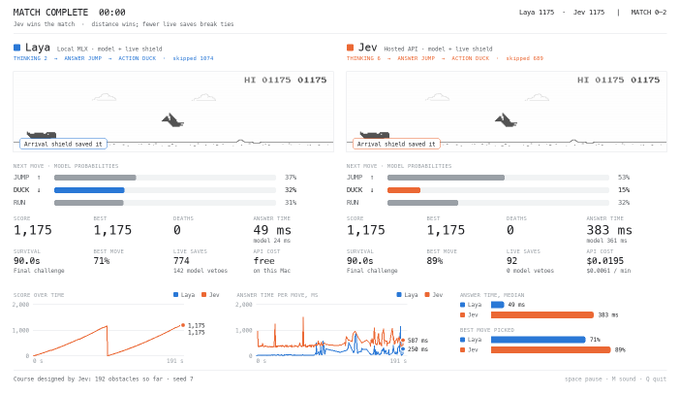
把本地 MLX 推理的 Laya 模型和托管 API 的 Jev 放在同一个 T-Rex 跑酷赛道上对打,用延迟、存活和回放数据对比本地推理与云 API。 github.com/virajbhartiya/…
XGames and real time
T-Rex Run: local MLX Laya vs. cloud Jev

Just AI
@thelazyyogii
上次说的 Jev: 不会陪聊,只负责拍板。 这几天又冒出个 Laya。 活差不多,路子不一样。 一起想成: 流水线上专门判题的人, 不写长文,只答「过不过 / 归哪类」。 Jev = 外面请来的裁判 开箱就能用,按量付钱, 选项多、材料长时更稳。 适合懒得自己搭、先要结果的人。 Laya = 自己厨房里养的裁判 权重能下,Apache 开源,本机跑, 更快更省隐私。 但要自己微调;选项一堆时容易糊。 适合有机器、要数据不出门、愿自己调的人。 一句人话: 不是谁取代谁—— 要省事找 Jev,要自己掌控找 Laya。 都是选择题机器,不是聊天搭子
XOpen source
Decisive judgment agents that don’t chat

Arthur Marques
@ArthurLabMRP
was trying to figure out how to make these 2 models fight each other, so I put jev vs laya in chess lol script picks the 10 best moves, captures, and moves that put pieces under attack. still wip but jev feels way smarter
XGames and real time
Jev vs. Laya, over chess

Morgan
@morganlinton
It has been a really interesting experience to build an eval suite for System One Models like Jev. My first two attempts didn't work out. But I learned a lot in the process, and since Jev is so fast, and cheap, it's a lot easier to run quick tests than with an LLM. I'm on attempt number three with this eval suite, and thought I'd share more about it. The eval suite is called @VulcanBench Verdict, and here's the high-level on how it works:
XBenchmarks and evals
An eval suite for System One models

Timothy Kassis
@TimothyKassis
We built a really nice free tool on top of @typesafeai Jev to see how rigorous an academic paper is.
XBenchmarks and evals
A free tool that scores how rigorous a paper is

Benchmark Heaven
@benchmarkheaven
Hopper (#3) beats Jev 1.13.0 on three of four columns: Calibration 79.1 vs 76.3, Speed 86.8 vs 83.3, Cost 58.7 vs 52.0. Jev keeps #1 on the fourth: Intelligence 53.1 vs 48.0, hard tier 74.1% vs 65.0%. Under 50, the gate applies. Score 63.29 vs 59.43. benchmarkheaven.com/jev-models/v1.…
Live siteBenchmarks and evals
Jev 1.13.0 against Hopper on Benchmark Heaven
- Intelligence
- 53.1 vs 48.0
- Calibration
- 76.3 vs 79.1
- Hard tier
- 74.1% vs 65.0%
- Score
- 63.29 vs 59.43