Is Jev open source?
No. Jev is a closed model, served from TypeSafe’s API, and the weights have not been published. What is open is everything that grew around it within a week: 54 projects in this directory train, adapt or replace a System One model you can run yourself.
Updated 8 Oct 2026 · by Made with Jev

In short
- Jev itself: closed weights, API only, $0.042 per million input tokens.
- The request shape is public, so an open clone that copies it works with the official SDKs. kev does exactly that.
- Most open models are small — Julia 1 is 144.3M, Laya 421M — because deciding is not generating. Laya runs in about 1 GB.
- Accuracy is close, in each project’s own tests. Calibrated confidence is the part nobody has matched in public.
What is closed, and what is not
Jev is sold as an endpoint. TypeSafe’s models page lists the version, the price, the rate limits and the context window. There is no download and no self-hosting licence. That is the whole of the closed part.
The rest is documented in public: the request shape, the three question types, the response with its probabilities and confidence, and the SDKs that wrap them. That is why so many replacements exist and why most of them are API-compatible — if your code already sends a state and a set of typed questions, pointing it somewhere else is a change of base URL.
- Weights
- Not published by TypeSafe
- Licence to self-host
- None offered
- What TypeSafe publishes (MIT)
- typesafe-sdk-js, typesafe-sdk-python, skills, n8n-nodes-typesafe-ai, system-one-adapter-python
- What is public
- The API, the SDKs and the docs. Quickstart
- Open alternatives here
- 54, across 5 families
- Fastest published local figure
- Under 15 ms a decision, on the same machine (von)
- Closest drop-in
- kev: TypeSafe's API shape, running on a MacBook
Caution
TypeSafe has no Hugging Face organisation (checked 8 Oct 2026). Repos named “Jev” or “OpenJev” there are independent models, not Jev weights. Check the author and the licence.
Privacy and data
TypeSafe does not train on customer requests or responses. Zero data retention is available to enterprise customers. All accounts use the same weights; there is no fine-tuning.
Sources: TypeSafe legal, TypeSafe models.
Closest self-hostable option: Cloudflare Clef
A 27B multimodal model, Apache-2.0, base Qwen3.8-27B. The model card says it was tested on a single H200. Cloudflare says it is fully Jev-API compatible.
- Model
- Cloudflare Clef, 27B multimodal
- Licence
- Apache-2.0
- Base
- Qwen3.8-27B
- Hardware tested
- Single H200 (from model card)
- Workers AI price
- $0.24 per million input tokens
- Context
- 65,536 tokens
Compared with Jev at $0.042/M input, Clef is 5.7× more expensive per token. More at /alternatives/cloudflare-clef.
Sources: Hugging Face model card, Cloudflare blog, Workers AI docs.
What each project claims
Every figure below is the project’s own, on a benchmark it chose. None has been re-run here, and at least one author says so himself: kev’s says plainly that kev was trained on the datasets he scored it against.
| Project | Built on | What it publishes |
|---|---|---|
| Laya | 421M English and 322M multilingual, Apache 2.0 | 32.8 ms a question on a T4, 45 of 51 languages usable, 0.766 on typed decisions |
| Julia 1 | mmBERT-small, 144.3M, Apache 2.0 | 73.15% on 2,000 typed decisions against a supplied Jev reference of 72.70%; 64 of 100 against 87 on a Banking77 pilot |
| kev | Qwen2.5-0.5B, LoRA and a head | 79.7% against Jev's 81.1% on the author's own suite; ~160 ms for six questions |
| OpenJev Verdict 2.0 | 151M, non-autoregressive | 77.10% accuracy, Brier 0.0636, ECE 0.0144 on its own set |
| von | Local, on your own machine | Under 15 ms a decision, because there is no network in the loop |
| NanoJev | 0.6B, with its training pipeline | The full distribution in one forward pass, no token decoding |
| QwenJev | Qwen-3.5-4B, a vision-language model | 0.169 s per frame, and it reads images, which Jev cannot |
| openjev-sglang | Qwen3.6-35B-A3B on SGLang | 64 tasks in under a second, reusing the prefill across questions |
| Simple Jev | Any Hugging Face model | In production at Featherless.ai; handles images too |
Models trained to do Jev's job
Small models, trained from scratch or adapted, that answer typed questions in one pass. This is the closest thing to an open Jev, and the sizes say how little the job needs: 151M to about 4B.

GitHubOpen source
kev
A tiny Jev-like model on Qwen2.5-0.5B that trains and runs on a MacBook.
Jared Palmer
8.7k~160 ms
Akshay 🚀
@akshay_pachaar
A faster, 100% open-source alternative to Jev. It’s called Laya. Both models solve the same problem. You give them unstructured state plus typed questions. Instead of generating a paragraph, they choose from answers you define and return probabilities your code can act on. But they make those decisions differently. Jev is a closed, hosted API. Its architecture and training are not public, but it works zero-shot and supports up to 255 options. Laya is Apache 2.0 licensed, runs locally, and uses open-weight encoder models. Here is how its pipeline works. → It routes by language first. Plain Python selects the English or multilingual checkpoint before inference. → It creates one sequence for each question. Every possible answer gets a `[MASK]` marker. The question and state provide the context needed to compare those options. → It scores instead of generating. A bidirectional encoder and small decision head assign one score to each option. Softmax turns those scores into a probability distribution. → It batches the questions. They run together in one model call, although every question still carries its own copy of the state. This removes network latency and token-by-token generation. In one independent test, Laya took about 35 milliseconds on a local GPU. Jev took roughly 380 milliseconds over the network. Laya also has no per-call API fee, keeps data on your infrastructure, and can run on older GPUs. But it is not a drop-in replacement for every workload. Jev is a hosted generalist that works well out of the box. Laya is a fast base you need to specialize. Laya makes the most sense when you have a stable answer set and representative training data. Fine-tune it for the task, calibrate its probabilities on held-out examples, and send uncertain decisions to a stronger model or human reviewer. Jev gives you stronger zero-shot decisions. Laya gives you speed, privacy, control, and no per-call fee after you teach it your task. The open-source repository is here: http://github.com/NandhaKishorM/laya If you want to self-host Laya, InstaCloud provides a really nice and easy way to do so. Check this out: https://www.instacloud.com/templates/laya If you're new to decision models, I wrote the full breakdown of how Jev. The article is quoted below.


MD Fazal Mustafa
@the_mdfazal
🚨 A LOCAL 421M MODEL JUST ATE CLOUD JEV ON SPEED Laya is an open-source System 1 decision model that runs on your machine. Laya: 86.5 decisions/sec, P50 ~9ms, score 46 Jev: 3.2 decisions/sec, 317ms API round-trip, score 1 Ships with: — 421M params — ~1GB inference memory — Millisecond local calls, no network — Typed decisions in one forward pass — Apache-2.0 and self-hosted While the cloud waits, local decides.


Geek Lite
@QingQ77
复刻 Jev 的并行决策思路,让 0.6B 小模型一次前向直接输出完整概率分布,不做输出 token 解码。 github.com/TianyuCodings/…

GitHubOpen source
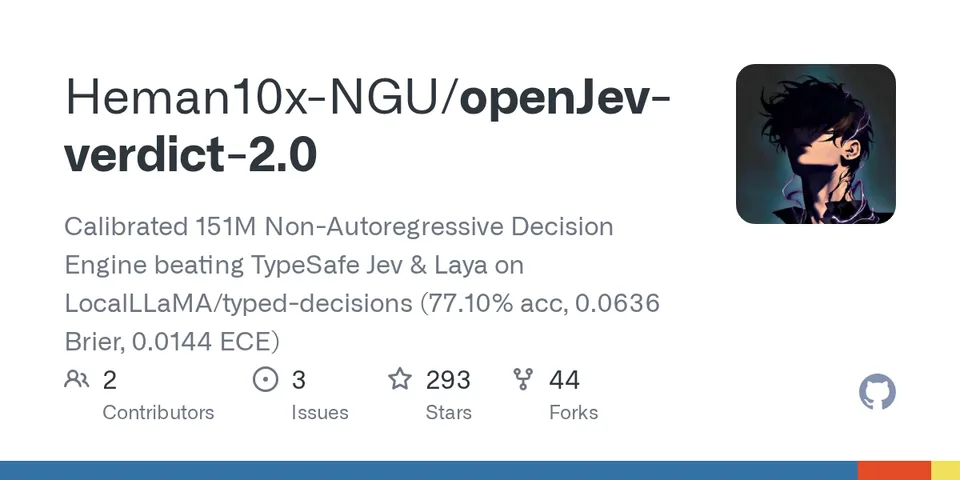
OpenJev Verdict 2.0
A 151M non-autoregressive decision engine, with its numbers published.
Heman10x
293151M
GitHubOpen source
OpenJev (Verdict)
An open 151M decision model on ModernBERT, with a WebGPU playground.
Hemant Kumar
111
GitHubOpen source
open-jev (PyTorch)
A from-first-principles rebuild of the ideas behind Jev.
Kye Gomez
89
Vincent Wang-Maścianica
@vinnylarouge
I reverse-engineered a jev-like architecture given its type. You can find the repo here to train your own jevlikes: github.com/vinnylarouge/j…

GitHubOpen source
jevlike

GitHubOpen source
open-spark-jev
Local System One models on Qwen3, for an NVIDIA DGX Spark.
Abhishek Rai
22Open-weights Jev alternatives on Hugging Face
Checkpoints you can download today, most with a model card that reports a figure against Jev. They range from Julia 1 at 144.3M parameters, which runs on a CPU, to APUS-OpenJev's 35B-A3B. Every comparison is the author's own, on a panel they chose.

Live siteOpen source
Julia 1
A 144.3M-parameter decision model that edges Jev on typed decisions.
Supersonic Labs
144.3M
Live siteOpen source
OpenJev (open weights)
Typed decisions about text, web pages and screenshots, within 2 points of Jev.
OpenJev
84.0% (Jev 85.4%)
Live siteOpen source
APUS-OpenJev-v1
Decision models for browser agents with a selectable compute depth.
APUS AI Lab
85.0% (Jev API 82.5%)
Live siteOpen source
decider-2b
An open reproduction of the System One model class on Qwen3.5-2B.
Mapika
0.577 (v10 0.459)
Live siteOpen source
System One scorer
Qwen3.5-4B with a scoring head, type-safe by construction.
pngwn
0.922
Live siteOpen source
autotrust/JEV-9B
An open student of Jev 1.13 with System 1 and System 2 in one set of weights.
AutoTrust
≈ 0.019


Live siteOpen source
laya-browser
Laya fine-tuned into the decision head of a browser agent.
cklxx
100% (54/54)
Live siteOpen source
Laya Vision
Typed decisions about an image plus text, in one forward pass.
r33drichards
201M
Live siteOpen source
AgentJev-0.6B
State in. A distribution out. Nothing decoded.
malevrigns
57.8% (606/1048)


Live siteOpen source
Tiny-Jev
A 0.6B System One model: structured state in, typed decisions out.
lostargon
0.6B
Live siteOpen source
mini-Jev
A frozen Qwen3-0.6B plus a 1.1 MB head for tool selection.
samatv256
~1.1 MB
Live siteOpen source
OpenThai-SystemOne
An open Thai and English System One decision model.
iApp Technology
0.8B
Live siteOpen source
Eikos-27B
An open typed-decision model for finance and trading rules.
caiovicentino

Live siteOpen source
Jeff 1
An open typed-decision model with a guide to training your own.
Gestalt Labs
Adapters that make any model answer like Jev
No training at all. Restrict the next token to your options, read the candidate logits, and you have a typed decision with probabilities out of a model you already serve.

Eugene Cheah - AI builder @ 🇸🇬|🇺🇸
@picocreator
love jev, but upset it - isn't open source? - it lack vision capability? We fixed all of that, introducing SimpleJev.ai A fully open source library which takes any HF model and Jev-ify it, with an API endpoint Now on github, and live in production at @FeatherlessAI

GitHubOpen source
Simple Jev
GitHubOpen source
AnyJev
Turn any LLM into a Jev-style decision model, with no training.
Nokia Applied Research
1.1k
GitHubOpen source
Open Alternative to Jev
Typed, calibrated decisions from any open-weights model, on your own GPU.
ikermoel
67

Eric Zhang
@ekzhang1
Inspired by @typesafeai , here is a Jev-compatible public API to play with It runs a comparable open model (Qwen3.6-35B-A3B), and just uses SGLang radix cache to preserve the prefill reuse / really fast parallel systemone generation - 64 tasks in <1s. github.com/ekzhang/openje…


Nick Khami
@skeptrune
you can make any open source model behave like jev with just a bit of inference engineering. it's shockingly easy. to prove it, we built a new endpoint we're calling deepseek-v4.1-flash-jev. see the demo below. here's how it's done: sglang (an inference engine) offers a scoring endpoint in addition to the normal generation one. in scoring mode, given an input & set of possible answers, it forces the model to produce probabilities for each one. example: > input: what is most common letter in abcccde? > possible answers: a, b, c > output: (c, 0.9), (b, 0.0.5), (a, 0.05) getting the above behavior instead of streamed output is as simple as using sglang's /v1/score endpoint instead of /generate. there's just one other trick required. for deepseek, you have to add a closing think tag before the response. this forces a direct answer instead of a reasoning trace. if you want reasoning, you can do that too, but imo that makes things too slow to be worth it. dsv4.1 flash is not as good as jev, but if we had enough spare compute to experiment with this same approach for a larger model then i think the decision quality would be at least as good, if not better. also, somewhat unrelated, i think decision-making models kill all prospecting & sourcing work. i would have absolutely killed to have jev or similar when i was recruiting @mintlify. absolutely incredible.

XOpen source
deepseek-v4.1-flash-jev

GitHubOpen source
QwenJev
A Jev-style conversion of Qwen-3.5-4B, at 0.169 s per frame.
RJMSWD
1030.169 s
alex nikolic
@justALEXWORTEGA
Typesafe: pnewed 💨 Jev: liberated 🫡 I trained an MLP on top of qwen 4b and it works literally like JEV huggingface.co/AlexWortega/op…

Live siteOpen source
openjev on Qwen 4B


Anand Prasad
@theanandprasad
you can turn any low-cost open-source LLM into a Jev like fast decision model without training it. Here's how to do it: An LLM doesn't write text directly. At every step it scores every word in its vocabulary for how likely that word is to come next, and then it picks one. Those scores are called logits. Suppose you want to know whether a customer email is angry. The usual way is to ask the model, wait while it writes a paragraph, and then try to pull a yes or no out of the response. The trick is to never let it write anything. Give it the email content and the question, and end your prompt with "Answer:". Your full prompt will look something like this: [ Message: "Third time I've contacted you. Still broken." Is this customer angry? Answer yes or no only. Answer: ] The model reads the prompt once and scores every possible next word. You look at two of those scores. "yes" scores 8.1 "no" scores 5.9 Convert those two scores into probabilities and you get 90% yes and 10% no. (Use softmax function -- google it) Your code then uses that number directly. If it's above 0.8, escalate the ticket. Congrats, you have created your own Jev! Here’s why it works: 1. It's fast. Reading a prompt happens in one parallel pass. Writing is the slow part because the model writes one word at a time. Here the model never writes. 2. It's cheap. Output tokens are the expensive ones, and this produces none. 3. There's nothing to parse. You always get a fixed output, and never a paragraph. 4. You get a confidence level along with the answer. A 0.55 means the case should go to a human or a bigger model. A 0.98 means you can act on it. I tried running the code on llama 3.3 70b (via openrouter) and the accuracy was 21/22 (95%). Cost per query: $0.000013, latency: ~500ms
XOpen source
Jev-like decisions from open LLMs

恒星sun
@vintcessun
如果分类结果最终要喂给业务系统,生成一段 JSON 往往不是最省事的路径。Simple Jev 把开放模型变成结构化决策接口。 https://github.com/featherless-ai/simple-jev 它复用共享上下文的 KV cache,只读取各问题候选标签的下一 token logits,再由服务端组装 choice、score 和真值判断。省掉逐 token 解码与 JSON 解析,多问题场景更有价值;common 目录还把提示契约和评分逻辑抽成可复用层。适合路由、审核、打分,但准确率与校准仍需按任务验证。

XOpen source
Simple Jev, reusing the KV cache
Running it on your own machine
Where self-hosting actually pays: no network hop, no token bill, and nothing leaving the device. The fastest published figure here is under 15 milliseconds, which no API can match by definition.
Live siteOpen source
Jev-Style 0.8B Decision v3
Jev-style decisions on a laptop, 0.53 GB in 4-bit.
chaoliangUNSW
0.53 GB
GitHubOpen source
open-jev (browser TypeScript)
Typed decisions in the browser: one state, any number of options.
Nico Martin
41
生ビール
@wmoto_ai
ローカルTypesafe Jev、できたんやないか? もうちょい速度は改善余地ありそう

XOpen source
A local Jev

Petru - Tech Driven
@techdrivenpetru
Yes but not with Jev. I used another classifier, locally, just as fast, just as good. Example: setup a "server" in python that loads the classifier model. Add a hook in Claude that fires on "pre-tool-use" and next time you ask Claude a random question like "how do I lint check a project?" and it tries to freelance and read your entire repo only to intoxicate itself and pollute its context, the classifier will slap its hand, say "no sir, you answer from knowledge" and deny the tool call. I tested this yesterday with success, but need to refine it as it misfires. Basically I was able to identify general queries, instances where I would ask something and Claude would rush ahead and run pip install without me asking or just write code instead of answering. A classifier is hypercheap compared to a regular LLM and would catch all of these. The model I used was DeBERT large. It's still stupid fast, I tested it on an Apple with M1 (regular) and you don't feel it running.

XOpen source
A local classifier instead of Jev

Simplifying AI
@simplifyinAI
so we already have an open source alternative to jev... and it's 6-7x faster?! it's a typed-decision classification system: no chat, no generated text, just fast yes/no, scoring, or choice answers. > runs in under 1gb of memory > free on hugging face > runs on a laptop, or even a phone there's a real demo where it plays snake live, making a fresh decision every single move. two honest limits, straight from the project itself: > only 512-1,024 token context, some cases won't fit > weaker generalization than jev out of the box

XOpen source
An open typed-decision classifier
Experiments at the edge of the idea
What happens when you push a decision model past what it is for. Two people built chat out of a model that cannot write; one project calibrates the questions themselves against your labels.
GitHubBenchmarks and evals
ChatJev
Driving the classifier as a next-token predictor, one token at a time.
Erik Dunteman
7
GitHubBenchmarks and evals
jevchat
A chatbot built out of a model that only answers typed questions.
Kyle Pena
96
GitHubBenchmarks and evals
jev-calibrate
Tune your Jev questions against your own labels, then confirm on held-out data.
smkrv
32What self-hosting actually requires
Less hardware than people expect. These are classifiers: they read a state and emit a distribution over options you defined, with no decoding loop, so the models are two to three orders of magnitude smaller than the ones you would otherwise ask. Laya fits in about a gigabyte. kev trains and runs on a laptop. Verdict runs in a browser tab on WebGPU, and so does Julia 1’s ONNX build. openjev-sglang is the outlier, because it wraps a 35B model and buys its speed from the SGLang radix cache rather than from the model’s size.
What it costs you is the three things TypeSafe absorbs. One: batching, because the speed everyone quotes for Jev comes from answering every question against one prefill, and a naive local server answers them one at a time. Two: calibration, because a probability is only useful if 0.8 means 0.8, and that is trained, not configured. Three: keeping a GPU warm, which is the real comparison against $0.042 per million tokens.
What the open alternatives do and do not match
They match the interface. Typed answers, several questions in one pass, probabilities over a closed set: all reproduced, and in places extended — Simple Jev and QwenJev both read images, which Jev does not.
They do not yet match the confidence. Jev’s confidence score is the number the builds in this directory actually depend on: act automatically above a threshold, escalate below it. No alternative has published a calibration comparison run by anyone other than its own author. OpenJev Verdict 2.0’s Brier score of 0.0636 and expected calibration error of 0.0144 are the most anyone has shown, on their own set. Treat that as a reason to run your own test — jev-calibrate exists for exactly that — not as a substitution.
Watch one run
Two walkthroughs of the open side, by people who ran the models themselves rather than reading the READMEs.
Guideyoutube.com/@CoderOne
Open Source, Faster Jev is HERE
Coderone on Laya, the open System One model from Convai Innovations: what typed decisions are, why they replace a share of LLM calls, and Laya run locally to see if its figures hold up.
Guideyoutube.com/@samwitteveenai
Open Jev Models Are Here!!
Sam Witteveen goes through the open decision models released in Jev's first week.
If you want it cheap rather than local
Self-hosting is usually the wrong lever for cost. A median published run in this directory costs a fraction of a cent per decision, so the reasons to run your own are data residency, an offline device, a latency floor the network cannot meet, or a model you want to fine-tune on your own labels. The numbers are on the pricing page, the model itself is explained on what is Jev, and every repository in the directory is on the GitHub page.
Common questions
- Is Jev open source?
- No. TypeSafe serves Jev from its own API and publishes docs, prices and rate limits, not weights or a licence to run it yourself. TypeSafe does publish MIT code: typesafe-sdk-js, typesafe-sdk-python, skills, n8n-nodes-typesafe-ai, and system-one-adapter-python. The weights are closed.
- Are Jev's weights available?
- TypeSafe has not released them. Other people have trained their own decision models instead and published those: Julia 1 at 144.3M parameters, Laya at 421M, NanoJev at 0.6B, OpenJev Verdict at 151M, kev on Qwen2.5-0.5B, and KaLM-Jev in three sizes.
- Can I run Jev locally?
- Not Jev itself, but a replacement, yes. von reports under 15 milliseconds a decision on the same machine. Laya runs in about a gigabyte of inference memory at 86.5 decisions a second. kev trains and runs on a MacBook and follows TypeSafe's API closely enough that the official SDK works against a local server.
- What is the best open-source alternative to Jev?
- It depends what you are replacing. For a drop-in local endpoint: kev, von or Laya. For a trained small model with published calibration: OpenJev Verdict 2.0 or NanoJev. For an open model you already serve, no training needed: Simple Jev, AnyJev or Open Alternative to Jev, all of which read the candidate logits instead.
- Do the open alternatives match Jev's calibration?
- Nobody has shown that they do. Accuracy is the number every project reports; calibrated confidence is the part Jev is built around, and the only public comparisons are each project's own, on datasets they chose. Test on your own labels before you trust a threshold.
- What is Laya?
- An open System 1 decision model, 421M parameters, that arrived within a week of Jev's launch. Its author reports 86.5 decisions a second at a P50 of about 9 milliseconds in roughly 1 GB of inference memory, and there are already Go and Apple-silicon ports of it.
Made with Jev is independent and not affiliated with TypeSafe AI. Every figure on this page is the one its author published, linked to where it can be checked.